
Border Energy Tests Sovereignty Markets Diplomacy And Regional Resolve

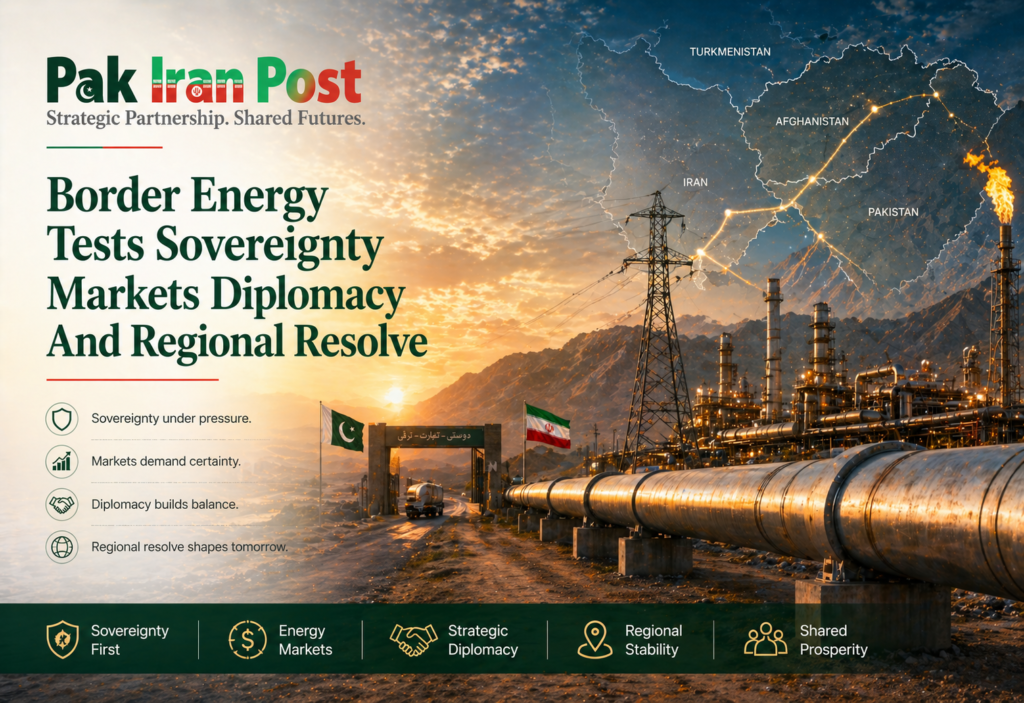
The map has always mocked the politics. Pakistan sits beside one of the world’s largest holders of natural gas reserves, yet it repeatedly suffers winter shortages, factory shutdowns, household distress and expensive emergency fuel purchases. Iran, separated by a frontier that is difficult but manageable, possesses abundant hydrocarbons and a pressing need for export revenue. Logic says molecules should move across the border. History says they do not. Between geography and reality stands geopolitics, and between need and delivery stands a pipeline that became one of South Asia’s most enduring symbols of strategic hesitation.
The proposition once looked simple. Iran would supply pipeline gas to Pakistan, easing chronic deficits, reducing dependence on volatile imported liquefied natural gas, and creating a durable economic stake in neighbourly stability. Yet the Iran Pakistan pipeline, discussed for decades and partially built on the Iranian side, remains unfinished on the Pakistani side. Its delay has outlived governments, sanctions cycles, commodity booms, commodity crashes and multiple regional realignments. Few projects better illustrate how economics can be obvious while politics remains prohibitive.
Pakistan’s energy dilemma has sharpened rather than softened. Domestic gas fields have matured, output has declined, and demand from households, fertiliser plants, power stations and industry has risen unevenly but persistently. LNG imports offered relief when global markets were calm, but they also exposed Pakistan to price spikes and cargo scarcity during crises. The European scramble for gas after Russia’s invasion of Ukraine showed how vulnerable import dependent emerging markets can become when wealthier buyers dominate spot markets. Pakistan faced cancelled tenders, unaffordable cargoes and renewed pressure on foreign exchange reserves. In that context, pipeline gas regained appeal not as ideology but as arithmetic.
Arithmetic, however, rarely governs sanction regimes. Any serious move on Iranian energy intersects with United States policy, international banking caution, insurance constraints and reputational risk. Even when sanctions architecture changes in tone or enforcement intensity, uncertainty itself acts as a deterrent. Private investors dislike ambiguity nearly as much as prohibition. Banks do not need an explicit ban to step back; they need only fear future penalties. Contractors, insurers and shipping firms price uncertainty into every decision. Thus a project can be commercially plausible and politically stranded at the same time.
For Islamabad, the challenge is not merely whether Iranian gas is cheaper than LNG at a given moment. It is whether securing that gas would jeopardise access to broader financial lifelines, multilateral support and strategic relationships that Pakistan considers essential. Pakistan’s economy remains exposed to balance of payments pressures. It values ties with Washington, the Gulf monarchies, Beijing and international lenders. Energy planners may see pipeline gas; macroeconomic managers see secondary consequences. This divergence helps explain why enthusiasm periodically rises during shortages, then fades when external financing realities reassert themselves.
Iran sees the equation from the other side. It needs export markets, foreign currency earnings and strategic proof that sanctions cannot fully isolate it. Selling gas eastward would diversify customers and strengthen its role as an indispensable regional energy state. Tehran also understands symbolism. A functioning pipeline to Pakistan would signal that neighbours can transact despite external pressure. For Iranian policymakers, therefore, the project is commercial, strategic and psychological all at once.
Meanwhile, reality has created a smaller, quieter model of cross border energy cooperation. Pakistan already imports electricity from Iran into parts of Balochistan, where geography makes such supply practical. These arrangements attract less drama than pipeline headlines, yet they may reveal the more realistic future of bilateral energy ties. Limited, localised, technically justified transactions can proceed where grand projects stall. Peripheral grids often care less about ideology than voltage. If homes receive power and businesses operate, practical cooperation acquires its own constituency.
That matters because Pakistan’s energy crisis is not only national; it is deeply regional within the country. Urban centres dominate headlines, but peripheral districts often endure weaker infrastructure, longer outages and higher effective costs. Iranian electricity into border areas can reduce diesel dependence, lower local grievances and support commerce. It also demonstrates that selective connectivity need not wait for mega deals. In a region where ambition often outruns execution, modest success can be strategically valuable.
Yet modest solutions cannot fully replace large volumes of gas. Pakistan still requires structural answers. Domestic exploration has limits. Renewables are growing but need grids, storage and financing. Coal carries environmental and financial burdens. Imported oil strains reserves. LNG remains useful but expensive and volatile. Hence the pipeline continues to return, like an unresolved chapter in every serious discussion of long term energy security.
China’s presence complicates and potentially enlarges the debate. Beijing has invested heavily in Pakistan through the China Pakistan Economic Corridor and has broad interests in regional connectivity. In theory, Chinese engineering capacity, financing tools and appetite for infrastructure could help unlock dormant projects. In practice, Chinese institutions are also commercially disciplined and sanctions aware. They assess sovereign risk, repayment capacity and diplomatic exposure carefully. China may prefer investments with clearer returns and lower controversy unless broader strategic calculations intervene.
Some analysts speculate about yuan denominated settlements, special purpose vehicles or barter style mechanisms that reduce dependence on dollar channels. Such tools are conceivable. They are not magical. Energy infrastructure requires capital expenditure, maintenance regimes, legal enforceability and predictable payment streams. Alternative settlement systems can ease some friction but cannot substitute for confidence. If Pakistan struggles with circular debt in its power sector and delayed payments across existing chains, any new supplier will ask hard questions.
Circular debt is central to the domestic side of the story. Pakistan’s energy system has long suffered from losses, delayed recoveries, tariff disputes and subsidies that are politically understandable yet fiscally corrosive. Fuel supply alone does not solve governance weaknesses. Cheaper gas can help, but if billing inefficiencies, theft, transmission losses and policy reversals persist, benefits dissipate. The pipeline debate sometimes assumes that supply scarcity is the sole problem. It is not. Pakistan’s challenge is both supply and system.
Still, supply matters politically because shortages are visible. Citizens remember cold homes, shuttered factories and expensive cylinders more than tariff architecture. Governments under stress search for immediate narratives of relief. That is why the pipeline periodically re-emerges in media discourse as a sovereignty question. Why, many ask, should a country facing shortages ignore resources next door? This argument resonates emotionally because it combines geography, dignity and frustration.
Pakistani media often frames the issue through three competing lenses. The first is nationalist pragmatism: use what geography offers, resist external pressure, serve domestic need. The second is cautionary realism: avoid moves that trigger sanctions costs larger than the energy benefit. The third is governance scepticism: even if built, can Pakistan manage payments and distribution effectively. Television talk shows favour the first lens because it is vivid. Financial editors often stress the second. Technocrats quietly emphasise the third.
Iranian media tends to frame Pakistan as an understandable but hesitant partner, constrained by foreign influence yet ultimately drawn by economic necessity. This narrative flatters Iranian resilience and keeps diplomatic doors open. It also shifts responsibility for delay outward rather than inward. Every side uses media to preserve leverage.
The United States position has historically reflected broader Iran policy rather than hostility to Pakistan’s energy needs as such. Washington prefers alternatives that do not deepen Tehran’s revenues or regional influence. It has at times supported electricity trade concepts, private sector reforms, renewables and broader energy diversification for Pakistan. American policymakers also recognise Pakistan’s economic fragility. Yet recognition does not erase strategic priorities. In this sense, Islamabad faces not a simple bilateral disagreement but a hierarchy of interests in which its shortage problem competes with larger geopolitical contests.
The Gulf states add another layer. Saudi Arabia, the United Arab Emirates and Qatar are major partners for Pakistan through remittances, investment, labour markets and, in Qatar’s case, LNG supply. Their own evolving relations with Iran are less confrontational than in previous years, but competition and caution remain. Pakistan seeks balanced ties across the Gulf and cannot ignore how energy decisions echo diplomatically.
What then are the plausible futures. One scenario is perpetual delay. Pakistan keeps the project nominally alive, cites legal obligations or strategic optionality, but makes minimal progress while relying on LNG, domestic reforms and incremental alternatives. This has been the default model for years because it postpones hard choices.
A second scenario is segmented cooperation. Instead of a headline pipeline, Pakistan expands electricity imports, border fuel arrangements under regulated channels, and technical coordination in adjacent districts. This lowers tension, builds trust and delivers tangible benefits without provoking maximal external reaction.
A third scenario is strategic opening. If broader Iran West diplomacy improves meaningfully, financing channels reopen and Pakistan’s macroeconomy stabilises, the pipeline could regain viability quickly because the geographic logic never disappeared. Infrastructure delayed by politics can move rapidly when politics changes.
A fourth scenario is substitution. Pakistan accelerates renewables, storage, domestic exploration, efficiency gains and perhaps regional power trade elsewhere, reducing the urgency of Iranian gas. The pipeline would then remain symbolically important but economically less central.
From a policy standpoint, Islamabad should avoid binary thinking. The choice is not surrender sovereignty or defy the world. It is to maximise energy security across multiple timelines. In the short term, stabilise LNG procurement, reduce system losses and protect vulnerable consumers. In the medium term, expand grid upgrades, solar deployment, storage pilots and industrial efficiency. In the regional domain, pursue legally sound electricity trade and technical border cooperation. In the strategic domain, preserve the option value of larger connectivity should geopolitical conditions improve.
Pakistan should also professionalise the narrative. Energy debates often become theatre. A better approach would publish transparent comparative costing of LNG, domestic gas, renewables and potential pipeline imports under different scenarios. Citizens deserve numbers, not slogans. If pipeline gas is advantageous only under certain sanction assumptions and financing terms, say so. If governance reforms yield larger savings than any single import source, show it.
For Washington, a pragmatic Pakistan policy would recognise that chronic energy insecurity undermines economic stability, which in turn weakens broader strategic objectives. Pressuring Islamabad without offering credible alternatives creates resentment and policy drift. Support for grid modernisation, methane reduction, renewable finance and market reforms can align principles with practicality.
For Tehran, realism also matters. Pricing flexibility, phased delivery concepts, and acceptance that Pakistan balances multiple relationships would improve credibility. Demanding strategic declarations in exchange for commerce would likely fail. Neighbours often cooperate best when ideology is lowered and invoices are clear.
For Beijing and Gulf partners, the opportunity lies in selective co financing of neutral infrastructure such as transmission lines, storage, efficiency upgrades and industrial modernisation. Not every useful project must become a geopolitical banner.
The deeper lesson is that energy in South Asia is never just energy. It is state capacity, external alignment, provincial equity, media identity and public trust. The pipeline became famous because it condensed all these themes into one steel line that never crossed the finish line. Yet the real contest is broader. Can Pakistan build an energy system resilient enough that no single supplier, sanction cycle or cargo tender can hold the economy hostage.
Geography still offers Pakistan advantages. It borders producers, sits near shipping lanes and possesses ample solar potential. Misfortune lies less in location than in delayed execution. Iran’s gas reserves will not vanish tomorrow. Nor will Pakistan’s need for affordable energy. Time therefore has not killed the logic, only tested it.
The smartest reading of the present moment is that grand breakthroughs remain difficult, but quiet pragmatism is possible. Electricity imports can expand. Border energy management can improve. Technical talks can continue. Legal obligations can be handled carefully. Domestic reforms can narrow the desperation that makes every shortage a strategic crisis.
In the end, molecules care little for ideology. They flow where pipes, payments and politics permit. Pakistan and Iran possess the first condition by geography, can solve the second by policy, and remain trapped by the third. Until politics changes, the map will continue to mock the statecraft.
A Public Service Message