From Chokepoint to Cash Engine: How Pakistan Can Leverage the Monetization of the Strait of Hormuz in a Post-Conflict Order

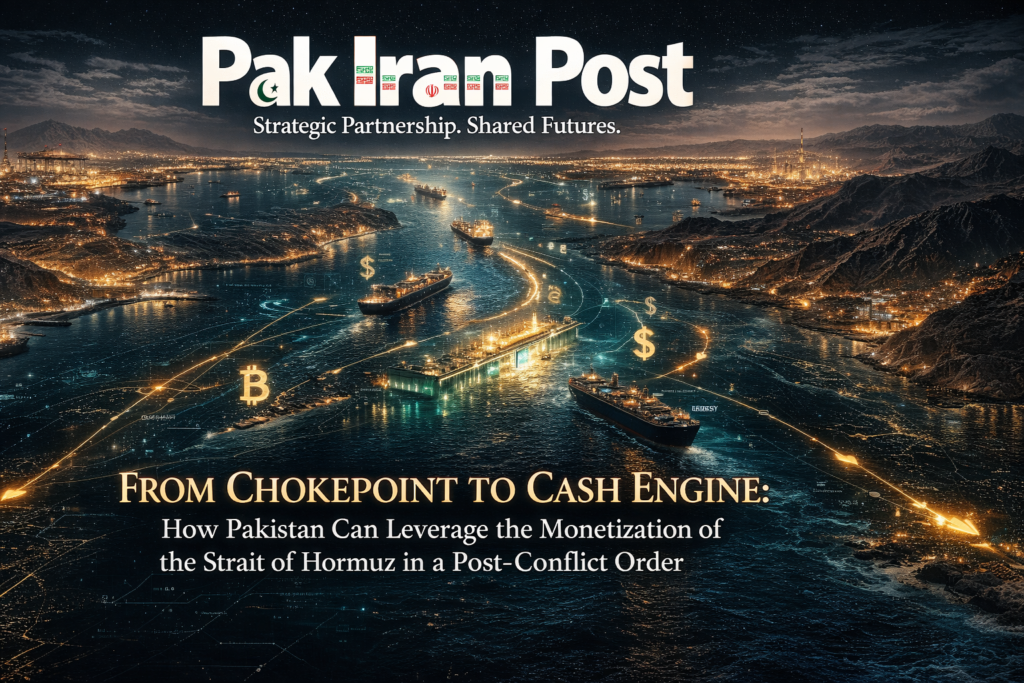
What is unfolding in the waters of the Strait of Hormuz is no longer confined to traditional geopolitical contestation. It represents a deeper transformation in the logic of global power, where geography is being converted into a monetizable financial asset. For decades, the Strait functioned as an open artery of globalization, facilitating the movement of nearly a fifth of the world’s oil supply without direct toll-based extraction by the littoral states. That era appears to be entering a decisive transition. The idea of an “IPO of Hormuz” is not merely rhetorical. It reflects the emergence of a system where maritime risk, security provisioning, and transit flows are priced, securitized, and potentially institutionalized into structured revenue streams.
At the center of this transformation lies Iran. Faced with prolonged sanctions, constrained fiscal space, and evolving regional rivalries, Tehran is increasingly incentivized to leverage its geographic advantage not only as a deterrent but as a source of sustainable income. The monetization of transit through layered mechanisms such as security levies, insurance premiums tied to risk exposure, escort services, and differentiated access regimes could fundamentally alter the economics of global energy flows. This would mark a shift from a rules-based open sea regime toward a quasi-managed corridor model, where access is conditioned by political alignment, security arrangements, and willingness to pay for stability.
Such a transformation would have cascading implications. Oil pricing would no longer be shaped solely by supply and demand fundamentals but increasingly by embedded security costs. Freight rates would incorporate a Hormuz premium, recalibrating global shipping economics. Insurance markets, particularly maritime underwriting, would evolve to price conflict risk more dynamically, leading to the creation of new financial instruments tied to geopolitical volatility. In this context, the Strait would cease to be a passive conduit and instead function as an active node in the global financial architecture.
For Pakistan, this moment presents both a strategic challenge and a rare geoeconomic opportunity. Historically positioned as a peripheral observer to Gulf dynamics, Islamabad now faces the possibility of inserting itself into a newly emerging economic ecosystem centered on maritime monetization. The key lies in recognizing that the transformation of Hormuz is not an isolated phenomenon but part of a broader reconfiguration of regional connectivity, energy security, and financial flows. Pakistan’s geographic proximity, its existing infrastructure, and its diplomatic relationships provide a foundation upon which a more proactive strategy can be constructed.
One of the most immediate pathways for engagement lies in maritime security collaboration with Iran. While direct alignment carries sensitivities, particularly in the context of Pakistan’s relationships with Gulf states and the United States, there exists space for calibrated cooperation focused on non-escalatory domains. Joint mechanisms for ensuring the safety of shipping lanes, intelligence sharing on maritime threats, and participation in multilateral security frameworks could enable Pakistan to position itself as a contributor to regional stability rather than a partisan actor. Such participation would not only enhance Pakistan’s strategic relevance but also open avenues for revenue generation through security provisioning.
The role of Gwadar Port becomes central in this evolving equation. Conceived as a cornerstone of regional connectivity, Gwadar has yet to realize its full potential. The monetization of Hormuz offers a context in which Gwadar can be repositioned as a complementary logistics and energy redistribution hub. As transit through the Strait becomes more structured and potentially more expensive, there will be incentives for diversification of routes and redistribution points. Gwadar, with its proximity to the Gulf and its integration within broader connectivity frameworks, is uniquely positioned to capture spillover traffic.
This would require a deliberate policy shift. Infrastructure development must be aligned with emerging demand patterns, including storage facilities for oil and gas, refining capacity, and integrated logistics services. Regulatory frameworks must be streamlined to attract international shipping companies and energy traders. Crucially, Gwadar must be embedded within a broader network that connects it to domestic consumption centers and regional markets. Without such integration, its potential as a Hormuz-adjacent hub will remain underutilized.
Another avenue of engagement lies in the domain of maritime insurance and risk management. As the Strait becomes a priced corridor, the demand for risk underwriting will expand significantly. Pakistan, through its financial institutions and potential partnerships with international insurers, can seek to develop a niche role in this emerging market. While the country’s financial sector currently lacks the scale to compete with established global players, targeted investments and regulatory support could enable the development of specialized capabilities. Over time, this could evolve into a broader financial services ecosystem linked to maritime trade.
Shipping facilitation represents an additional layer of opportunity. Participation in escort services, port call optimization, and logistical coordination can generate both direct and indirect economic benefits. Pakistan’s naval capabilities, while primarily oriented toward national defense, can be leveraged in limited and carefully structured roles that contribute to regional maritime security. Such participation must be framed within multilateral arrangements to avoid perceptions of alignment with any single actor.
Energy connectivity remains perhaps the most transformative dimension of this emerging landscape. The long-stalled Iran Pakistan Gas Pipeline acquires renewed relevance in a context where maritime transit is increasingly monetized and potentially disrupted. A land-based energy corridor between Iran and Pakistan would not only provide a stable source of supply but also reduce dependence on volatile maritime routes. Reviving this project, however, requires navigating a complex web of sanctions, financing constraints, and political considerations. Innovative approaches, including phased implementation, localized currency arrangements, and third-party guarantees, may be necessary to move forward.
The potential economic benefits for Pakistan are substantial. Even partial participation in Hormuz-linked financial flows could contribute to offsetting the country’s chronic energy import burden. By reducing the cost of energy through diversified supply channels and capturing value from transit and logistics services, Pakistan can alleviate pressure on its balance of payments. Enhanced foreign exchange earnings from shipping, insurance, and port operations would strengthen reserves and provide greater macroeconomic stability. Over time, these gains could translate into a reduction in the current account deficit, creating fiscal space for development initiatives.
Beyond immediate economic benefits, deeper engagement with the Hormuz ecosystem would enhance Pakistan’s geoeconomic relevance. In an era where connectivity defines power, the ability to link China, the Middle East, and South Asia positions Pakistan as a critical node in emerging trade networks. This aligns with broader regional initiatives and provides leverage in negotiations with major powers. However, this enhanced relevance comes with increased scrutiny and responsibility. Missteps in policy or alignment could have far-reaching consequences.
The diplomatic dimension of this strategy is perhaps the most delicate. Pakistan’s relationships with the United States, Gulf countries, and Iran are characterized by both cooperation and tension. Engaging with Iran on Hormuz-related initiatives risks triggering concerns among Gulf partners, who may view such moves as undermining their own strategic positions. Similarly, the United States’ sanctions regime imposes constraints on the extent of permissible engagement. Navigating this landscape requires a nuanced approach that balances competing interests without alienating key partners.
One possible pathway is to frame Pakistan’s engagement in strictly economic and multilateral terms. By emphasizing the role of stability, connectivity, and shared prosperity, Islamabad can position its initiatives as contributing to regional public goods rather than advancing narrow geopolitical agendas. Engagement with international institutions and adherence to transparent regulatory standards can further mitigate concerns. At the same time, maintaining open channels of communication with all stakeholders is essential to prevent misunderstandings and manage expectations.
China’s role in this equation cannot be overlooked. As a major consumer of Gulf energy and a key partner in Pakistan’s development, Beijing has a vested interest in the stability and efficiency of Hormuz. Aligning Pakistan’s strategy with Chinese interests, while preserving autonomy, can unlock additional resources and political support. This requires careful coordination to ensure that initiatives are mutually beneficial and do not create dependencies that limit policy flexibility.
A coherent policy roadmap is essential to translate these opportunities into tangible outcomes. At the strategic level, Pakistan must articulate a clear vision of its role in the evolving Hormuz ecosystem. This vision should be grounded in realism, recognizing both the opportunities and the constraints. Institutional coordination is critical, with relevant ministries and agencies working in concert to implement policies. Capacity building, particularly in maritime, financial, and energy sectors, must be prioritized.
In the domain of maritime diplomacy, Pakistan should actively engage in regional forums and initiatives that address security and trade in the Gulf. Building partnerships with both state and non-state actors will enhance credibility and influence. Energy agreements with Iran and other regional players must be pursued with a focus on flexibility and resilience, incorporating mechanisms to manage risk and uncertainty. Economic integration efforts should prioritize connectivity, infrastructure development, and regulatory reform to create an enabling environment for investment.
The private sector has a vital role to play. Encouraging participation from domestic and international firms in shipping, logistics, and financial services will accelerate the development of a Hormuz-linked ecosystem. Public-private partnerships can provide the necessary capital and expertise while distributing risk. At the same time, ensuring transparency and accountability is essential to build trust and attract long-term investment.
Ultimately, the monetization of the Strait of Hormuz represents a broader shift in the global order, where control over critical nodes translates into economic and political power. For Pakistan, the challenge is to move from the margins to the center of this transformation. This requires vision, pragmatism, and a willingness to engage with complexity. The rewards, however, are significant. By positioning itself as a secondary stakeholder in Hormuz-linked revenue ecosystems, Pakistan can not only address immediate economic challenges but also secure a more prominent role in the emerging geoeconomic landscape.
The window of opportunity is narrow and the risks are real. Yet, in a world where traditional boundaries between geopolitics and economics are increasingly blurred, those who can adapt and innovate will shape the future. Pakistan stands at such a crossroads. The question is not whether the Strait of Hormuz will be monetized, but whether Pakistan will find a way to participate in and benefit from this transformation.
A Public Service Message