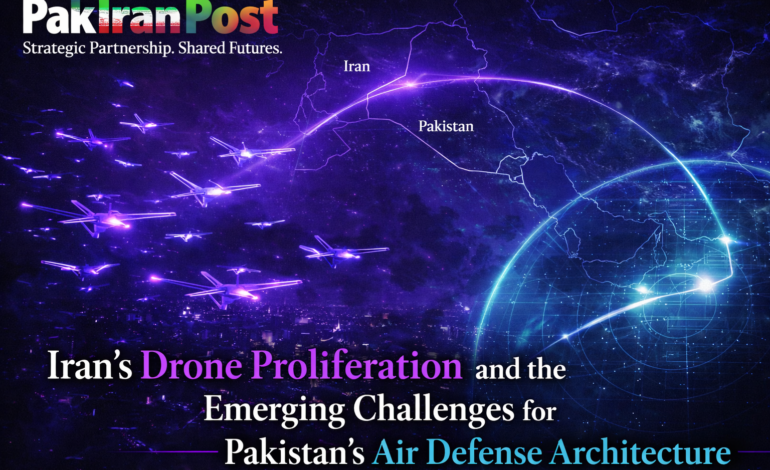
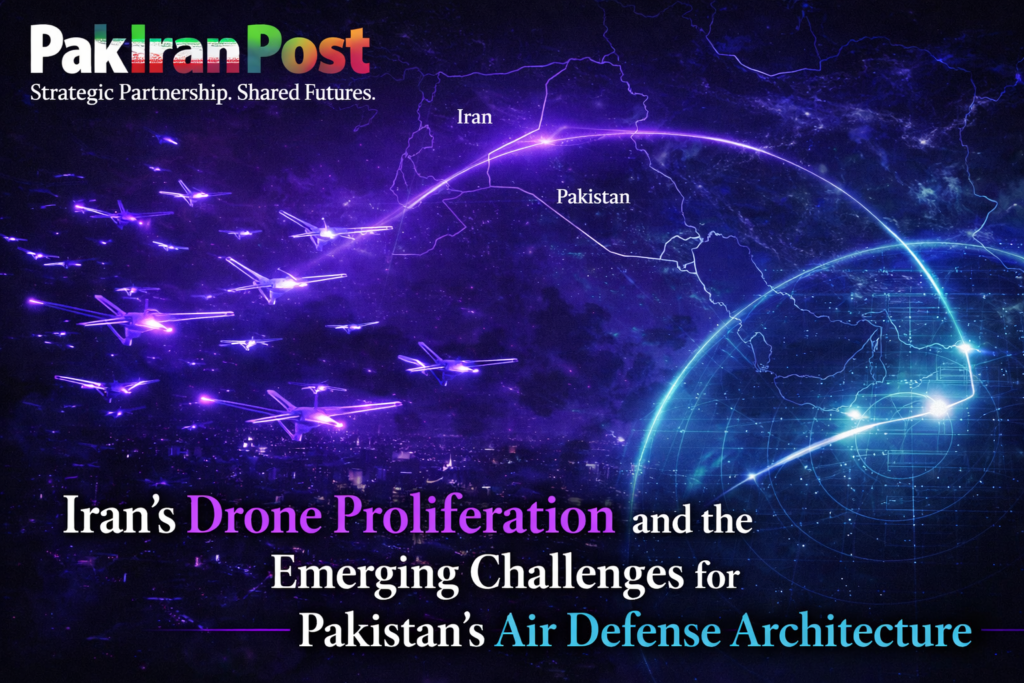
Iran’s Drone Proliferation and the Emerging Challenges for Pakistan’s Air Defense Architecture

Iran’s military-industrial strategy over the past decade has increasingly emphasized the development, deployment, and export of unmanned aerial systems as a central component of its regional influence and strategic deterrence. The proliferation of Shahed drones, originally designed for surveillance and precision strike missions, has extended from the Yemeni theater into the broader Middle East and South Asia, creating a new vector of security considerations for neighboring states. For Pakistan, the diffusion of Iranian drone technology poses a multi-layered challenge, affecting conventional air defense planning, border security operations, and the calibration of technological partnerships with regional and global allies. The strategic dilemma is complex because it combines technological proliferation with operational sophistication, requiring Islamabad to consider both defensive and diplomatic responses in a rapidly evolving regional security architecture.
Iran’s motivation for drone proliferation is grounded in a blend of strategic, technological, and economic imperatives. Tehran perceives unmanned aerial systems as cost-effective instruments to project power, counter technologically superior adversaries, and sustain influence through proxy actors in Yemen, Syria, Iraq, and Afghanistan. The Shahed drone platform, in particular, has demonstrated operational versatility, capable of conducting reconnaissance, precision strike missions, and coordinated swarm attacks. Iran’s ability to transfer these capabilities to non-state actors, and potentially to allied regional states, is both a manifestation of asymmetric warfare doctrine and a calculated effort to extend strategic influence without direct conventional confrontation. For Pakistan, this proliferation represents a dual concern: the potential adaptation of these systems by transnational militant groups and the challenge of aligning its air defense infrastructure to counter asymmetric aerial threats effectively.
The operational implications for Pakistan are profound. The western and southwestern borders, including the Balochistan frontier and the Afghanistan-Pakistan corridor, are characterized by complex terrain, limited radar coverage in remote valleys, and a history of militant movement across porous borders. Iranian-supported groups in Afghanistan, or indigenous networks inspired by Iranian drone tactics, could exploit these vulnerabilities, introducing high-precision strike capabilities and surveillance assets into Pakistan’s western operational theater. The threat is compounded by the potential for coordination with technologically capable non-state actors, including those with access to communications encryption, satellite navigation systems, and small-scale payload delivery mechanisms. Islamabad must therefore reassess air defense priorities, integrating layered detection systems, electronic warfare capabilities, and rapid response protocols to mitigate the risk of drone-enabled incursions or attacks.
The technological diffusion of drones is not uniform, and understanding its operational trajectory is essential for Pakistan’s defense planning. Iran has exported systems through formal and informal channels, with varying levels of operational sophistication. Some drones are supplied directly to state allies, accompanied by technical training and logistical support, while others reach non-state actors through black-market networks and proxy distribution chains. The evolution of swarm tactics, networked targeting, and payload customization has created a scenario in which conventional air defense solutions may be inadequate, necessitating investments in adaptive counter-drone technologies, sensor fusion, and integrated command and control networks. For Islamabad, collaboration with allied partners in intelligence, technology acquisition, and capacity-building becomes indispensable to maintaining a credible deterrent posture.
Strategically, the proliferation of Iranian drones reshapes the regional threat environment by lowering the cost threshold for asymmetric attacks. In previous conflicts, high-value aerial targets could only be threatened by technologically advanced states with substantial air power. The introduction of cost-effective, networked drone systems enables smaller actors to threaten infrastructure, military installations, and civilian targets with relative impunity. For Pakistan, this requires a paradigm shift in threat assessment, planning, and resource allocation, as traditional air defense investments designed for conventional aerial platforms may not provide adequate coverage against small, agile, and potentially autonomous unmanned systems. The strategic calculus must therefore integrate a broad spectrum of scenarios, ranging from localized border incursions to coordinated multi-vector attacks targeting critical nodes of national infrastructure.
Diplomatic and policy considerations further complicate the air defense dilemma. Iran’s regional posture, including its role in the drone proliferation chain, is intertwined with broader geopolitical dynamics involving the United States, Gulf states, Russia, and China. Pakistan’s foreign policy must navigate this landscape carefully, balancing the imperatives of maintaining cordial bilateral relations with Iran against the strategic necessity of securing its borders and critical assets. Cooperative intelligence-sharing, joint technical assessments, and dialogue on unmanned aerial threats can form part of a broader framework aimed at mitigating the risk of escalation. Simultaneously, Islamabad must ensure that its engagement does not compromise the credibility of its alliances or operational autonomy, preserving flexibility in both defense planning and diplomatic maneuvering.
The economic dimension of Iran’s drone strategy also indirectly affects Pakistan. The cost of adapting air defense infrastructure to counter sophisticated unmanned aerial threats is substantial, encompassing investments in radar systems, command and control networks, electronic warfare suites, interceptor technologies, and training of personnel. Pakistan must allocate resources strategically, balancing air defense modernization with broader national security priorities, including conventional force readiness, counterterrorism operations, and border management. The interplay between resource allocation, threat perception, and technological investment highlights the multi-dimensional nature of the challenge, demonstrating that drone proliferation is not merely a tactical concern but a structural issue shaping defense policy, fiscal planning, and strategic posture.
Operational case studies from Yemen, Syria, and Iraq illustrate the evolving efficacy of Iranian drones in asymmetric conflict environments. In Yemen, Houthi forces have leveraged Shahed drones to strike high-value targets, disrupt supply chains, and impose psychological pressure on adversaries. In Syria, Iranian-aligned militias have demonstrated integrated drone operations, combining surveillance, targeting, and strike coordination to enhance operational impact. In Iraq, the use of drones against coalition forces highlights the capacity for operational innovation and tactical adaptation. Each of these theaters provides lessons relevant to Pakistan’s western security considerations, particularly in terms of threat modeling, counter-drone tactics, and the potential for non-state actors to operationalize advanced aerial systems against both military and civilian targets.
The human and organizational dimensions of drone proliferation cannot be ignored. Training, maintenance, operational doctrine, and command structures influence the effectiveness of these systems, meaning that the operational capability of actors using Iranian drones depends not only on technology but also on human capital and organizational cohesion. Pakistan must therefore consider not only technological solutions but also intelligence operations aimed at mapping training networks, logistical pathways, and operational leadership within non-state groups capable of deploying drones. Understanding the organizational underpinnings of drone-enabled networks is critical to preemptive action, threat interdiction, and strategic planning.
Electronic warfare and cyber dimensions are integral to the air defense dilemma. Drones are increasingly networked, GPS-guided, and potentially remotely controlled through sophisticated command interfaces that may be vulnerable to interception, jamming, or disruption. Pakistan’s response strategy must integrate electronic warfare capabilities, real-time intelligence fusion, and rapid decision-making processes to counter both physical and cyber-enabled threats. The convergence of kinetic and non-kinetic operational domains underscores the necessity of a holistic defense architecture capable of addressing the multi-vector challenges posed by unmanned systems proliferated by Iran and potentially adapted by regional non-state actors.
Looking forward, Pakistan faces the task of developing a layered and adaptive air defense strategy. This involves integrating advanced radar systems, mobile anti-drone units, electronic warfare platforms, interceptor drones, and command and control networks designed to provide rapid response to asymmetric aerial threats. Cross-border coordination with Afghanistan, intelligence sharing with regional partners, and engagement with international technology providers are critical components of a comprehensive approach. Investment in indigenous research and development is also essential, allowing Pakistan to adapt rapidly to emerging threats, reduce dependence on external suppliers, and develop customized solutions suited to local operational environments.
In conclusion, Iran’s drone proliferation represents a multi-dimensional strategic challenge for Pakistan, encompassing technological, operational, diplomatic, and economic dimensions. The diffusion of unmanned aerial systems, particularly Shahed drones, has created a security environment characterized by asymmetric threats, cross-border vulnerabilities, and complex operational dynamics. Pakistan’s air defense architecture must evolve to meet these challenges, integrating advanced technology, intelligence-driven operations, and regional cooperation into a coherent and adaptive strategy. The implications of Iran’s drone exports extend beyond tactical considerations, influencing regional security architecture, defense planning, and the strategic calculus of Islamabad as it navigates the intersecting domains of conventional security, asymmetric threats, and technological proliferation. Addressing this challenge effectively requires foresight, resource allocation, and multi-level engagement with both domestic and international stakeholders to ensure that Pakistan maintains both strategic resilience and operational effectiveness in the face of evolving aerial threats.
A Public Service Message