
AI Border Intelligence Can Pakistan Predict Risk Before Incidents

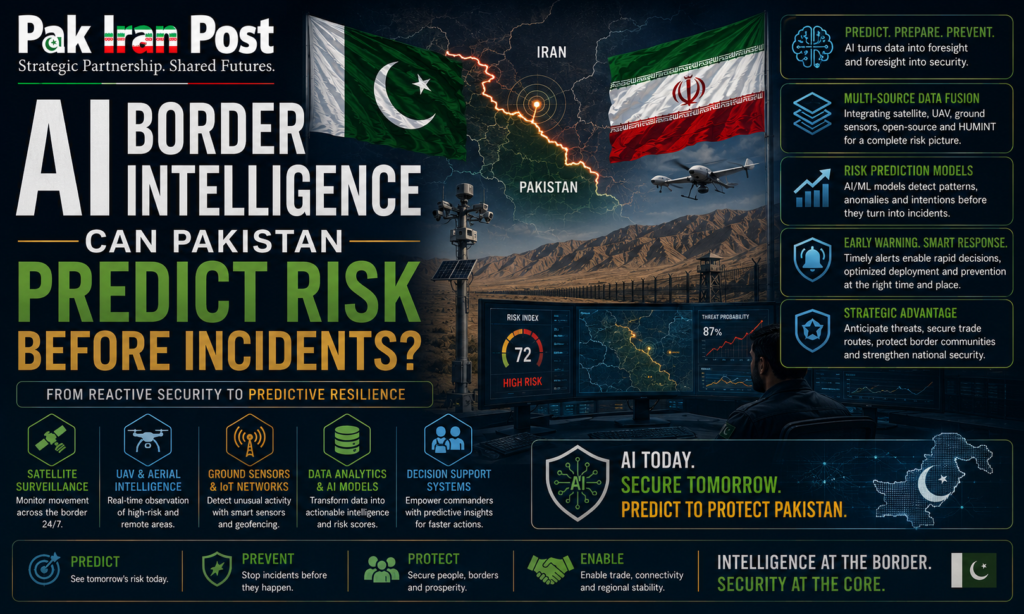
Pak Iran Post confronts a frontier where security volatility, commercial necessity and human mobility intersect with unusual intensity. Along the Pakistan Iran boundary, the central intelligence problem is no longer simply identifying an intrusion after it occurs. It is determining whether a vehicle convoy, passenger cluster, freight consignment, biometric pattern or communications signal represents routine frontier activity, economically motivated evasion, organised smuggling, militant preparation or an emerging humanitarian contingency before these trajectories crystallise into a security incident. Artificial intelligence can materially improve that anticipatory capacity, but only if Pakistan treats it as an intelligence augmentation architecture rather than an automated mechanism for suspicion. The strategic objective should be a controlled border risk platform that fuses customs records, immigration movements, surveillance feeds, satellite imagery, road traffic, freight documentation, weather conditions, open source intelligence and incident histories into a continuously updated risk picture, while retaining accountable human authority over consequential decisions.
The Pakistan Iran frontier presents precisely the type of operating environment in which conventional watch lists and episodic intelligence assessments can become inadequate. Legitimate cross border commerce often coexists with informal trade, fuel movement, pilgrim travel, migrant mobility, family connections and extensive local familiarity across the frontier. A system trained merely to detect unusual movement could therefore classify normal border behaviour as suspicious. Conversely, a network operating through predictable commercial routes could deliberately imitate legitimate patterns and remain invisible to simplistic anomaly detection. The technological challenge is consequently not to maximise the number of alerts. It is to improve the probability that the limited number of alerts reaching security personnel correspond to genuinely consequential deviations from established patterns.
That distinction should shape the architecture from its inception. Pakistan should establish a pilot AI enabled Border Risk Platform focused initially on selected high volume and strategically sensitive corridors linking Balochistan with Iran. The pilot should not attempt to automate border control across the entire frontier. It should operate as a decision support layer over existing institutions, generating risk assessments that can be interrogated, challenged and overridden by authorised officers. The platform should produce a dynamic risk score for consignments, vehicles, routes and movement patterns, accompanied by an explanation of the factors contributing to that score. An unexplained algorithmic designation should never become sufficient grounds for detention, intrusive search or denial of legitimate movement.
The data architecture is more important than the sophistication of the algorithm. Pakistan already possesses fragmented datasets across customs, immigration, law enforcement, provincial administration, border security institutions and other government entities. Their principal weakness is not necessarily absence of information, but incompatible formats, inconsistent identifiers, delayed updates and institutional reluctance to share operational data. A customs record may identify a vehicle differently from immigration documentation, while provincial policing systems may use separate identifiers for incidents occurring along the same transport corridor. Satellite imagery may reveal unusual activity without possessing the contextual information necessary to interpret it. AI cannot rectify defective institutional data merely by applying more powerful computation. A predictive platform built upon contradictory records will manufacture confidence without producing reliable intelligence.
The pilot should therefore begin with a common data model. Each authorised data source should retain its institutional ownership while contributing defined fields to a controlled fusion environment. Vehicle registration, driver identity, cargo description, declared value, origin, destination, crossing history, inspection outcomes, route deviations, travel frequency and previous enforcement findings could form the commercial risk layer. Immigration records could provide movement velocity, frequency and unusual clustering. Security information could contribute verified incident indicators rather than unsubstantiated suspicion. Geospatial systems could identify route anomalies, prolonged stoppages, repeated diversions or activity around designated sensitive locations. Satellite imagery could provide periodic confirmation of changes in roads, storage areas, vehicle concentrations and border infrastructure. Open source intelligence could supplement rather than dominate the model, particularly where publicly available information reveals emerging criminal narratives, market disruptions or security incidents.
Freight risk assessment offers one of the most immediately practical applications. A consignment should not become high risk merely because it originates from Iran or because its commodity belongs to a category associated with previous enforcement cases. The platform should examine combinations of variables. An abrupt change in declared commodity, unusual invoice valuation, inconsistent route behaviour, repeated changes in consignee, unexplained vehicle substitutions, anomalous crossing frequency or discrepancies between declared cargo and observable vehicle characteristics may collectively justify additional scrutiny. The system should learn from confirmed inspection outcomes so that future assessments are informed by evidence rather than institutional intuition.
This is where machine learning can be more useful than conventional rules engines. Rules remain indispensable for legally defined prohibitions and established customs procedures, but machine learning can detect relationships that are difficult to encode manually. A vehicle that appears ordinary when assessed against a single variable may become statistically unusual when its movement frequency, cargo profile, timing and route are considered simultaneously. Network analysis could identify recurring associations among vehicles, traders, intermediaries, routes and consignments without automatically declaring those relationships criminal. The distinction is critical. Association is an intelligence lead, not a finding of culpability.
Biometric movement analysis requires an even more restrained approach. Facial recognition and other biometric technologies can assist identity verification at controlled crossing points, but their deployment should not evolve into unrestricted population surveillance. The platform should prioritise authenticated identity matching, duplicate identity detection and abnormal credential use over indiscriminate facial tracking. A traveller repeatedly presenting valid documentation at predictable intervals should not be transformed into a risk subject simply because an algorithm detects frequent movement. Conversely, simultaneous use of multiple identities, improbable travel sequences or systematic credential irregularities may justify a human review. Biometric information should be encrypted, access controlled, retained for defined periods and subject to auditable rules governing secondary use.
Satellite intelligence could provide a particularly valuable layer because the Pakistan Iran frontier includes expansive terrain where physical observation is inherently uneven. High resolution imagery, synthetic aperture radar and multispectral data can help identify changes in road usage, temporary encampments, vehicle concentrations, unusual construction or activity around logistics nodes. Yet satellite interpretation also carries serious limitations. Cloud cover, image frequency, resolution constraints and difficulties in distinguishing commercial from illicit activity can produce misleading conclusions. AI should therefore compare imagery across time and integrate it with ground intelligence rather than treating a single image as dispositive evidence.
Open source intelligence should be subjected to similar discipline. Social media posts, local reporting, commercial information, publicly available imagery and digital communications can provide early indicators of disruption, market stress or movement. They can also generate misinformation, fabricated narratives and deliberate deception. An AI system trained to ingest every available digital signal without source validation would become vulnerable to manipulation. Pakistan should establish source reliability classifications, confidence scores and provenance requirements so that publicly generated information is explicitly separated from verified government reporting. The model should communicate uncertainty rather than conceal it.
False positives constitute the principal strategic danger. Along a commercially sensitive frontier, an algorithm that produces excessive alerts can paralyse legitimate trade, overwhelm customs officers and gradually lose institutional credibility. An alert system should therefore be evaluated not by the quantity of suspicious cases identified but by its precision, recall and operational utility. The pilot should establish measurable benchmarks, including false positive rates, confirmed threat detection rates, average alert resolution time, percentage of alerts requiring no intervention, inspection yield, customs clearance time, reduction in unnecessary secondary inspections and the proportion of high risk consignments identified before physical examination. These indicators should be independently audited and reviewed quarterly.
The platform should also possess a formal human in the loop architecture. Every high consequence alert should identify the officer responsible for adjudication, the evidence available to that officer and the decision ultimately taken. Where an algorithmic recommendation is rejected, the reason should be recorded. These decisions would create a valuable feedback dataset, enabling the model to distinguish between genuine predictive weakness and legitimate institutional override. Over time, this human feedback could become one of the system’s most important intelligence assets.
Institutional interoperability will determine whether the pilot becomes a functioning national capability or another isolated technology project. A joint governance cell should include representatives from customs, immigration, relevant federal ministries, Balochistan authorities, law enforcement, border management institutions and authorised intelligence stakeholders. Its mandate should be narrowly defined around risk fusion, data standards, model validation and operational performance. It should not become another bureaucratic coordination forum. The platform requires a single technical architecture, designated data custodians, legally defined access privileges and a clear escalation chain for urgent alerts.
The security establishment should retain control over sensitive intelligence while permitting appropriately sanitised indicators to enrich the broader risk environment. Not every intelligence source should enter the central model in raw form. Classified information can instead generate controlled risk features, allowing the system to benefit from intelligence without exposing sensitive sources, methods or operational details. This architecture would reduce the danger that a compromise of the platform could reveal the provenance of individual intelligence streams.
Cybersecurity must therefore be treated as part of border security rather than an information technology afterthought. The platform should employ zero trust access principles, multifactor authentication, encryption at rest and in transit, immutable audit logs, segmented networks and continuous anomaly monitoring. Model integrity also requires protection. An adversary capable of poisoning training data could deliberately induce the system to underestimate particular routes, commodities or behavioural patterns. Periodic red teaming, adversarial testing and independent model validation should be mandatory before operational expansion.
Pakistan should resist the temptation to procure a foreign artificial intelligence package and simply connect it to government databases. Sovereign capability does not necessarily mean building every algorithm domestically, but it does require control over data architecture, model governance, auditability and operational decision rules. Procurement contracts should require explainability, source code escrow where appropriate, independent security testing, interoperability and the ability to migrate models without surrendering institutional control to a vendor. Local universities and technology institutions should participate in model validation, particularly for Urdu, Balochi, Persian and multilingual open source intelligence.
The pilot should run for twelve months under controlled operational conditions. Its initial deployment could cover a limited number of border crossing points and associated freight corridors, allowing a baseline to be established before algorithmic intervention. For three months, the platform should operate in silent mode, generating predictions without influencing inspections. This would permit authorities to measure how accurately the model would have predicted subsequently confirmed incidents or anomalous activity. The next phase could introduce risk informed prioritisation for selected cargo categories, followed by carefully supervised expansion to passenger movement and geospatial anomaly detection.
Success should not be defined as discovering more violations. A mature system would ideally enable authorities to inspect fewer shipments more intelligently, accelerate legitimate commerce, identify emerging threats earlier and allocate scarce personnel according to quantified risk. If clearance times fall while inspection yield rises, the system would be demonstrating genuine institutional value. If alerts multiply while confirmed findings remain static, the model should be recalibrated rather than celebrated as technologically aggressive.
The broader strategic implication is significant. Pakistan’s western frontier cannot be governed indefinitely through a cycle of reactive deployment, episodic crackdowns and post incident intelligence reviews. Nor can artificial intelligence substitute for political judgement, field intelligence or institutional coordination. Its value lies in compressing the distance between observation and decision. A border officer should increasingly receive not merely a record of what crossed the frontier, but an evidence based assessment of what has changed, why it matters, how confident the system is and what additional verification would resolve the uncertainty.
The Pakistan Iran frontier requires precisely that transition. The objective should be anticipatory governance without algorithmic overreach, stronger security without indiscriminate surveillance, and faster commerce without sacrificing state control. A properly governed AI border intelligence platform could provide Pakistan with an operational capability that is currently missing: the ability to distinguish noise from signal across an exceptionally complex frontier before ambiguity becomes crisis. The decisive investment, however, will not be in artificial intelligence alone. It will be in disciplined data governance, institutional interoperability, calibrated human judgement and an intelligence culture prepared to treat algorithms as instruments of statecraft rather than substitutes for it.
A Public Service Message