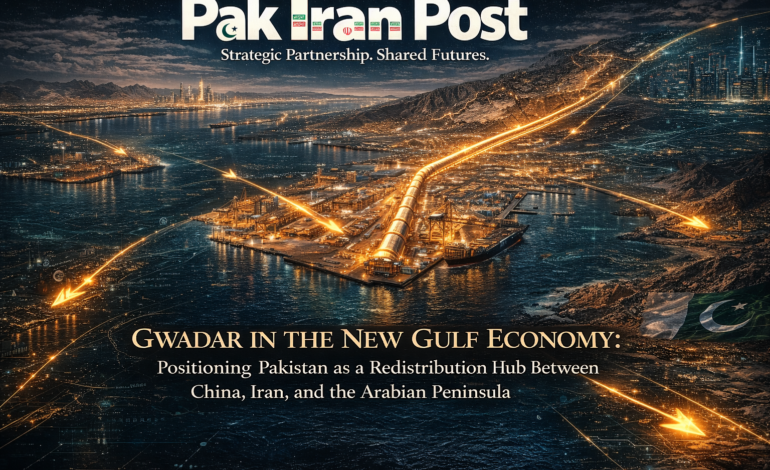
Gwadar in the New Gulf Economy: Positioning Pakistan as a Redistribution Hub Between China, Iran, and the Arabian Peninsula

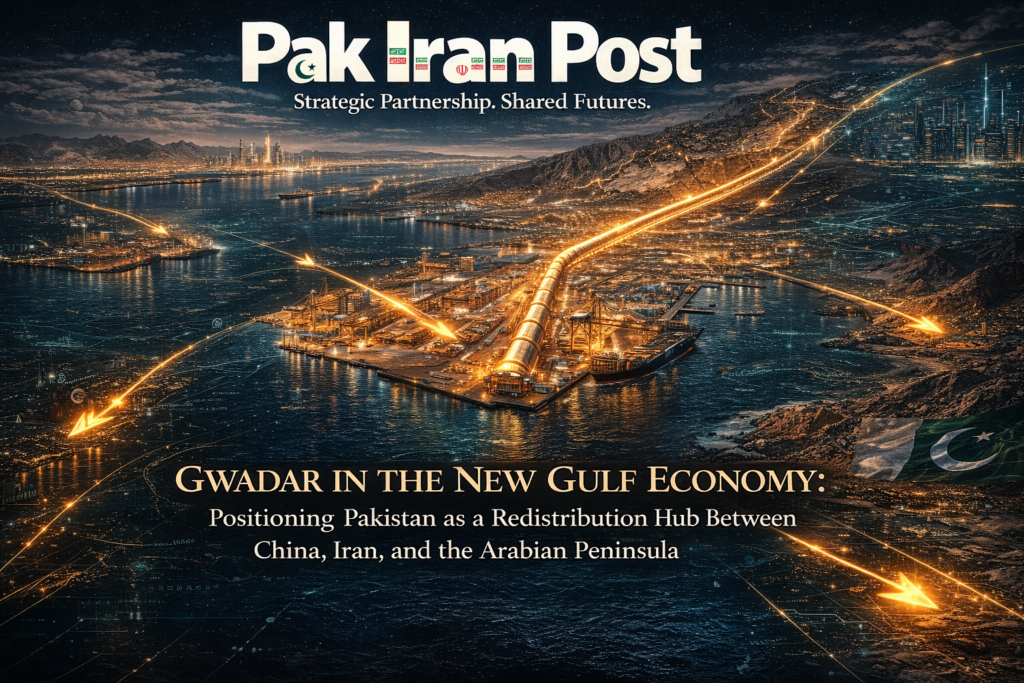
The transformation underway in the Gulf’s economic architecture is not incremental but structural. Maritime corridors that once functioned as neutral conduits of global trade are increasingly being recast as priced, securitized, and politically conditioned routes. The Strait of Hormuz, through which a substantial share of global energy flows, is no longer insulated from the logic of monetization. Insurance premiums, security surcharges, and risk-adjusted freight costs are embedding a permanent layer of volatility into maritime trade. As these costs rise and unpredictability becomes systemic rather than episodic, the global logistics system begins to reconfigure itself around efficiency, redundancy, and risk mitigation. It is within this shifting landscape that Gwadar Port emerges as a potential redistribution hub capable of capturing value from the reorganization of regional trade and energy flows.
Gwadar’s significance lies not merely in its location but in the convergence of geography, geopolitics, and geoeconomics. Situated at the mouth of the Arabian Sea and in proximity to the Gulf, the port occupies a position that naturally connects South Asia with the Middle East and beyond. Yet, for much of its existence as a modern infrastructure project, Gwadar has remained underutilized, constrained by gaps in connectivity, limited industrial integration, and an absence of a coherent economic strategy. The current transformation in maritime economics offers a rare opportunity to reposition Gwadar from a peripheral asset into a central node within an emerging redistribution network.
At the heart of this opportunity is the changing cost structure of maritime trade. As transit through Hormuz becomes increasingly expensive due to embedded security and insurance costs, shipping companies and energy traders will seek alternative points of storage, processing, and redistribution that can optimize overall logistics expenses. Gwadar, by virtue of its proximity and its potential for expansion, can serve as such a point. However, this requires a shift from viewing the port as a standalone infrastructure project to conceptualizing it as an integrated economic ecosystem.
The first pillar of this transformation is energy infrastructure. For Gwadar to function as a redistribution hub, it must develop the capacity to handle, store, and process large volumes of energy commodities. This includes the construction of oil storage facilities, liquefied natural gas terminals, and refining capacity. Without these capabilities, the port cannot capture value beyond basic transshipment. By enabling storage and processing, Gwadar can allow energy traders to arbitrage price differentials, manage supply disruptions, and optimize distribution routes. This transforms the port from a transit point into a value-adding hub.
Equally important is the development of inland connectivity. A port’s efficiency is determined not only by its maritime capabilities but by its ability to connect seamlessly with its hinterland. Gwadar must be linked to Pakistan’s major industrial and consumption centers through a network of highways, railways, and pipelines. This connectivity must extend further to regional markets, including Central Asia and Western China, creating a corridor that integrates Gwadar into broader trade networks. Without such integration, the port risks becoming an isolated node with limited economic impact.
Regulatory reform constitutes the second pillar. Investors require certainty, transparency, and efficiency. Special economic zones associated with Gwadar must offer competitive incentives, including tax concessions, simplified procedures, and robust legal protections. At the same time, governance standards must be strengthened to ensure that these incentives do not lead to inefficiencies or corruption. A clear and consistent regulatory framework will be essential to attracting both domestic and international investment.
The role of China in Gwadar’s development is both enabling and complex. As a major investor and strategic partner, China provides capital, technology, and political support. Integrating Gwadar within broader regional connectivity initiatives enhances its viability and accelerates development. However, Pakistan must ensure that this partnership remains balanced. Overreliance on a single partner can limit strategic flexibility and create perceptions of exclusivity that deter other investors. A diversified investment strategy that welcomes participation from Gulf countries, Western firms, and regional players will enhance resilience and credibility.
From a geoeconomic perspective, Gwadar’s potential lies in its ability to capture spillover effects from the monetization of Hormuz. As costs rise within the Strait, alternative routes and redistribution points become more attractive. Gwadar can position itself as a cost-effective and secure alternative, particularly for cargo destined for South Asia, Central Asia, and parts of China. This requires not only competitive pricing but also operational efficiency. Port operations must be streamlined, turnaround times minimized, and services standardized to meet global benchmarks.
The development of a logistics ecosystem around Gwadar is critical. This includes warehousing, cold storage, packaging, and value-added services that enhance the port’s attractiveness. Logistics companies must be encouraged to establish operations within the Gwadar economic zone, creating a cluster effect that drives efficiency and innovation. Digitalization of logistics processes, including real-time tracking and automated documentation, will further enhance competitiveness.
The economic benefits of transforming Gwadar into a redistribution hub are significant and multifaceted. Increased port activity generates direct revenue through fees and services. Indirectly, it stimulates economic activity in surrounding regions, creating jobs and supporting local businesses. At the macroeconomic level, foreign exchange earnings from logistics and trade services contribute to the stabilization of external accounts. This aligns with broader economic objectives of reducing reliance on external financing and enhancing resilience.
However, the pursuit of this strategy must be grounded in a realistic assessment of risks. Geopolitical sensitivities are particularly acute. Gwadar’s development is closely watched by regional actors, some of whom perceive it as altering strategic balances. Managing these perceptions requires a proactive diplomatic strategy that emphasizes Gwadar’s role as a commercial hub open to all. Transparency in operations and inclusivity in investment can help mitigate concerns.
Security is another critical dimension. The success of any port depends on its ability to provide a safe and stable operating environment. This requires investment in both physical security and institutional capacity. Coordination between civilian and military agencies is essential to ensure comprehensive coverage. At the same time, community engagement in the surrounding region is crucial to building local support and reducing the risk of disruptions.
Aggressive policy action is required to unlock Gwadar’s potential. The government must prioritize the port’s development as a national strategic objective, supported by sustained investment and institutional commitment. Coordination between federal and provincial authorities is essential to ensure alignment and avoid duplication of efforts. A dedicated Gwadar development authority with clear mandates and accountability can provide the necessary focus.
Financial structuring of Gwadar’s development must be innovative. Public funding alone is insufficient to meet the scale of investment required. Public-private partnerships can mobilize capital and expertise, while risk-sharing mechanisms can attract private investors. Sovereign guarantees may be necessary in certain cases but must be carefully managed to avoid excessive fiscal exposure. Transparent and competitive procurement processes will enhance credibility and efficiency.
The integration of Gwadar into Pakistan’s broader economic strategy is essential. The port should not be treated as an isolated project but as a central component of a comprehensive geoeconomic vision. Policies related to trade, industry, and investment must be aligned to maximize Gwadar’s impact. This includes promoting export-oriented industries within the Gwadar economic zone, leveraging the port’s connectivity to access regional markets.
Human capital development is another critical factor. Operating a modern port and associated logistics ecosystem requires skilled labor, including engineers, technicians, and management professionals. Investment in education and training programs tailored to these needs will ensure that Pakistan can capture maximum value from Gwadar’s development. Partnerships with international institutions can provide access to best practices and advanced training.
Environmental sustainability must also be considered. As global trade increasingly incorporates environmental standards, Gwadar must align with these expectations. Investments in clean energy, efficient waste management, and sustainable practices will enhance the port’s attractiveness and ensure compliance with international norms. This is not only a regulatory requirement but also a competitive advantage in an increasingly environmentally conscious market.
The timeline for Gwadar’s transformation must be realistic yet ambitious. Delays have historically undermined confidence and increased costs. Setting clear milestones, backed by political commitment and institutional accountability, is essential to maintaining momentum. Regular monitoring and evaluation will enable timely identification of challenges and corrective action.
In the broader context of regional dynamics, Gwadar’s rise has the potential to reshape trade patterns and economic relationships. By providing an alternative redistribution hub, the port can reduce dependence on traditional routes and create new opportunities for regional integration. This aligns with the interests of multiple stakeholders, including China, Iran, and Gulf countries, creating a basis for cooperative development.
In conclusion, the monetization of maritime corridors and the reconfiguration of the Gulf economy present a historic opportunity for Pakistan. Gwadar, if developed with strategic clarity and operational efficiency, can become a central node in this new order. Realizing this potential requires aggressive policy action, sustained investment, and a willingness to undertake structural reforms. It demands a shift from reactive to proactive policymaking, from isolated projects to integrated strategies.
The stakes are high, but so are the rewards. A fully operational Gwadar as a redistribution hub would not only transform Pakistan’s economic landscape but also enhance its strategic relevance in a rapidly changing world. In an era defined by uncertainty and competition, the ability to capture value from shifting trade patterns is a decisive advantage. Gwadar offers Pakistan that opportunity. The challenge lies in seizing it with vision, discipline, and determination.
A Public Service Message