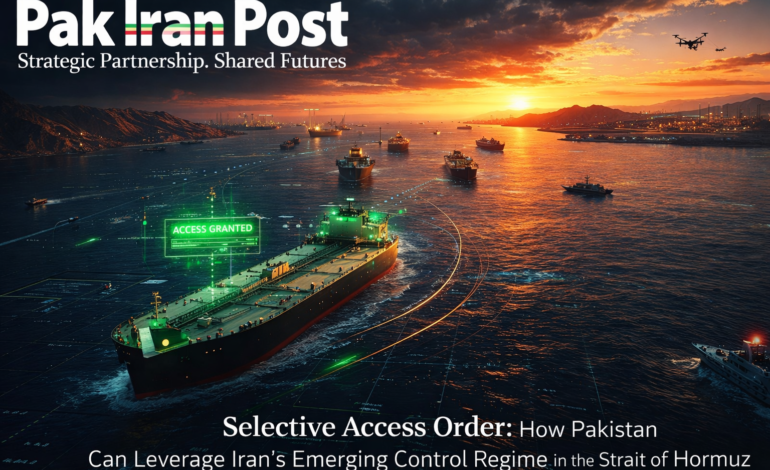
Selective Access Order: How Pakistan Can Leverage Iran’s Emerging Control Regime in the Strait of Hormuz

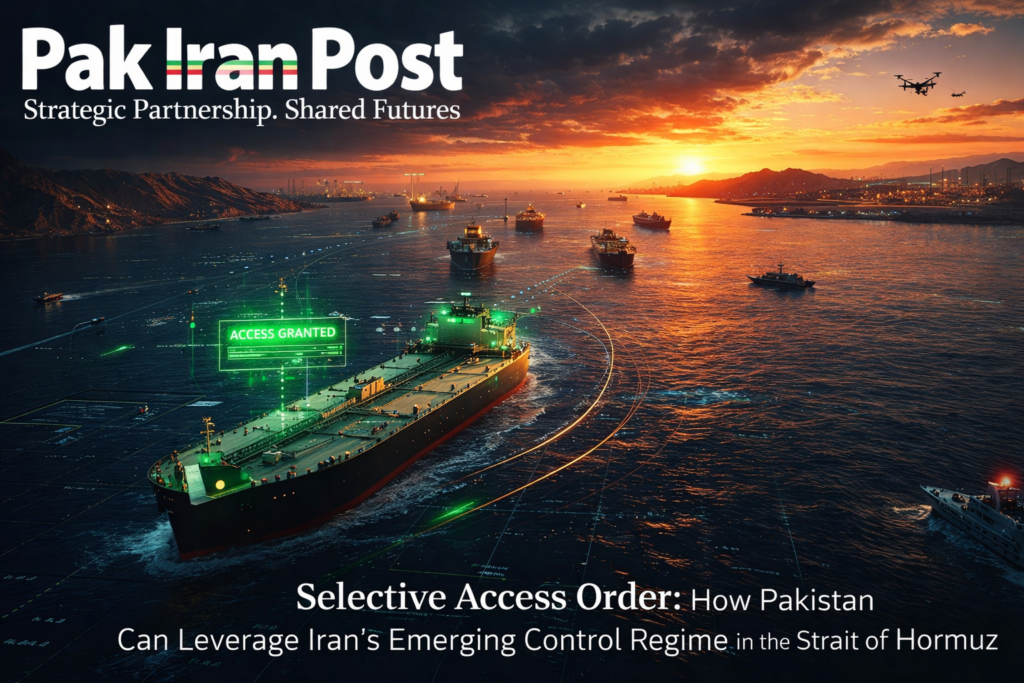
The global maritime order is undergoing a profound transformation in which the long-standing principle of open and neutral sea lanes is being replaced by a more conditional and politically mediated system of access. Nowhere is this shift more visible than in the Strait of Hormuz, a chokepoint that has historically functioned as a shared global artery but is increasingly being reimagined as a controlled gateway shaped by power, alignment, and strategic intent. The emerging logic is not merely about denial or disruption but about selective access, where passage is implicitly or explicitly conditioned on political relationships and strategic understanding. This evolution marks a departure from the liberal maritime order toward a fragmented regime in which geography becomes an instrument of calibrated influence rather than a neutral facilitator of trade.
Iran stands at the center of this transition. Facing prolonged sanctions, strategic encirclement, and economic isolation, Tehran is recalibrating its approach to Hormuz from deterrence-based disruption toward managed control. This does not necessarily imply the closure of the Strait, which would be economically and strategically self-defeating, but rather the gradual introduction of differentiated access regimes. In such a system, states that maintain cooperative relations with Iran may experience smoother transit conditions, lower risk exposure, and implicit security assurances, while adversarial actors face heightened uncertainty, increased costs, and potential disruptions. The result is the emergence of a tiered maritime order that redefines the economics and politics of global shipping.
For Pakistan, this transformation presents a rare geostrategic opening. Positioned geographically adjacent to the Gulf and maintaining a complex but functional relationship with Iran, Pakistan has the potential to secure a privileged position within this evolving access regime. Unlike distant powers whose engagement with Hormuz is mediated through naval projection, Pakistan’s proximity and regional embeddedness provide a foundation for more organic integration into emerging maritime arrangements. The challenge lies in converting this latent advantage into a structured and durable strategic gain.
The concept of selective access is fundamentally about leverage. By conditioning transit on political alignment, Iran can extract concessions, build partnerships, and reshape regional hierarchies. For Pakistan, the objective should not be passive inclusion but active negotiation of its status within this system. This requires moving beyond informal understandings toward formalized frameworks that institutionalize access and reduce uncertainty. Bilateral agreements focused on maritime cooperation, security coordination, and transit facilitation can provide the legal and operational foundation for such an arrangement.
At the core of this strategy is the need to secure uninterrupted energy flows. Pakistan’s dependence on imported energy makes it acutely vulnerable to disruptions in Hormuz. A privileged access arrangement would mitigate this vulnerability by ensuring continuity of supply even during periods of heightened tension. This is not merely a logistical advantage but a strategic buffer that enhances national resilience. By reducing exposure to external shocks, Pakistan can stabilize its economy, strengthen investor confidence, and create space for long-term planning.
However, access alone is insufficient. The true value lies in the ability to shape and influence the terms of access. Pakistan must seek to participate in the governance mechanisms that underpin the emerging maritime order. This could include joint committees on transit protocols, collaborative frameworks for risk management, and coordinated approaches to maritime security. By embedding itself within these structures, Pakistan can transition from a beneficiary of selective access to a co-architect of the system.
Maritime security cooperation represents a critical dimension of this engagement. While direct military alignment may be neither feasible nor desirable, there is significant scope for collaboration in non-escalatory domains such as information sharing, search and rescue operations, and anti-piracy efforts. Such cooperation enhances trust, builds interoperability, and reinforces Pakistan’s role as a responsible stakeholder. At the same time, it provides a platform for deeper strategic engagement that can be expanded as conditions evolve.
The economic implications of privileged access are substantial. Reduced transit risk translates into lower insurance premiums and shipping costs, which in turn improve the competitiveness of Pakistan’s imports and exports. Over time, this cost advantage can attract trade flows and investment, positioning Pakistan as a preferred partner in regional supply chains. The integration of maritime access with domestic infrastructure, particularly ports and logistics networks, can amplify these benefits by creating a seamless corridor from the Gulf to inland markets.
Yet, the pursuit of such a strategy must be carefully calibrated to avoid over-alignment with Iran. Pakistan’s relationships with Gulf states, particularly Saudi Arabia and the United Arab Emirates, are deeply embedded in economic, political, and social ties. Any perception of strategic drift toward Iran could strain these relationships and undermine Pakistan’s broader regional position. Similarly, engagement with Iran must be managed within the constraints imposed by the United States, whose sanctions regime continues to shape the parameters of permissible interaction.
Strategic ambiguity becomes a necessary tool in this context. Pakistan must maintain a posture that allows for engagement with Iran without signaling exclusivity or alignment against other partners. This requires a nuanced diplomatic approach that emphasizes economic pragmatism and regional stability rather than ideological or geopolitical alignment. Communication is key. Pakistan must articulate its actions as part of a broader strategy of diversification and resilience, rather than a shift in allegiance.
The role of multilateralism can be instrumental in managing these sensitivities. By embedding its engagement with Iran within broader regional or international frameworks, Pakistan can distribute responsibility and reduce the perception of bilateral alignment. Participation in forums focused on maritime security, trade facilitation, and regional connectivity can provide a platform for cooperative engagement that is less politically charged. At the same time, these forums can serve as vehicles for advancing Pakistan’s interests and shaping the emerging order.
China’s involvement adds another layer of complexity and opportunity. As a major consumer of Gulf energy and a key partner in Pakistan’s development, China has a vested interest in the stability and accessibility of Hormuz. Aligning Pakistan’s strategy with Chinese interests can provide additional leverage and resources. However, this alignment must be balanced to avoid creating dependencies that limit Pakistan’s strategic autonomy. A diversified approach that engages multiple partners will enhance resilience and flexibility.
From a policy perspective, the transition to a selective access order demands a proactive and coordinated response. Pakistan must develop a comprehensive maritime strategy that integrates diplomatic, economic, and security dimensions. This strategy should be anchored in a clear understanding of national interests and supported by institutional capacity. A dedicated body tasked with overseeing maritime policy can ensure coherence and continuity across different domains.
Legal frameworks must be updated to accommodate new forms of cooperation and engagement. This includes agreements on transit rights, security protocols, and dispute resolution mechanisms. Clarity and predictability are essential to building trust and attracting investment. At the same time, flexibility must be preserved to adapt to changing circumstances and evolving opportunities.
Economic policy must align with strategic objectives. Investments in port infrastructure, logistics, and energy systems should be prioritized to maximize the benefits of privileged access. Incentives for private sector participation can mobilize capital and expertise, accelerating development and innovation. The integration of maritime access with domestic economic planning will ensure that benefits are widely distributed and sustainably realized.
Risk management is critical. The evolving maritime order is inherently uncertain, and Pakistan must be prepared to navigate potential disruptions and reversals. This requires robust contingency planning, including alternative supply routes and diversified energy sources. By maintaining flexibility and redundancy, Pakistan can mitigate the impact of adverse developments and preserve its strategic position.
The importance of timing cannot be overstated. The transition to a selective access regime is still in its formative stages, and early movers have the advantage of shaping its contours. Pakistan must act decisively to secure its position before the system becomes more rigid and competitive. Delay risks marginalization, as other actors may move to establish their own arrangements and capture available opportunities.
In a broader sense, the emergence of a selective access order in the Strait of Hormuz reflects a shift in the global balance of power. Control over critical nodes is becoming a central determinant of influence, and states that can leverage their geographic and strategic assets will shape the future of global trade. For Pakistan, this is a moment of both challenge and opportunity. By recognizing the significance of this transformation and responding with clarity and purpose, Pakistan can elevate its role from a peripheral observer to a central participant.
The stakes are high, but the potential rewards are commensurate. Privileged access to Hormuz, if properly institutionalized and integrated into a broader strategy, can provide Pakistan with a durable competitive advantage. It can enhance energy security, strengthen economic resilience, and increase geopolitical relevance. Achieving this outcome requires vision, discipline, and a willingness to engage with complexity.
Ultimately, the question is not whether the maritime order will change, but how Pakistan will position itself within that change. The emergence of a selective access regime is a defining feature of the current moment, and it demands a response that is both strategic and adaptive. By leveraging its geographic position, diplomatic relationships, and economic potential, Pakistan can convert this transformation into a long-term national advantage, securing its place in an increasingly contested and dynamic global order.
A Public Service Message