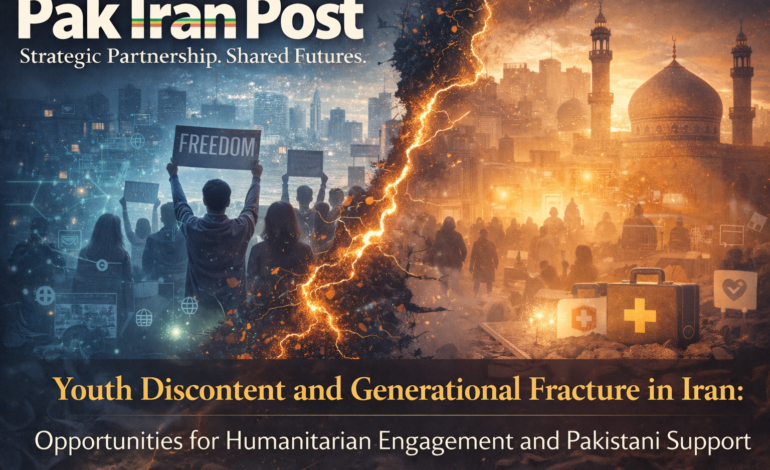
Youth Discontent and Generational Fracture in Iran: Opportunities for Humanitarian Engagement and Pakistani Support

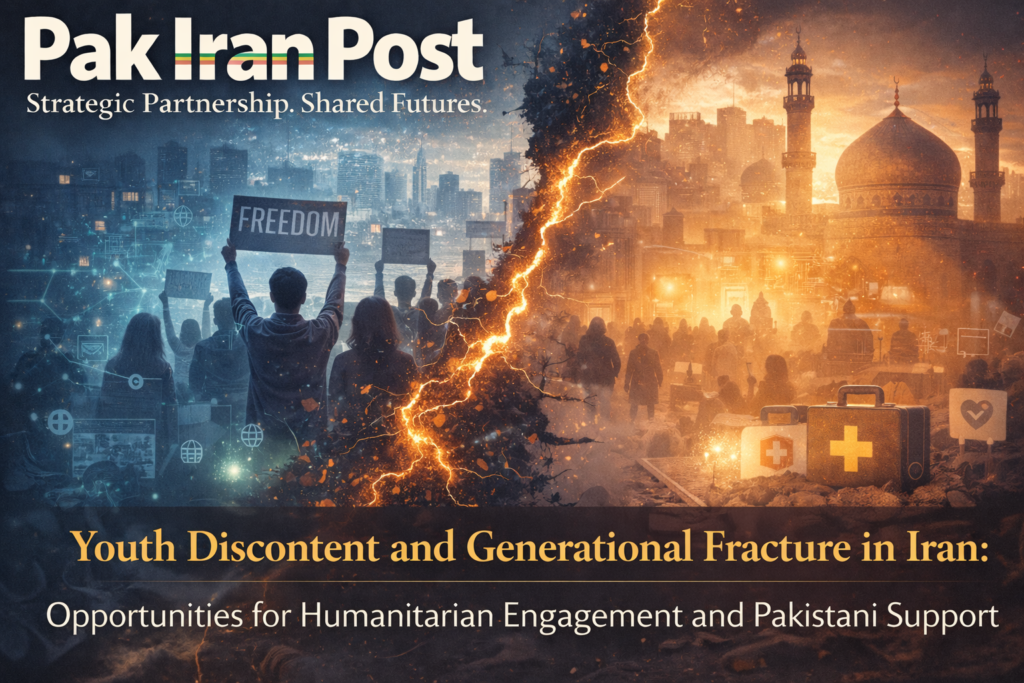
Iran is a nation at a crossroads, where a significant proportion of its population consists of young people navigating complex societal pressures, economic limitations, and restricted personal freedoms. While political and strategic discourses dominate international coverage of Iran, the realities faced by its youth reflect a much deeper societal tension, one that is shaping the nation’s present and future in ways that are largely invisible in headlines. Millions of young Iranians grapple with constrained opportunities, limited access to education and employment, curtailed social freedoms, and a widening gap between aspirations and institutional realities. This generational discontent represents not only a domestic social challenge for Iran but also an opportunity for neighboring countries, including Pakistan, to engage constructively in humanitarian, educational, and social support initiatives that reinforce stability and regional connectivity. Understanding the contours of this youth crisis is essential for policymakers, civil society actors, and international humanitarian stakeholders seeking to respond effectively to the unfolding humanitarian and social challenge.
At the core of youth discontent in Iran is the persistent mismatch between aspirations and opportunity. Educational attainment has expanded dramatically over the past few decades, producing a generation of young Iranians who are among the most educated in the region. Universities and technical institutions have equipped students with knowledge and skills in diverse fields, from science and technology to humanities and social sciences. Yet, the Iranian economy has not kept pace with this expansion, leaving millions of graduates facing limited employment prospects. The result is a paradoxical combination of intellectual empowerment and economic frustration. Highly educated young people find themselves underemployed or in informal labor markets, creating a sense of disenfranchisement and wasted potential. This tension is particularly acute in urban centers where expectations of employment are high but opportunities remain scarce, and in provincial regions where migration to larger cities compounds social and economic pressures.
The consequences of unemployment and underemployment extend beyond individual frustration. They shape family dynamics, social relationships, and broader community structures. Young people experiencing prolonged periods of economic inactivity may delay marriage, reduce fertility decisions, or migrate internally or internationally in search of opportunity. The social contract between the state and its youth, which is fundamentally predicated on the promise of education leading to livelihood, is strained. Families experience economic pressure while also managing the social implications of generational frustration. These dynamics produce cascading effects on housing, health, nutrition, and social stability, intensifying the humanitarian dimensions of the crisis.
Education itself, while providing opportunity, is a double-edged sword. Iranian universities have expanded access, yet curricula, institutional structures, and social expectations frequently limit opportunities for independent thought, innovation, and entrepreneurial activity. Students often navigate rigid institutional norms, censorship of ideas, and limited practical exposure to international standards of professional or academic practice. The result is a sense of unfulfilled potential, as youth recognize the gap between the knowledge they acquire and the avenues available to apply it meaningfully. The lack of integration between educational outcomes and labor market needs creates frustration that manifests not only in economic terms but also in civic disengagement and cultural tension.
Cultural and social restrictions further exacerbate youth discontent. Young Iranians operate within a societal framework that limits freedoms of expression, mobility, and association. These constraints affect leisure, creative production, participation in cultural events, and social networking, shaping a generation that is highly aware of boundaries and potential consequences for perceived transgressions. The psychological burden of negotiating these boundaries on a daily basis is significant. It influences decision-making, risk-taking, and the formation of personal and professional networks. In extreme cases, these pressures contribute to social withdrawal, emigration aspirations, and reduced civic engagement, further weakening the social fabric.
The humanitarian consequences of generational frustration are compounded by uneven access to health and mental health services. Young people experiencing prolonged economic and social stress exhibit higher rates of anxiety, depression, and psychosocial challenges. Mental health infrastructure in Iran, while present, is often insufficient to address the scale and complexity of youth needs. Public awareness around mental health remains limited, and social stigma discourages many from seeking assistance. The resulting vulnerabilities are not isolated; they affect academic performance, workforce participation, interpersonal relationships, and long-term life trajectories. These human costs underscore the urgency of interventions that address psychosocial wellbeing alongside economic and educational opportunities.
Migration pressures are another dimension of generational fracture. Internal migration from smaller towns and rural regions to urban centers is common, as youth seek access to education, employment, and social services. Urban centers, in turn, face intensified pressures on housing, public infrastructure, and labor markets. Simultaneously, international migration aspirations are rising, as educated and ambitious young Iranians seek opportunities abroad in environments perceived to offer greater personal freedom, economic security, and social mobility. This outflow represents not only a humanitarian challenge but also a potential loss of human capital for the country. Understanding the patterns, motivations, and consequences of migration is essential for designing targeted interventions that mitigate negative social impacts while supporting youth development.
Within this context, Pakistan is uniquely positioned to play a humanitarian and supportive role. Pakistan shares historical, cultural, and linguistic ties with Iran, and these linkages provide pathways for engagement that go beyond political rhetoric. Educational collaboration, scholarships, skill-building programs, and cultural exchanges can provide avenues for Iranian youth to access new opportunities without the risks associated with migration to more distant countries. By facilitating knowledge transfer, vocational training, and mentorship initiatives, Pakistan can help address the gap between youth potential and opportunity while reinforcing regional bonds.
Higher education collaboration is a key area for Pakistani engagement. Pakistani universities, technical institutions, and research centers can develop joint programs with Iranian counterparts, including exchange programs, online learning platforms, and research partnerships. These initiatives can provide Iranian youth with access to alternative educational experiences, exposure to regional expertise, and opportunities to participate in collaborative projects that enhance skill sets relevant to labor market needs. Such programs also strengthen people-to-people ties, foster cultural understanding, and build networks of regional youth leadership.
Vocational and technical skill programs represent another critical avenue. Many young Iranians face employment barriers not due to lack of ability but because of a mismatch between available skills and labor market demand. Pakistan can support targeted vocational training programs in sectors such as information technology, healthcare, renewable energy, and entrepreneurship. These programs can be delivered through regional partnerships, online platforms, or joint institutes, providing youth with practical skills that enhance employability while addressing the structural challenges of economic underutilization.
Cultural and humanitarian engagement provides complementary avenues. Pakistan can facilitate creative and artistic exchanges, youth forums, and social initiatives that allow young Iranians to express themselves in safe and supportive environments. These platforms can support mental health, social cohesion, and resilience, addressing the psychosocial dimensions of youth discontent. Initiatives could include joint music, arts, media, or literary projects, online mentorship forums, and storytelling programs that give voice to youth experiences and aspirations. Such efforts reinforce a sense of agency, belonging, and hope, mitigating the social consequences of systemic constraints.
Healthcare and mental health support is another critical area where Pakistan can contribute. Joint programs focused on psychosocial support, mental health awareness, and preventive health can alleviate some of the pressures experienced by Iranian youth. Collaboration with healthcare institutions, professional associations, and NGOs can facilitate training, awareness campaigns, and service provision. These efforts, while humanitarian in nature, also strengthen regional cooperation, build trust, and demonstrate the capacity of neighboring countries to respond constructively to shared social challenges.
Digital platforms and connectivity are increasingly important in engaging youth. Pakistan can support initiatives that expand access to online learning, mentorship, and cultural exchange, creating secure channels for participation that circumvent local constraints while respecting Iranian sovereignty. Online forums, e-learning modules, and digital collaboration projects provide scalable avenues for engagement, enabling youth from diverse regions to participate regardless of geographic or social barriers. These platforms also cultivate digital literacy, resilience, and collaboration skills that are essential for personal and professional development.
The humanitarian engagement of Pakistan also has broader strategic implications. By providing opportunities and support to Iranian youth, Pakistan can reinforce regional stability, reduce migration pressures, and build long-term networks of influence and cooperation. Humanitarian initiatives grounded in education, skill development, and psychosocial support create goodwill, foster trust, and position Pakistan as a constructive partner in addressing social vulnerabilities. These efforts are particularly impactful when integrated with regional cooperation frameworks, multilateral agencies, and civil society networks, creating sustainable engagement models.
Policy frameworks to guide such engagement must be comprehensive and evidence-based. Pakistan can develop dedicated agencies or task forces to coordinate youth-focused initiatives, ensuring that programs are responsive to needs, culturally sensitive, and scalable. Monitoring and evaluation mechanisms should be incorporated to assess impact, capture lessons, and adapt programs over time. Partnerships with NGOs, educational institutions, and local Iranian organizations can enhance reach, legitimacy, and effectiveness. Policy design should prioritize sustainability, ensuring that interventions build local capacity and foster self-sufficiency among youth participants.
Financial support and resource mobilization are also critical. Scholarships, program funding, infrastructure support, and technical assistance can be mobilized through government allocations, private sector contributions, and international partnerships. Funding mechanisms should be transparent, accountable, and aligned with strategic objectives, ensuring that resources directly address the needs of Iranian youth while promoting sustainable development outcomes.
Finally, research and knowledge generation underpin effective engagement. Pakistan can support joint studies, surveys, and data collection initiatives to map youth challenges, aspirations, and opportunities. Evidence-based research provides the foundation for targeted interventions, program evaluation, and policy advocacy. It also contributes to regional understanding, enabling both Pakistan and Iran to address shared social vulnerabilities collaboratively.
In conclusion, Iran’s youth face complex challenges at the intersection of education, employment, social freedom, and psychosocial wellbeing. These pressures have created a generation marked by frustration, constrained opportunity, and aspirations that extend beyond domestic boundaries. Pakistan, leveraging historical, cultural, and regional ties, is uniquely positioned to provide humanitarian and social support that addresses these challenges. Through education collaboration, vocational training, cultural exchange, mental health support, and digital engagement, Pakistan can help bridge the gap between potential and opportunity, offering Iranian youth constructive avenues for development, resilience, and empowerment.
Such initiatives not only fulfill humanitarian imperatives but also reinforce regional stability, strengthen people-to-people ties, and build networks of cooperation that extend into the future. Policy frameworks should be evidence-based, culturally sensitive, and focused on sustainable impact, ensuring that engagement delivers tangible benefits to Iranian youth while positioning Pakistan as a proactive partner in addressing social and humanitarian challenges in the region. By prioritizing human development, psychosocial support, and opportunity creation, Pakistan can transform humanitarian engagement into a strategic humanitarian pivot, fostering goodwill, resilience, and shared regional prosperity for generations to come.
A Public Service Message