
Environmental Stress and Resource Scarcity in Iran: Humanitarian Opportunities for Pakistani Engagement

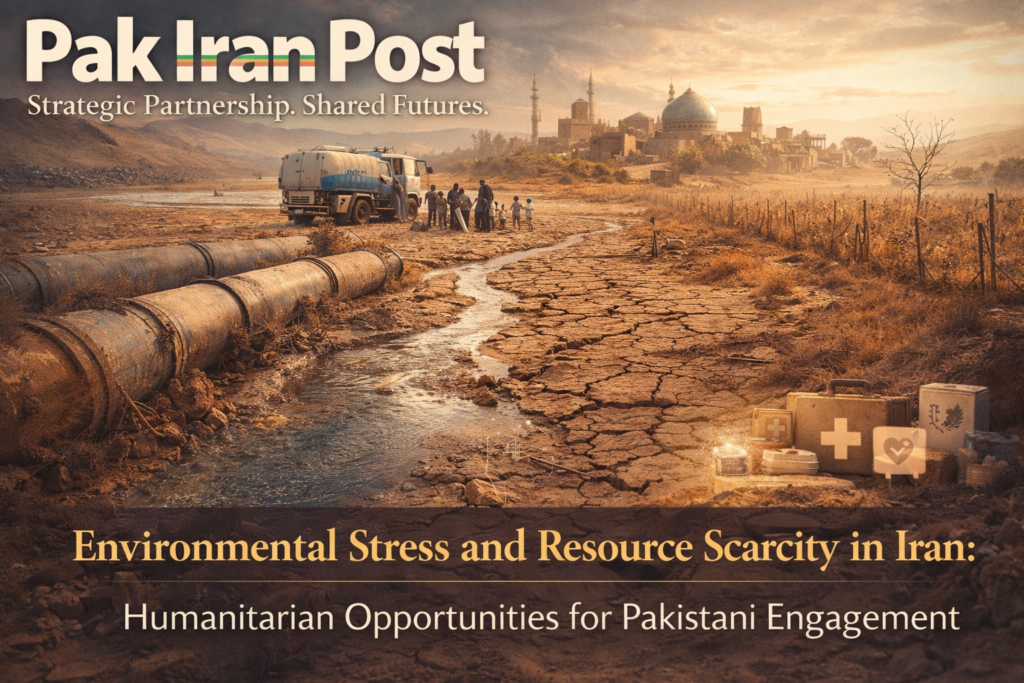
Iran is confronting one of the most severe environmental crises in the modern Middle East. Decades of overexploitation of natural resources, climate variability, water mismanagement, deforestation, soil degradation, and air pollution have created a scenario in which environmental stress directly affects livelihoods, health, and social stability. Resource scarcity, particularly concerning water, energy, and arable land, has emerged as a pressing humanitarian challenge with profound societal implications. While much attention is focused internationally on Iran’s geopolitical positioning, nuclear program, or regional strategic ambitions, the domestic environmental realities are quietly reshaping human life and community resilience. For millions of Iranians, daily existence is increasingly defined by access to clean water, reliable energy, arable land, and safe living conditions, highlighting the urgency of a coordinated humanitarian and development response.
Water scarcity represents the most immediate and visible dimension of Iran’s environmental stress. Iran is one of the most water-stressed countries in the world, with per capita renewable water availability declining sharply over the past two decades. Groundwater overextraction, inefficient irrigation practices, river damming, and climate-induced variability have created a precarious water landscape. Cities frequently experience water rationing, agricultural regions face irrigation deficits, and rural communities struggle to sustain basic needs. The consequences for households are immediate: limited drinking water, reduced agricultural productivity, increased food insecurity, and heightened migration pressures. Women and children, who often bear the burden of water collection and household management, experience the most direct impact, deepening social inequalities and heightening humanitarian vulnerability.
Agricultural stress compounds water scarcity. Iran’s agricultural sector has traditionally relied on extensive irrigation, groundwater extraction, and monoculture practices. Declining water tables, soil salinization, and desertification have reduced crop yields, undermined rural livelihoods, and contributed to rising food insecurity. Farmers face economic hardship, debt accumulation, and increasing risk of displacement. As agricultural communities struggle to sustain income, rural-to-urban migration intensifies, placing additional pressure on urban infrastructure and social services. This cycle of environmental degradation, economic stress, and population movement creates a complex humanitarian challenge that requires both domestic policy innovation and international cooperation.
Energy production and consumption are also tightly linked to environmental pressures. Iran’s energy sector, particularly fossil fuel extraction and electricity generation, places additional stress on water resources, air quality, and public health. Inefficient energy use, combined with rapid urbanization, has contributed to chronic air pollution in cities such as Tehran, Mashhad, and Isfahan. Poor air quality increases respiratory illnesses, strains healthcare systems, and diminishes quality of life for urban residents. Energy scarcity, resulting from both environmental stress and infrastructure constraints, affects industrial productivity, domestic consumption, and social well-being, compounding the humanitarian implications of environmental degradation.
Urbanization and industrial expansion intersect with environmental stress to produce social vulnerabilities. Rapid urban growth has led to inadequate sanitation, insufficient waste management, and heightened exposure to environmental hazards. Informal settlements often emerge in vulnerable areas, such as floodplains or degraded lands, exposing populations to additional risk. Industrial pollution, combined with regulatory gaps, exacerbates water, soil, and air contamination, creating public health challenges that disproportionately affect low-income communities. Environmental stress, therefore, is not only an ecological or economic issue but a humanitarian one, directly influencing the ability of individuals and communities to meet basic needs safely and sustainably.
Climate change adds a compounding layer of risk. Rising temperatures, prolonged droughts, extreme weather events, and shifting precipitation patterns threaten water availability, agricultural productivity, and ecosystem stability. Iranian communities are increasingly exposed to climate shocks, including desertification of arable land, flooding of rivers and urban areas, and heat stress on vulnerable populations. These risks are amplified by existing structural weaknesses in infrastructure, governance, and resource management, creating urgent demand for humanitarian, technical, and social support interventions.
In this context, Pakistan is uniquely positioned to engage constructively, offering humanitarian support that addresses both immediate needs and longer-term resilience. Pakistan shares historical and geographic linkages with Iran, making collaboration feasible and culturally resonant. By leveraging expertise in water management, agriculture, disaster response, and environmental health, Pakistan can provide technical assistance, knowledge transfer, and operational support to mitigate the humanitarian impact of environmental stress in Iran. Such engagement reinforces regional solidarity, contributes to stability, and addresses pressing social needs in a way that complements broader diplomatic and strategic relations.
Water management and technology transfer represent key areas for intervention. Pakistan, with experience in large-scale irrigation projects, groundwater management, and community water governance, can collaborate with Iranian counterparts to improve efficiency, conserve resources, and enhance equitable access. Initiatives could include joint technical training, development of water-saving agricultural practices, implementation of modern irrigation systems, and cross-border knowledge exchanges on sustainable water policy. Humanitarian framing of these interventions ensures that assistance is targeted toward communities most affected by scarcity, reducing social vulnerabilities and improving quality of life.
Agricultural resilience programs provide another critical avenue. Pakistan’s expertise in crop diversification, drought-resistant farming techniques, and rural development can inform Iranian initiatives aimed at sustaining food security. Collaboration could involve joint research, farmer training programs, introduction of climate-resilient crops, and community-based agricultural extension services. These efforts address immediate humanitarian needs while building long-term capacity for self-sufficiency, mitigating displacement pressures, and promoting rural livelihoods.
Health and environmental protection initiatives are equally vital. Pakistan can support programs to address air and water quality, sanitation, and public health risks associated with environmental degradation. Partnerships could include technical assistance for pollution monitoring, training of public health personnel, and development of early-warning systems for environmental hazards. Psychosocial support programs could also be incorporated, recognizing the mental and social stress associated with prolonged environmental scarcity. By framing these interventions as humanitarian assistance, Pakistan can provide tangible benefits to vulnerable populations while strengthening trust and collaboration across borders.
Renewable energy and sustainable infrastructure projects offer further opportunities for engagement. Pakistan can provide technical guidance, joint research, and training in solar, wind, and small-scale hydropower technologies to reduce environmental pressure, increase energy security, and support community resilience. Infrastructure planning, urban sanitation, and waste management programs can be adapted and scaled in collaboration with Iranian municipalities, targeting the most vulnerable urban populations. These interventions have dual benefits: improving immediate living conditions while addressing structural challenges that exacerbate environmental risk.
Digital technology and knowledge-sharing platforms can amplify impact. Pakistan can support the development of online portals, training modules, and data-sharing mechanisms to facilitate collaboration on environmental monitoring, disaster preparedness, and resource management. Digital tools enable community engagement, rapid response, and participatory problem-solving, enhancing resilience in areas affected by scarcity. They also provide youth and civil society actors with access to expertise, networks, and decision-making platforms that empower local solutions and promote sustainable practices.
Humanitarian engagement must be guided by evidence-based policy frameworks. Pakistan can establish dedicated task forces or cross-border collaboration units focused on environmental and social resilience initiatives. These bodies would coordinate technical assistance, manage resource allocation, monitor impact, and ensure culturally appropriate interventions. Integration with NGOs, civil society, and international agencies enhances legitimacy, reach, and sustainability. Policy design should prioritize transparency, inclusivity, and adaptability, ensuring that assistance remains responsive to evolving environmental and social conditions.
Financial and operational support is essential for implementation. Funding for water, agricultural, health, and energy initiatives can be mobilized through government allocations, private sector partnerships, and regional development programs. Efficient resource management ensures that humanitarian assistance reaches communities most in need, reduces duplication, and maximizes impact. Cross-border funding frameworks can facilitate accountability, transparency, and long-term sustainability, reinforcing the credibility and effectiveness of Pakistani engagement.
Research and knowledge generation underpin successful humanitarian interventions. Joint studies, impact assessments, and community mapping initiatives provide the evidence base necessary to design targeted programs. Collaboration on climate monitoring, water management, and social vulnerability mapping informs decision-making and enhances resilience planning. Knowledge-sharing initiatives empower Iranian communities, strengthen local capacity, and create a foundation for sustained cooperation between Pakistan and Iran in addressing environmental challenges.
Youth engagement is critical in environmental and humanitarian initiatives. Iranian youth are both disproportionately affected by environmental stress and key agents of change. Pakistan can facilitate youth training programs, mentorship initiatives, and participatory projects that involve young people in water management, sustainable agriculture, energy conservation, and community resilience planning. Empowering youth ensures intergenerational sustainability, promotes social cohesion, and creates networks of expertise that support long-term adaptation to environmental pressures.
Humanitarian engagement in environmental issues has broader implications for regional stability. By addressing resource scarcity, improving community resilience, and supporting social adaptation, Pakistan contributes to mitigating migration pressures, reducing conflict risk, and enhancing cross-border cooperation. These initiatives reinforce regional security indirectly by strengthening social stability and economic opportunity, demonstrating that humanitarian support is a strategic investment in both human welfare and regional resilience.
In conclusion, Iran’s environmental and resource challenges represent an urgent humanitarian concern with direct implications for social stability, health, and economic security. Water scarcity, agricultural stress, energy pressures, and urban environmental degradation create cascading effects on daily life, particularly for vulnerable populations. Pakistan, leveraging historical, cultural, and geographic linkages, is uniquely positioned to provide humanitarian assistance that addresses these challenges while promoting knowledge transfer, technical capacity, and community resilience.
Through initiatives focused on water management, agricultural support, health and environmental protection, renewable energy, youth engagement, and digital knowledge sharing, Pakistan can deliver tangible humanitarian benefits to Iranian communities. Policy frameworks must be evidence-based, culturally sensitive, and designed for sustainability, ensuring that assistance is effective, accountable, and adaptable. Financial mobilization, operational coordination, and research-driven planning enhance the impact of interventions, creating long-term solutions that strengthen both Iranian resilience and regional cooperation.
By prioritizing environmental humanitarian engagement, Pakistan positions itself as a constructive partner in addressing shared social vulnerabilities, building trust, and fostering intergenerational resilience. These efforts transform humanitarian assistance into a strategic regional pivot, demonstrating that Pakistan can lead in facilitating sustainable human development, social stability, and cooperative problem-solving in the face of complex environmental and resource challenges.
A Public Service Message