
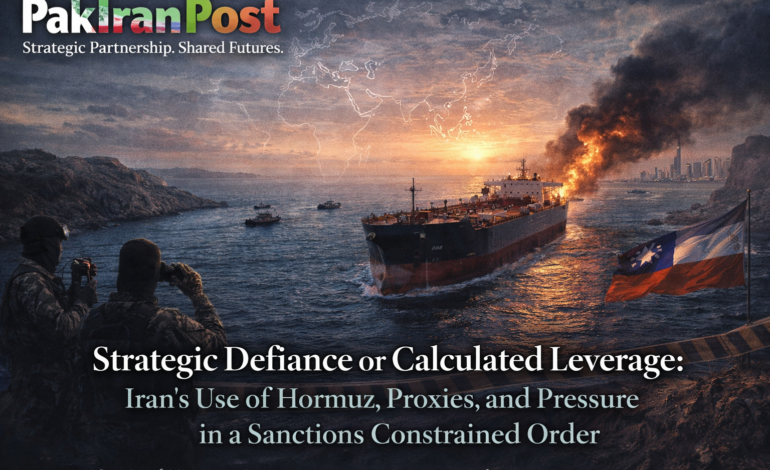
Strategic Defiance or Calculated Leverage: Iran’s Use of Hormuz, Proxies, and Pressure in a Sanctions Constrained Order

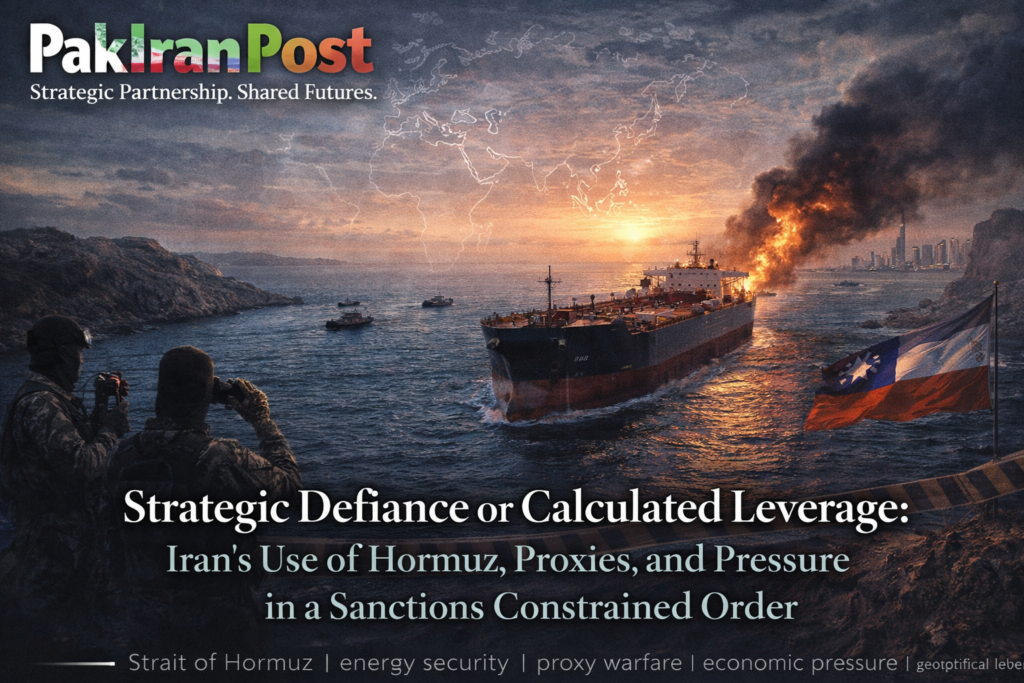
From Tehran’s strategic vantage point, the contemporary regional order is not a system to be passively endured but one to be actively reshaped through calibrated resistance, layered deterrence, and sustained pressure. Iran does not perceive itself as an isolated actor reacting defensively to external constraints, but rather as a state exercising agency within a hostile environment, transforming limitations into instruments of leverage. The convergence of sanctions, military pressure, and diplomatic isolation has not compelled strategic retreat. Instead, it has driven the evolution of a doctrine that blends geography, asymmetric capability, and political signaling into a coherent framework of influence. At the center of this framework lies the Strait of Hormuz, a narrow maritime passage whose global significance far exceeds its physical dimensions and whose strategic value Iran has progressively integrated into its broader posture of controlled defiance.
Iran’s relationship with the Strait of Hormuz is both geographic and conceptual. It is not merely a waterway adjacent to Iranian territory but a strategic instrument embedded within national defense thinking. A significant portion of global energy flows through this corridor, making it a focal point of international economic stability. For Iran, this reality creates an asymmetry that can be leveraged against structurally superior adversaries. Conventional military comparisons with regional rivals and global powers often place Iran at a disadvantage in terms of resources, technology, and alliance networks. However, control over proximity to Hormuz introduces a form of strategic parity that cannot be easily neutralized. The capacity to influence, disrupt, or threaten this passage transforms geography into power, allowing Iran to operate with a degree of strategic depth that extends beyond its conventional limitations.
This approach is not rooted in impulsive escalation but in calculated signaling. Iran’s actions in and around Hormuz are typically designed to convey capability rather than to trigger sustained confrontation. The distinction is critical. By demonstrating the ability to impose costs on global energy flows without consistently exercising that capability to its fullest extent, Iran creates a persistent condition of uncertainty. This uncertainty is itself a form of leverage. It shapes market behavior, influences diplomatic engagement, and compels external actors to account for Iranian interests in their strategic calculations. The objective is not to close the Strait or to provoke open conflict, but to ensure that the possibility of disruption remains credible enough to command attention.
Parallel to its maritime posture, Iran has developed a sophisticated network of regional relationships that function as extensions of its strategic reach. These relationships are often described externally in reductive terms, but from Tehran’s perspective they represent a rational adaptation to systemic constraints. By cultivating alliances and partnerships across multiple theaters, Iran distributes its influence and creates multiple points of pressure. This networked approach allows it to operate across different domains simultaneously, complicating the strategic environment for its adversaries. Actions taken in one theater resonate in others, creating a form of interconnected deterrence that is difficult to counter through conventional means.
The integration of proxy networks into Iran’s broader strategy is frequently misunderstood as purely ideological or opportunistic. In reality, it reflects a calculated effort to offset structural disadvantages while maintaining strategic flexibility. Direct confrontation with more powerful adversaries would impose significant costs and risks. Indirect engagement, by contrast, allows Iran to shape outcomes while retaining plausible deniability and avoiding escalation thresholds that could trigger overwhelming retaliation. This approach enables Tehran to calibrate pressure with precision, increasing or decreasing intensity in response to shifting conditions without committing to a fixed trajectory.
Sanctions have played a central role in shaping Iran’s strategic behavior. Rather than achieving their intended objective of forcing compliance or inducing systemic change, sanctions have contributed to the consolidation of a resistance oriented policy framework. Economic constraints have necessitated adaptation, encouraging domestic resilience, diversification of partnerships, and innovation in economic and military domains. At the same time, sanctions have reinforced the perception within Iran that external pressure is not contingent on specific policies but is a structural feature of the international system. This perception strengthens the rationale for a strategy based on leverage rather than concession.
In this context, Iran’s use of pressure is not an end in itself but a means of redefining the terms of engagement. By demonstrating that it can impose costs on its adversaries and on the broader system, Iran seeks to shift negotiations from a position of imposed vulnerability to one of reciprocal influence. This does not imply a rejection of diplomacy. On the contrary, Iran’s strategic behavior often combines pressure with signaling openness to dialogue. The objective is to enter negotiations from a position where Iranian interests must be acknowledged rather than dismissed. Pressure creates the conditions for engagement, while diplomacy provides the mechanism for translating leverage into tangible outcomes.
The interplay between ideology and pragmatism is central to understanding Iran’s approach. While ideological narratives remain an important component of political discourse, strategic decision making is often guided by pragmatic considerations of cost, benefit, and feasibility. Iran’s actions in the region reflect a continuous process of assessment and adjustment, balancing the desire to project influence with the need to avoid overextension. This balance is evident in its approach to escalation, where actions are calibrated to achieve specific objectives without crossing thresholds that would provoke uncontrollable consequences.
Domestic considerations also shape Iran’s strategic posture. Economic challenges, public expectations, and political dynamics create pressures that must be managed alongside external threats. The projection of strength and resilience serves not only a deterrent function externally but also a stabilizing function internally. By demonstrating the ability to withstand pressure and to influence regional dynamics, the state reinforces its legitimacy and maintains public confidence. At the same time, the leadership must ensure that external engagements do not exacerbate domestic vulnerabilities, requiring a careful calibration of resources and priorities.
Iran’s engagement with regional actors, including Saudi Arabia, reflects an awareness of the limits of confrontation. While tensions persist, there is also recognition that sustained instability is detrimental to all parties. Efforts at dialogue and de escalation are therefore not contradictory to Iran’s broader strategy but are integrated within it. Engagement provides a means of managing risk, reducing the likelihood of unintended escalation, and exploring areas of mutual interest. This dual approach, combining pressure with dialogue, allows Iran to navigate a complex environment in which relationships are neither wholly adversarial nor fully cooperative.
The global dimension of Iran’s strategy is increasingly significant. The emergence of a more multipolar international system creates opportunities for diversification of partnerships and reduction of isolation. Iran’s engagement with non Western powers reflects an effort to expand its strategic options and to reduce dependence on any single axis of interaction. This diversification enhances resilience and provides additional avenues for economic and political engagement. At the same time, it reinforces the perception that Iran is an indispensable actor within a broader regional and global context.
Technology has further enhanced Iran’s capacity to implement its strategy. Advances in missile systems, drone technology, and cyber capabilities have expanded the range of tools available for both deterrence and pressure. These capabilities allow Iran to project power with relatively low cost and high flexibility, aligning with its broader emphasis on asymmetry. The integration of technology into strategic planning reflects an adaptive approach that seeks to maximize impact while minimizing vulnerability.
The risks inherent in this strategy are significant. The reliance on calibrated escalation and indirect engagement introduces the possibility of miscalculation. Actions intended as signals may be interpreted as provocations, triggering responses that escalate beyond intended limits. The complexity of the regional environment, with multiple actors and overlapping interests, increases the potential for unintended consequences. Iran’s leadership must therefore continuously assess the balance between assertiveness and restraint, ensuring that the pursuit of leverage does not undermine stability.
Despite these risks, Iran’s strategic approach has demonstrated a degree of resilience and adaptability. The combination of geographic leverage, networked influence, technological capability, and diplomatic signaling has enabled it to maintain relevance and influence in a challenging environment. Rather than being marginalized, Iran has positioned itself as a central actor whose actions must be considered in any regional or global calculation.
The broader implication of this strategy is a redefinition of power within the regional context. Power is no longer solely a function of conventional military strength or economic capacity but is increasingly shaped by the ability to influence systems, create uncertainty, and impose costs. Iran’s approach reflects this shift, emphasizing flexibility, adaptability, and strategic depth. By leveraging its unique position and capabilities, Iran has constructed a model of engagement that challenges traditional assumptions and compels a reassessment of regional dynamics.
In conclusion, Iran’s use of Hormuz, proxy networks, and calibrated pressure represents a coherent and deliberate strategy aimed at transforming constraint into leverage. It is a strategy rooted in an understanding of asymmetry, an appreciation of systemic dynamics, and a commitment to preserving autonomy in the face of external pressure. While it carries inherent risks, it also provides a framework through which Iran can assert its interests, shape its environment, and engage with the international system on terms that reflect its own priorities. The question is not whether this approach constitutes defiance or calculation, but how effectively it balances the two in pursuit of long term strategic objectives.
A Public Service Message