
Artificial Intelligence and Digital Skill Acceleration: Pakistan and Iran’s Opportunity to Build a Competitive Regional Tech Ecosystem

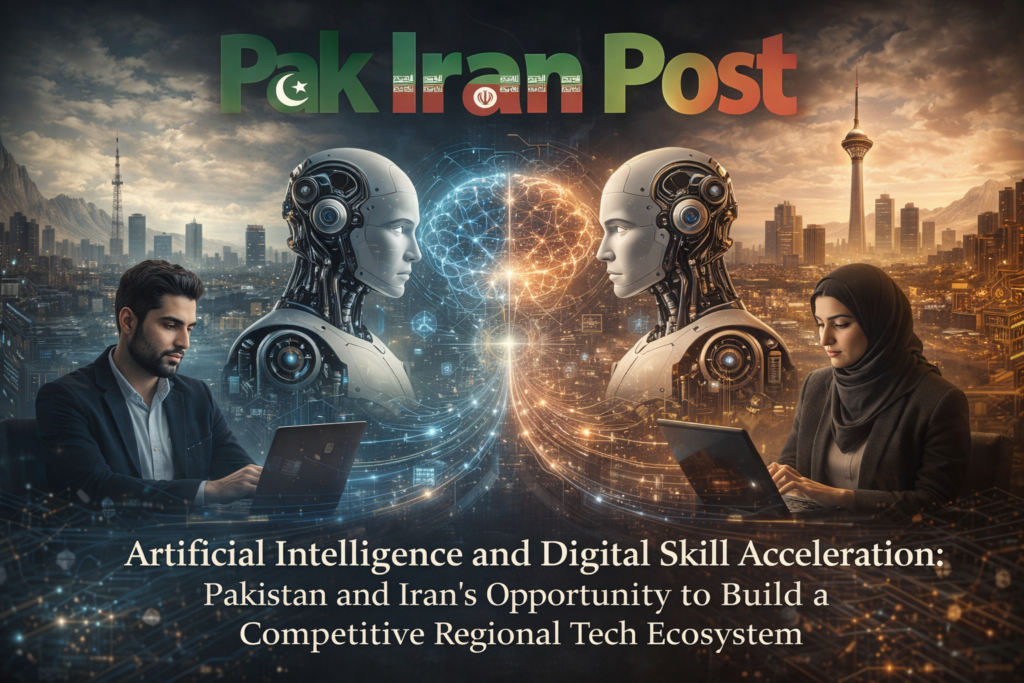
Artificial intelligence (AI) stands at the forefront of technological transformation in the twenty‑first century, redefining the nature of work, economic competitiveness, national security, and social development. Nations around the world are racing not only to adopt AI tools but also to cultivate the human capital needed to innovate, regulate, and ethically deploy these technologies. Recent developments in Iran show an ambitious ambition to teach AI to millions of learners a recognition that AI literacy is quickly becoming crucial for national competitiveness, social mobility, and economic resilience. At the same time, Pakistan has launched comprehensive digital inclusion and youth‑driven innovation strategies aimed at preparing its population for an AI‑enabled future. These parallel trajectories present an opportunity for Islamabad and Tehran to build collaborative frameworks that accelerate AI education, deepen skill acquisition, and empower youth in both countries to compete on a global digital stage.
Iran’s national strategy to expand AI knowledge is rooted in the recognition that rapid technological changes, economic constraints, and restrictive external pressures make domestic capacity building imperative. Initiatives to provide AI instruction to millions of students signal a shift toward democratizing access to digital tools and preparing a generation for future labor market demands. Iran’s young population is technically aware, digitally connected, and highly motivated to engage with new technologies. However, access alone does not guarantee proficiency or innovation. Structural barriers such as limited access to global platforms, insufficient research funding, and restrictions on cross‑border collaboration impede the development of a robust innovation ecosystem. This is where strategic partnership with Pakistan can be beneficial, both for humanitarian objectives and for building a mutually supportive regional technology corridor.
Pakistan’s own digital transformation journey provides a foundation for meaningful engagement. Islamabad has prioritized digital literacy, tech education, mobile internet penetration, and innovation ecosystems driven by youth participation. The emergence of technology incubators, digital skills programs, and public‑private collaborations in major Pakistani cities points to an ecosystem ready to share best practices, develop joint curricula, and co‑invest in AI education frameworks. Pakistan’s demographic dividend—a large, youthful population eager for opportunity can align with Iran’s goals to create a new generation of digitally empowered professionals. Strategic cooperation in AI education, skills training, and applied research can strengthen both countries’ competitiveness while fostering regional cohesion and technological independence.
Understanding the scope and scale of AI skill needs is essential. AI encompasses machine learning, natural language processing, computer vision, robotics, data analytics, and automation. Mastery of these domains requires a combination of foundational knowledge in mathematics, programming, and statistics, along with access to computing resources, mentorship networks, and real‑world project experience. For most young learners in both Iran and Pakistan, access to quality resources is uneven. Urban centers have pockets of excellence, while rural and peripheral regions lag behind. A collaborative effort that pools educational resources, leverages digital platforms, and standardizes skill frameworks can close these gaps more effectively than siloed national initiatives.
The joint development of AI curricula tailored to regional needs is a foundational step. Pakistan and Iran can co‑design education modules that start at basic digital literacy and progress through advanced AI concepts. These curricula should align with global standards while contextualizing content for local languages, use cases, and community needs. Modular design allows learners to enter at various skill levels and supports lifelong learning pathways. Partnerships with tech companies, universities, and international organizations can ensure that the content remains relevant, adaptive, and aligned with industry trends.
Scholarships and exchange programs focused on AI education provide another layer of impact. Pakistan can offer scholarships to Iranian students for AI and computer science degrees, short‑term intensive courses, and research fellowships. Conversely, Iranian institutions can host Pakistani learners in domains where they have deep expertise. These opportunities expand access, encourage cross‑border intellectual exchange, and build personal networks that endure well beyond individual programs. Scholarships should prioritize gender inclusion, economically disadvantaged students, and those from underrepresented regions to ensure that the benefits of AI education reach broad segments of the population.
Joint AI research incubators represent a powerful mechanism for collaboration. These incubators would provide shared labs, computing resources, mentorship, and funding opportunities for student‑led projects and early‑stage startups. By pooling talent and resources, Pakistan and Iran can create innovation hubs that address regional challenges—such as healthcare diagnostics, agricultural optimization, disaster response systems, and educational technology platforms—through AI‑driven solutions. These hubs can also act as bridges to global networks, enabling participation in international competitions, joint patents, and co‑authored publications that elevate the regional tech ecosystem’s visibility.
Skills development cannot be limited to formal education alone; hands‑on training programs like internships and apprenticeships are essential. Pakistan can broker partnerships between Iranian youth and tech companies, including startups and multinational firms operating regionally. Conversely, Iranian industry players can facilitate placements for Pakistani youth. These experiences give learners a chance to apply theoretical knowledge to real products, gain exposure to professional environments, and build portfolios that make them competitive in the global digital labor market.
Another critical avenue is the establishment of AI mentorship networks. Mentorship programs connect learners with experienced professionals who can guide career pathways, assist with portfolio development, and provide exposure to industry expectations. Mentors from Pakistan’s tech sector, academia, and research institutions can support Iranian participants, while Iranian experts can offer reciprocal guidance in areas of shared interest. Online mentorship platforms that facilitate one‑to‑one interaction, peer forums, and project collaboration can expand this support beyond geographic constraints.
Regional hackathons, tech challenges, and innovation competitions are complementary mechanisms that energize youth engagement. These events invite participants to solve real‑world problems using AI, encouraging creativity, teamwork, and practical application of skills. Pakistan and Iran can co‑host regional hackathons that span multiple cities or virtual platforms, focusing on thematic areas such as climate adaptation, health analytics, smart mobility, and inclusive education. These competitions generate prototypes that can mature into viable solutions, stimulate interest in technology careers, and build community among participating youth.
Digital infrastructure support enhances access and continuity. Expanding high‑quality broadband, cloud computing resources, and AI development platforms ensures that learners are not constrained by technical barriers. Pakistan and Iran can explore shared cloud resources, subsidized computing access for students, and partnerships with global cloud providers to provide scalable development environments. These measures ensure that education and training programs are not limited by local infrastructure deficiencies, particularly in rural and underserved regions.
Standardization of certification frameworks is another important policy step. Recognized certifications in AI, data science, and related fields allow learners to signal competence to employers and educational institutions. Pakistan and Iran can negotiate mutual recognition of certifications, develop joint accreditation standards, and align programs with international benchmarks such as those offered by global technology consortia. Standardization enhances portability of skills, facilitates labor mobility, and ensures that learners from both countries are globally competitive.
AI ethics, governance, and responsible innovation must be priorities in any educational collaboration. As youth acquire technical skills, they must also understand ethical considerations related to AI deployment, including privacy, bias mitigation, and transparency. Pakistan and Iran can co‑develop modules on AI ethics, host joint forums on digital rights, and build shared frameworks for responsible innovation. These components ensure that technological progress is matched with social responsibility, preparing learners to be not only innovators but conscientious stewards of emerging technologies.
Public‑private partnerships (PPPs) are essential for operational scale and sustainability. Tech companies, philanthropy, and non‑profit organizations can co‑invest in education infrastructure, scholarship programs, research funds, and mentorship networks. Pakistan’s burgeoning tech startups and Iranian tech communities can pool resources and expertise, creating PPP models that align commercial incentives with social impact. Incentives such as tax breaks, innovation grants, and shared intellectual property arrangements can make such partnerships attractive and scalable.
Digital transformation must be inclusive, and gender equity is critical. Women’s participation in STEM fields remains uneven in both countries. Programs that specifically support women’s training in AI and technology such as women‑only cohorts, mentorship pairings, and targeted scholarships will expand the talent pipeline and ensure that digital transformation benefits all. Pakistan and Iran can share best practices, co‑design inclusive outreach programs, and measure progress through gender participation metrics.
AI education collaboration also has implications for labor mobility and economic integration. By aligning curricula, certifications, and training outcomes, Pakistan and Iran can create a regional talent pool that is attractive to global employers. Economic partnerships in technology sectors can expand job markets, attract investment, and reduce youth unemployment. A shared focus on skills acceleration creates a competitive ecosystem that leverages the strengths of both countries’ youth populations.
Monitoring, evaluation, and impact assessment are key to ensuring that initiatives deliver measurable results. Pakistan can develop joint data systems with Iran to track participation, skill acquisition, employment outcomes, entrepreneurial ventures, and cross‑border collaboration patterns. Evidence‑based evaluation allows policymakers to refine programs, prioritize high‑impact interventions, and allocate resources efficiently. Longitudinal studies can reveal how AI education impacts career trajectories, economic resilience, and social mobility among youth.
Cybersecurity and data privacy considerations are integral to AI and digital skill programs. Collaborative efforts should include training on secure coding practices, cyber defense strategies, and responsible data governance. Pakistan and Iran can co‑develop cybersecurity curricula, host workshops on data protection, and create incident response networks that safeguard digital ecosystems. These measures build confidence in digital platforms, protect users, and ensure that technology adoption does not introduce new vulnerabilities.
Legal and regulatory alignment is essential. Pakistan and Iran can negotiate bilateral agreements that facilitate cross‑border recognition of qualifications, labor mobility for tech professionals, joint intellectual property arrangements for collaborative innovation, and shared standards for data protection. Harmonizing regulatory frameworks reduces friction, enhances cooperation, and unlocks broader economic opportunities in the technology sector.
International partnerships can amplify impact. Collaboration with global technology companies, multilateral organizations, and academic consortia introduces best practices, additional resources, and access to wider networks. Pakistan and Iran can leverage these partnerships to expand the reach of their AI education programs, participate in international conferences, and integrate into global research initiatives. International engagement also enhances credibility and positions the region as an emerging hub for AI talent and innovation.
Policy recommendations for Pakistan include the establishment of a joint AI and digital skills task force with Iran, co‑development of modular AI curricula, expansion of scholarships and exchange programs, creation of regional hackathons and innovation challenges, investment in shared digital infrastructure, gender‑inclusive training initiatives, standardized certifications, public‑private partnership frameworks, cybersecurity collaboration, and evidence‑based monitoring systems. These measures provide a comprehensive roadmap for transforming the region into a competitive AI talent corridor.
The long‑term benefits of this cooperative approach are multi‑faceted. Youth in both countries gain access to market‑relevant skills, economic opportunity, and professional networks. Pakistan enhances its soft power and regional influence by serving as a knowledge partner. Iran benefits from expanded educational access and collaboration that bypasses restrictive external pressures. Together, a Pakistan‑Iran AI training ecosystem contributes to regional stability, economic resilience, and global competitiveness.
In conclusion, artificial intelligence and digital skill acceleration represent a strategic frontier for cooperation between Pakistan and Iran. By aligning education systems, pooling resources, and co‑developing programs that meet global standards, both nations can empower their youth to thrive in the digital age. This collaboration not only addresses immediate skill gaps but builds a foundation for long‑term technological independence, economic growth, and regional integration. Strategic investment in AI education and digital transformation positions Pakistan and Iran to compete on the global stage, create resilient innovation ecosystems, and unlock the vast potential of their most valuable asset their young people.
A Public Service Message