
Pakistan’s Transit Bet Under the Shadow of Sanctions


There are moments in regional commerce when geography stops being a static fact and becomes a strategic instrument. Pakistan may be entering one of those moments. What looks, at first glance, like a technical adjustment in transit policy, the notification of six overland corridors for Iran-bound cargo under the Transit of Goods through Territory of Pakistan Order 2026, may in fact be the early outline of a larger commercial role. In April Islamabad formally opened a legal pathway for third-country goods to move across Pakistani territory into Iran, using Gwadar, Karachi, Port Qasim, Gabd and Taftan as the relevant commercial and border nodes, and requiring bank guarantees under customs supervision. The move came as containers for Iran piled up at Pakistani ports and maritime trade across the Gulf was distorted by war, sanctions uncertainty and disruption in the Strait of Hormuz. Yet the most consequential question is not whether Pakistan has created routes on paper. It is whether the state now understands what it may have volunteered to become.
The obvious reading is that Pakistan has acted pragmatically. Iran, under sanctions pressure and exposed to maritime instability, needed overland alternatives. Pakistani ports had stranded cargo. Border corridors existed in skeletal form. Officials responded by regularising a transit option that had previously been underdeveloped or administratively uncertain. But the harder reading, and the one policymaker in Islamabad should now take seriously, is that Pakistan is drifting into the role of a logistical shock absorber for a sanctioned neighbour at precisely the moment when commercial geography in West Asia is being rewritten by coercive finance, wartime rerouting and selective maritime access. That role can be monetised. It can also be dangerous.
The temptation in Islamabad will be to narrate the episode as a modest trade facilitation measure. That would be a mistake. Transit regimes are not neutral plumbing in a sanction’s theatre. They are part of the sanction’s theatre. Once a state becomes an operational interface for cargo moving into or out of a heavily sanctioned economy, the questions cease to be only about road transport and customs documentation. They become questions about beneficial ownership screening, end-user verification, bank guarantees, insurance coverage, container integrity, route security, port liability, fuel settlement, correspondent banking exposure, and the possibility that a neighbour’s sanctions risk can migrate, transaction by transaction, into one’s own financial system and diplomatic posture.
Pakistan’s recent move did not occur in a vacuum. In late April the government notified six transit routes for Iran-bound cargo, including the Gwadar-Gabd corridor and multiple Karachi, Port Qasim and Gwadar connections to Gabd and Taftan, under an SRO that brought the 2026 transit order into force. The mechanism permits movement of third-country goods to Iran against encashable bank guarantees under the Customs Act and Federal Board of Revenue procedures. The policy was introduced after containers bound for Iran had piled up at Pakistani ports amid regional disruption. Yet within weeks it was reported that parts of the framework remained non-operational despite the formal notification, exposing a familiar Pakistani pattern in which strategic announcements outrun administrative readiness.
That implementation lag matters because the value of a transit regime in a sanction’s environment lies less in its declaration than in its controls. A route without a compliance architecture is not a trade corridor. It is a liability corridor. In ordinary trade, weak administration is inefficient. In Iran-related trade, weak administration can become sanctionable ambiguity.
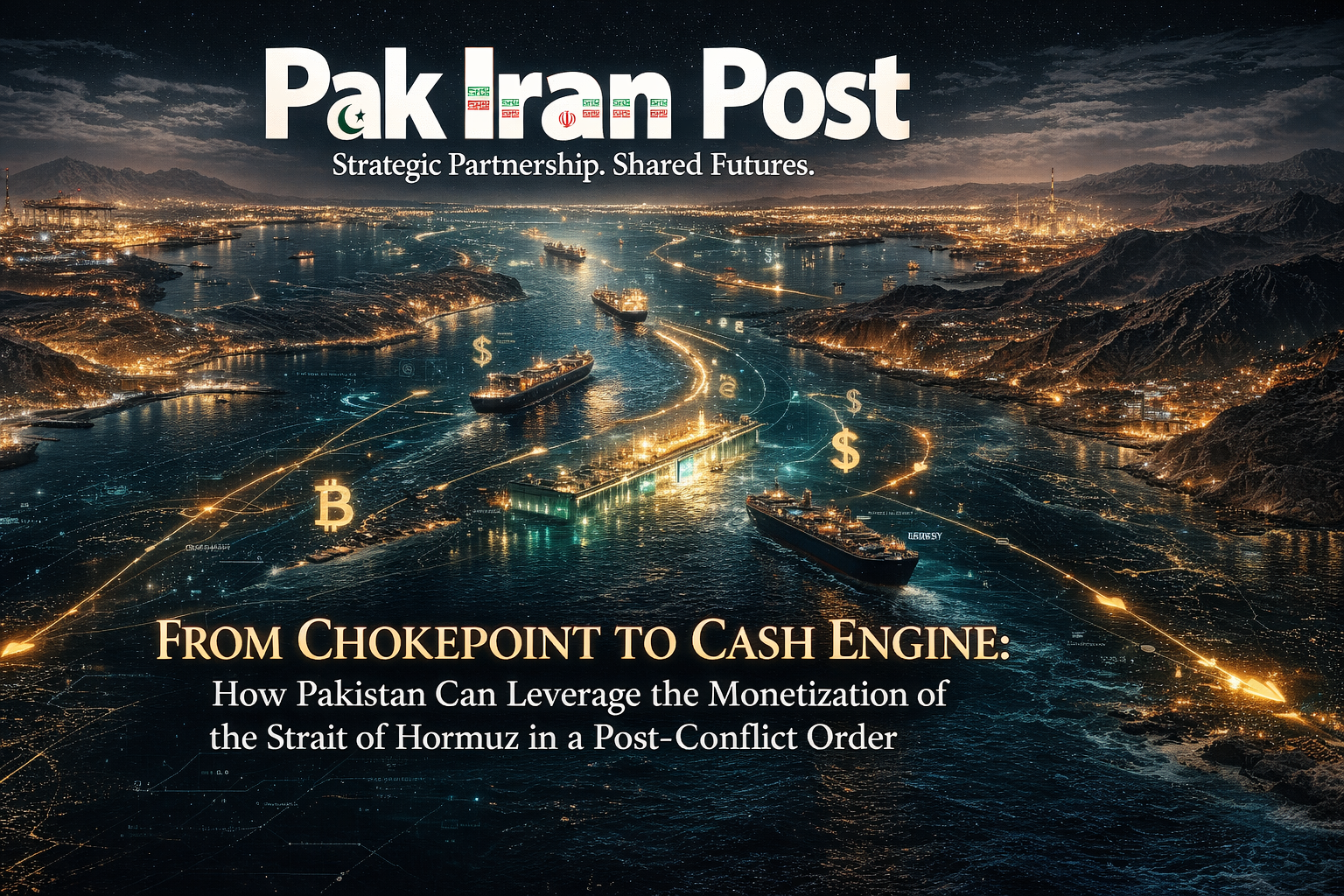
The broader regional context has made Pakistan’s role more visible. The war-related disruption in and around the Strait of Hormuz has exposed the fragility of maritime dependence. During the recent crisis, traffic through Hormuz slowed sharply, ships were stranded, insurers repriced risk, and shipping shifted under emergency arrangements rather than normal commercial logic. Even after the latest ceasefire framework, Reuters reported that movement through Hormuz remained far below pre-conflict levels, with supervised evacuation routes, mine risks, high tanker rates and a backlog of vessels still trapped by insecurity and uncertainty. For Iran, this matters because sanctions already constrain normal access to finance, shipping and insurance. Maritime disruption adds a second layer of pressure by degrading the reliability of the sea routes through which Iran’s licit, semi-licit and illicit trade ordinarily interacts with the world. For Pakistan, it creates a commercial opening, but only if the state can distinguish between serving as a lawful transit jurisdiction and sliding into the murkier role of grey-zone brokerage.
That distinction is not academic. American sanctions policy toward Iran has evolved into a dense ecosystem of primary sanctions, secondary sanctions, sectoral restrictions, vessel designations, shipping advisories and financial prohibitions. The current environment is not one in which a neighbouring state can simply move cargo and assume that legal responsibility ends at the border. OFAC’s Iran sanctions architecture is explicit that shipping, trade finance, insurance, dealings with blocked persons and certain transactions benefiting designated sectors or entities can create exposure for non-U.S. actors as well, particularly where petroleum, sanctioned shipping networks or sanctioned financial institutions are implicated. Recent U.S. measures have continued to target vessels, trading companies and networks involved in Iranian oil commerce, while official guidance has warned maritime stakeholders about sanctions-evasion practices and the risks of payments or services that benefit sanctioned Iranian actors.
This is where Pakistan’s policy debate has so far been too shallow. The real issue is not whether transit trade with Iran is politically desirable. It is whether Pakistan possesses the state capacity to intermediate trade with Iran without contaminating its own banking, insurance and customs ecosystem. A transit state in a sanction’s theatre must know far more than the origin and destination of a consignment. It must know the beneficial owner of the cargo, the vessel or shipping line from which it was unloaded, the financing bank, the freight forwarder, the insurer, the consignee in Iran, the route by which payment or guarantee will be settled, the nature of the goods, the likelihood of diversion, and whether any actor in the chain is designated, controlled by a designated person, or engaged in a sector of the Iranian economy subject to active enforcement.
Pakistan’s current border and customs machinery is not built for that level of precision. It is built, unevenly, for revenue collection, anti-smuggling enforcement and conventional trade facilitation. Those are not trivial functions, but they are not enough. The state is now flirting with a role that requires a sanctions-screening bureaucracy. It requires customs officers trained not only to inspect cargo but to understand high-risk transshipment patterns, falsified bills of lading, ship-to-truck transfer risk, dual-use goods exposure, and the use of front companies in third jurisdictions. It requires a digital record of custody from port to border. It requires inter-agency fusion between the Ministry of Commerce, the Federal Board of Revenue, the State Bank of Pakistan, the ministries of petroleum, foreign affairs and interior, the port authorities, the intelligence apparatus and, crucially, the private banks that will be asked to issue guarantees or touch the related transactions.
None of that can be improvised through an SRO.
Yet there is a reason Islamabad moved. Pakistan can see, correctly, that regional commercial geography is being reordered. The old assumption that maritime routes are always cheaper, safer and politically simpler than land corridors has been punctured by conflict. Gulf insecurity, Houthi attacks in the Red Sea, war-risk insurance spikes and selective access to Hormuz have all increased the strategic premium on redundancy. A state that can offer redundancy acquires leverage. That is what Pakistan is trying to test. If Karachi, Port Qasim and Gwadar can serve as western-facing gateways not only for Pakistan’s own trade but for Iranian-bound cargo, Central Asian access and eventually even westbound Chinese or Russian commercial flows, then Pakistan is no longer merely a coastal economy on the edge of South Asia. It becomes a switchyard between theatres.
That possibility should not be dismissed. Pakistan’s geography is real, and geography is having a renaissance. Gwadar’s utility has often been overstated in political speeches and understated in strategic analysis. The truth lies in between. Gwadar is not, at present, a fully mature rival to the Gulf’s established port ecosystems. But in a crisis, mature ecosystems can be degraded by risk, while second-order ports become valuable precisely because they are underused and available. A Gwadar-Gabd corridor into Iran is not a substitute for Hormuz. Trucks do not replace tankers. But commercial systems do not require perfect substitution to alter behaviour. They require enough alternative capacity to move priority cargo, reduce bottlenecks, create bargaining leverage and signal that sanctions or blockades will not operate in the clean, totalising way their architects may imagine.
This is why the more interesting concept is not sanctions evasion but sanctions adaptation. Sanctions are often analysed as bilateral coercion between the sender and the target. In practice they restructure the behaviour of neighbouring states, ports, truckers, banks, insurers and customs agencies. They create a new class of intermediary jurisdictions whose value lies in managing legal ambiguity. These states are not formal sanctions breakers. Nor are they neutral spectators. They are service providers to disruption. They sell proximity, optionality and bureaucratic flexibility. Sometimes they profit handsomely. Sometimes they inherit risks they do not understand.
Pakistan now sits on the threshold of that category. It has not crossed fully into it, but the threshold itself is strategically important. The question is whether Islamabad wants to remain an improvising border state or become a credible transit jurisdiction with rules, filters and bargaining power.
To answer that, one must be clear-eyed about the incentives. There are at least four reasons Pakistan may be tempted to deepen the role. First, transit revenue. A country with chronic external financing stress, thin export growth and under-monetised geography will be drawn to any opportunity that promises fees, port throughput, trucking income, warehousing demand and fuel sales. Second, leverage with Iran. A structured transit regime gives Pakistan something more useful than rhetorical goodwill. It gives it operational relevance. Third, leverage with Central Asia and western China. A functioning westbound corridor through Iran, if properly managed, could complement Pakistan’s northbound and eastbound connectivity ambitions rather than compete with them. Fourth, bargaining power with Gulf partners and Western interlocutors. A state that becomes necessary to regional commercial continuity can, if it is disciplined, turn relevance into diplomatic room.
But each of those gains has a mirror-image risk. Transit revenue can be offset by sanctions exposure. Leverage with Iran can become suspicion in Washington or among Gulf capitals if Pakistan appears to be offering a quiet sanctions relief valve. Central Asian or Chinese linkages can remain notional if the border ecosystem is insecure and slow. Diplomatic room can collapse into diplomatic scrutiny if the perception hardens that Pakistan is a permissive channel for Iranian trade under pressure.
That last point is not hypothetical. In sanctions environments, perception matters almost as much as legal form. International banks, insurers and shipping firms do not need a court judgment to become cautious. They need uncertainty. If Pakistan becomes associated with poorly supervised Iran-bound transit, even where much of the cargo is licit, banks may price the risk more conservatively, compliance teams may delay payments, insurers may seek higher premiums, and multinational firms may avoid the corridor altogether. In that case Islamabad will have built a politically sensitive transit regime that only the most risk-tolerant actors use. That is the opposite of leverage. It is the creation of a low-quality market.
A credible regime therefore begins with selectivity. Pakistan should not attempt to monetise every conceivable Iran-related cargo flow. It should define a narrow, defensible universe of transit first, and expand only after the compliance architecture is proven. That universe should begin with non-sanctioned third-country goods, full digital documentation, pre-cleared consignors and consignees, and bank guarantees issued only by Pakistani banks operating under a sanctions-screening protocol approved jointly by the State Bank, FBR and the relevant national security authorities. Petroleum, dual-use goods, high-risk industrial inputs and any cargo involving designated shipping entities should sit outside the first phase unless and until there is an explicit legal comfort mechanism.
This is where the current policy discussion in Pakistan is still underdeveloped. There is talk of routes, but little public evidence of the institutional design behind them. A transit order can specify corridors and guarantees. It cannot, by itself, answer the crucial operational questions. Who screens the Iranian consignee against sanctions lists and related-party ownership? Who verifies that a third-country shipment unloaded at Karachi is not in fact part of a disguised transaction involving a sanctioned vessel or intermediary? What happens if a cargo is delayed at Taftan and the underlying bank guarantee expires? Which authority bears the liability if a container is tampered with en route? Are port operators required to segregate Iran-bound cargo from other traffic? Are customs seals electronic and trackable in real time? Can the State Bank compel enhanced due diligence by banks financing ancillary services such as warehousing, trucking or fuel supply for transit cargo? Does Pakistan have a designated sanctions-risk cell for Iran-related commerce, or is every agency improvising its own interpretation?
At present the honest answer to many of those questions is either no or not yet.
That is why the administrative lag after the April notification is more revealing than embarrassing. It exposed the fact that the state understood the geopolitical opportunity before it had built the bureaucratic machinery to hold it. There is a pattern here. Pakistan often excels at recognising strategic openings and underperforms at converting them into governed systems. Connectivity is announced before customs are digitised. Corridors are marketed before insurance is priced. Ports are branded before inter-agency standard operating procedures exist. In a normal trade environment this produces inefficiency. In a sanctions environment it produces exposure.
The solution is not retreat. It is statecraft. Pakistan should decide, deliberately, whether it wants to become a grey-zone logistics broker or a rules-based transit jurisdiction. The first path offers quick gains and long-term fragility. The second offers slower gains but strategic durability. A serious state chooses the second.
What would that require. First, a dedicated Iran Transit Compliance Cell housed jointly between FBR, the State Bank and the commerce ministry, with liaison officers from foreign affairs, interior, petroleum, the port authorities and the intelligence community. Its function would not be political signalling. It would be transaction governance. Every transit consignment above a defined risk threshold should be pre-screened through a centralised digital portal linked to sanctions lists, shipping data and bank guarantee records.
Second, Pakistan needs sanctions-aware customs digitisation rather than generic customs modernisation. The existing digital reforms within FBR are necessary but insufficient. Iran-related transit cargo should move on an end-to-end electronic chain of custody, including container identification, customs seal status, truck registration, driver biometrics, route geofencing, checkpoint timestamps and border exit confirmation. The objective is not merely anti-smuggling. It is evidentiary defensibility. If a foreign regulator, correspondent bank or insurer asks what Pakistan knew about a consignment and when it knew it, the answer cannot be a paper file in a provincial office.
Third, the bank guarantee model needs redesign. Requiring an encash able guarantee is sensible as a customs control, but in a sanctions environment it must become a compliance instrument too. Only banks that have implemented enhanced Iran-related screening protocols should be permitted to issue such guarantees. Those guarantees should be backed by explicit representations regarding the non-designated status of the applicant, the disclosed end-use of the goods, and the absence of sanctioned intermediaries to the extent reasonably knowable. False declarations should trigger not only customs penalties but financial blacklisting from the corridor.
Fourth, Pakistan should create a transit escrow mechanism for fees, duties, demurrage and ancillary service payments connected to Iran-bound cargo. The purpose would be to ring-fence corridor transactions from ad hoc cash settlement, opaque fuel payments or informal side arrangements with local officials and transporters. A controlled escrow environment, supervised by the State Bank and subject to transaction reporting, would reduce both corruption and sanctions ambiguity.
Fifth, the insurance problem needs to be addressed before the corridor scales. Trucks, cargo and operators moving Iran-bound goods through Balochistan cannot be expected to shoulder war-risk, theft and seizure exposure on ordinary commercial terms. Pakistan should work with domestic insurers, possibly with sovereign backstop support for a limited pilot phase, to create a border transit insurance instrument covering approved cargo on approved routes under approved conditions. Without this, the corridor will either remain underused or be captured by informal operators who accept risk because they intend to evade oversight.
Sixth, security must be treated as a commercial variable, not merely a policing matter. The Taftan and Gabd corridors traverse areas where smuggling, militancy, fuel diversion and extortion are not abstract risks. A transit regime that depends on convoy discretion and local negotiation will never achieve reputational credibility. Pakistan should establish corridor security protocols with defined escort thresholds, emergency communications, rapid claims procedures for cargo loss, and integrated monitoring between customs, Frontier Corps and provincial law enforcement. If a container disappears between Gwadar and the border, the issue is not only law and order. It is whether Pakistan can still market itself as a reliable transit jurisdiction.
Seventh, Islamabad needs a diplomatic doctrine for the corridor. This is not a purely domestic administrative matter. Pakistan should quietly brief key partners, including Gulf states, China and relevant Western interlocutors, that its transit regime is designed for regulated third-country commerce, not sanctions circumvention, and that it will exclude prohibited sectors and designated actors absent lawful authorisation. Such signalling will not eliminate suspicion, but silence will deepen it. In sanctions politics, opacity is rarely interpreted charitably.
There is, of course, a counterargument. Some in Pakistan will say that overcompliance is its own trap, that Islamabad should not internalise Washington’s sanctions worldview more than necessary, and that a neighbour under pressure will inevitably seek commercial relief through land routes regardless of Western preferences. There is truth in that. Pakistan cannot design its entire regional policy around the risk appetite of American compliance officers. Nor should it abandon every opportunity for border monetisation because a future sanctions package might complicate the optics. But strategic autonomy is not the same as administrative negligence. A sovereign state can choose to engage Iran commercially while still building rigorous filters to protect itself. Indeed, if Pakistan wants room for sovereign manoeuvre, it needs stronger compliance architecture, not weaker. Capacity is what converts vulnerability into choice.
The deepest issue, then, is not trade. It is whether Pakistan can finally think of connectivity as governance rather than rhetoric. For years, the country has spoken of its location as destiny. Location is not destiny. Location is an invitation. Some states answer it with ports, railways and slogans. More serious states answer it with customs law, insurance law, sanctions screening, digital traceability, dispute resolution and disciplined inter-ministerial coordination. Pakistan has tended to do the first three-quarters of the speech and the first quarter of the statecraft.
Iran’s sanctions predicament, and the wider dislocation of Gulf commerce, have now offered Pakistan a difficult but potentially valuable test. Islamabad can continue to improvise, allowing routes to exist in law while operations drift in the grey zone between opportunity and exposure. Or it can treat the current moment as the foundation of a new doctrine: that if Pakistan is to monetise transit relevance in a fractured region, it must do so through a high-control, high-visibility, legally insulated logistics regime that protects its banks, disciplines its borders and signals that geography will be governed, not merely advertised.
The strategic prize is not the movement of a few thousand containers. It is the creation of a reputation. If Pakistan can prove that it can handle politically sensitive transit cargo with digital discipline, sanctions awareness and security reliability, then the significance extends well beyond Iran. It touches Central Asian access, westbound Chinese trade, crisis rerouting for Gulf-linked cargo, and Pakistan’s long-standing ambition to be taken seriously as a commercial state rather than merely a security state with ports attached. If it fails, then the opposite lesson will harden. Pakistan will once again have demonstrated that it can announce corridors faster than it can govern them.
For policymakers in Islamabad, especially those who think in strategic rather than merely commercial terms, that should be the central takeaway. Sanctions do not simply punish the target. They reorganise the neighbourhood. Pakistan is now being asked, by circumstance more than design, what kind of neighbour it intends to be. A passive bystander no longer fits the facts. A covert sanctions-breaker would be reckless. The only sustainable role is that of a disciplined intermediary, a state capable of converting geopolitical disruption into lawful commercial advantage without importing the full liabilities of the crisis next door.
That requires less romanticism about connectivity and more seriousness about administration. It requires a transit regime built not around speeches about regional integration but around the dry, unglamorous instruments by which serious states manage risk: sanctions screening, escrow accounts, digital customs trails, corridor insurance, secure trucking protocols, bank compliance rules and an inter-agency crisis cell that can make decisions in hours rather than months. The routes to Iran have now been notified. The harder question is whether Pakistan has the institutional stamina to turn them into something more than a map with ambitions.
A Public Service Message