
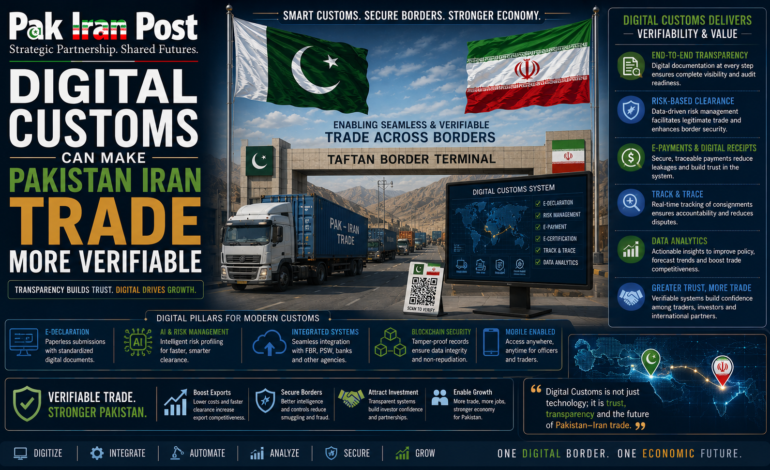
Digital Customs Can Make Pakistan Iran Trade More Verifiable

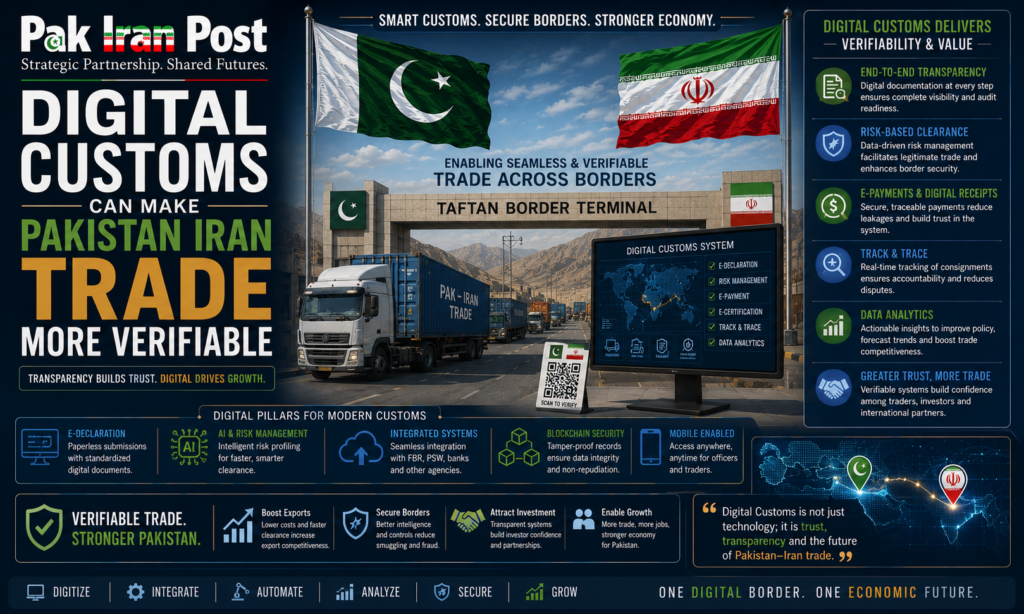
Pak Iran Post, the credibility of Pakistan Iran commercial governance increasingly depends on whether the two states can convert customs documentation from a paper trail into a verifiable data architecture. The central weakness is no longer merely the existence of fraudulent invoices, duplicate declarations or concealed consignments. It is the inability of institutions on opposite sides of the frontier to establish, in machine readable form, that the invoice presented to one customs administration corresponds to the commercial transaction, cargo identity, declared quantity, transport movement and financial settlement recognised by the other. Pakistan has already moved substantially towards electronic customs through WeBOC and the Pakistan Single Window, while the World Customs Organization has developed a common data language intended precisely to enable interoperable cross border systems. The strategic question for the Pakistan Iran frontier is therefore not whether customs should be digitised. It is whether digitisation can be designed to withstand the political economy of a border where legitimate commerce, informal livelihoods, sanctions exposure, revenue leakage and security imperatives intersect.
Pakistan should approach the problem as a bilateral data assurance project rather than another software procurement exercise. A customs platform becomes strategically useful only when the declaration lodged by an importer, the export record generated in Iran, the manifest submitted by a carrier, the certificate of origin, the banking information, the vehicle identity and the eventual border exit record can be reconciled against one another. At present, electronic submission can still coexist with documentary manipulation if the originating data are false, if agencies operate disconnected databases, or if a physical document remains the ultimate source of truth. Digitisation without interoperability merely produces faster transmission of unreliable information.
Pakistan already possesses several components from which a more sophisticated architecture could be constructed. WeBOC provides electronic goods declaration, online manifest filing, electronic payments, risk management channels and activity logs, while PSW is designed to integrate customs, regulatory agencies and financial institutions through a common digital environment. The PSW architecture already supports single declarations, electronic regulatory processing and data exchange with banks. This means the institutional challenge is not to construct a parallel Pakistan Iran customs system from zero. It is to establish a controlled bilateral interoperability layer capable of exchanging selected data between Pakistan’s existing national infrastructure and the corresponding Iranian customs environment without compromising national security, commercial confidentiality or sovereign control over domestic databases.
The most consequential reform would be a bilateral minimum data set. Pakistan Customs and Iranian Customs should agree on a mandatory schema covering exporter and importer identifiers, consignor and consignee, Harmonized System code, commodity description, quantity, gross and net weight, declared customs value, currency, unit price, country of origin, destination, transport operator, vehicle or container identifier, seal number, invoice number, certificate of origin, loading location, expected border crossing and declared financial instrument. The schema should follow the World Customs Organization Data Model rather than being invented through an ad hoc bilateral technical committee. The WCO model provides harmonised data definitions and electronic messages for goods declarations, cargo movements, inspections and regulatory requirements, and is specifically intended to enable interoperability among customs administrations and other border agencies.
This is particularly important because documentary fraud often survives through discrepancies that appear innocuous when examined separately. An invoice may state one quantity, the packing list another, the transport manifest a third and the customs declaration a fourth. A human officer may not immediately detect the inconsistency when the documents arrive at different moments and through different channels. A machine can. A bilateral reconciliation engine should compare the Iranian export declaration against the Pakistani import declaration before release, identify material deviations and assign a risk treatment according to predetermined thresholds. A discrepancy of two kilograms in a low value commodity should not generate the same response as a 30 percent divergence in declared quantity or a substantial mismatch between invoice value and historical transaction prices.
The system should consequently distinguish between data validation, anomaly detection and enforcement. These are different functions. Validation determines whether required fields are complete and logically coherent. Anomaly detection identifies deviations from established commercial patterns. Enforcement determines what government action follows. Conflating them would create an automated bureaucracy in which every irregularity becomes a security suspicion. The objective should be calibrated intervention. A low risk discrepancy could trigger electronic clarification. A recurrent valuation anomaly could require documentary verification. A high risk combination involving commodity classification, vehicle identity, declared value, trader history and route behaviour could trigger non intrusive inspection or physical examination.
Risk scoring should therefore operate on multiple variables rather than a single suspicious indicator. The bilateral engine could assign weighted scores to valuation variance, commodity risk, trader compliance history, frequency of declarations, changes in ownership, unusual routing, vehicle substitution, repeated invoice numbers, abnormal quantities, sudden alterations in commodity mix and discrepancies between export and import declarations. The algorithm should also incorporate positive compliance indicators. Traders with sustained conformity between declarations, timely tax payments, verifiable financial transactions and clean inspection histories should receive progressively lower intervention rates. The purpose of risk management is not to maximise seizures. It is to allocate scarce inspection capacity towards consignments presenting the greatest probability and consequence of non compliance. This principle is consistent with contemporary customs practice promoted by the WCO.
Digital seals would provide the physical bridge between electronic documentation and cargo reality. Selected high risk or high value consignments should receive tamper evident electronic seals linked to the declaration, vehicle identity and authorised route. The seal event should generate time stamped records at departure, designated checkpoints, border arrival, inspection and destination. An unexplained seal opening should not automatically be treated as proof of criminality because legitimate interventions, technical malfunction and emergency circumstances occur. Instead, the system should preserve the event, identify the responsible actor and require an electronically recorded explanation. This creates an evidentiary chain that is considerably more durable than handwritten remarks on a transit document.
Cargo tracking should be risk based rather than universal. Imposing expensive real time tracking on every small border trader would raise compliance costs and could push marginal commerce further outside the formal economy. Pakistan’s policy objective should be differentiated treatment. Commercial consignments above defined value or risk thresholds could enter enhanced digital tracking, while low value legitimate trade receives simplified processing. This distinction is strategically important in Balochistan, where the border economy has social characteristics that cannot be governed through the same compliance model applied to containerised maritime imports.
Machine readable invoices should become another verification layer. Instead of accepting a scanned document as the digital equivalent of paper, the system should require structured invoice data generated by an authenticated exporter. A unique invoice identifier should be cryptographically linked to the exporter, transaction, commodity and declaration. Repeated use of the same identifier should be automatically flagged. Alterations after issuance should create a new version rather than silently replacing the original. Digital signatures and verifiable certificates can establish authenticity without requiring officials to telephone foreign counterparts every time a document appears questionable. Pakistan already uses electronic certificates of origin incorporating digital verification mechanisms within PSW, demonstrating that the institutional principle is practicable.
The financial dimension is equally important because customs valuation cannot be isolated from commercial payment. PSW has already established electronic data exchange mechanisms involving traders, banks, customs and the State Bank of Pakistan, including real time validation and electronic transmission of relevant financial information. The Pakistan Iran architecture should exploit this capability while remaining attentive to applicable sanctions, banking restrictions and foreign exchange regulations. Customs should not become a surrogate financial intelligence system, but significant discrepancies between declared customs value and legitimate payment documentation should be available to authorised risk engines under carefully defined legal protocols.
The bilateral platform should also establish a common trader identity layer. Pakistani traders operating regularly with Iran should possess a verified digital trader profile containing their customs registration, beneficial ownership information, tax status, compliance history and authorised representatives. Iranian counterparties should be subject to equivalent verification within the limits permitted by Iranian law. A transaction involving a previously unknown entity, rapidly changing ownership, inconsistent addresses or repeated associations with high risk consignments should receive enhanced scrutiny. This would be substantially more effective than repeatedly inspecting individual trucks while leaving the commercial network behind them invisible.
Institutional interoperability is where the initiative will either succeed or collapse. Pakistan Customs cannot operate the system alone. PSW, the Federal Board of Revenue, the State Bank of Pakistan, the Ministry of Commerce, immigration authorities, border security institutions and relevant provincial departments would require defined access privileges. The architecture should use role based access, with agencies receiving only the fields necessary for their statutory functions. Sensitive intelligence should remain outside the routine commercial exchange. A customs officer does not need unrestricted access to intelligence databases merely because a consignment has crossed a risk threshold. Conversely, authorised security agencies should be able to request designated customs information through an auditable legal mechanism when a legitimate national security concern exists.
The same discipline should govern Pakistan’s engagement with Iran. Tehran is unlikely to accept a framework that resembles unilateral Pakistani intelligence extraction. Nor should Islamabad accept unrestricted foreign access to domestic customs or financial systems. The bilateral arrangement should therefore be based on reciprocal data exchange, purpose limitation, sovereign data custody and controlled query mechanisms. Each country should retain its primary database. Only agreed data fields should cross the border. Every query should generate an audit record identifying the requesting institution, official, purpose and time. Cross border access should expire automatically unless renewed under authorised procedures.
The political economy of manual customs procedures must be confronted rather than obscured by technological rhetoric. Manual systems create opportunities for rent extraction because discretion is concentrated at points where documents can be delayed, altered, substituted or selectively examined. Digitisation can reduce these opportunities by creating immutable records of decisions, timestamps, risk scores and inspection outcomes. Yet technology can also reproduce corruption if officials retain informal authority to override electronic decisions without justification. Every manual intervention should therefore require a reason code, officer identification and supervisory validation. Repeated overrides by the same officer or at the same location should become a management risk indicator.
Pakistan should establish an independent bilateral technical and governance cell responsible for monitoring these patterns. Its remit should include false positive rates, inspection conversion rates, valuation discrepancies, declaration amendments, system overrides, clearance times, seal breaches, repeated invoice identifiers, trader appeals and revenue outcomes. Performance should not be measured solely through seizures or additional assessments. An efficient customs regime is one that detects serious fraud while accelerating legitimate trade. The relevant strategic dashboard should therefore place revenue protection alongside clearance predictability, trader compliance and border throughput.
A phased architecture would reduce both political and technological risk. The initial phase should create a bilateral data dictionary, legal protocol and secure exchange gateway. Pakistan should map PSW and WeBOC fields against the WCO Data Model and identify the minimum Iranian data required for cross verification. Pakistan has already undertaken WCO Data Model alignment work involving Pakistan Customs, PSW and WeBOC, providing a useful domestic foundation for such a programme. The pilot should concentrate on a limited number of commodity classes and a designated commercial crossing, allowing both administrations to establish data quality benchmarks before expanding the system.
The second phase should introduce automated declaration matching, electronic certificates, invoice verification and risk scoring. The third should add digital seals, selective cargo tracking and automated post clearance audit. The fourth should establish predictive analytics based on accumulated bilateral transaction histories. Artificial intelligence should enter only after data integrity has reached an acceptable threshold. Machine learning trained on corrupted declarations merely industrialises bad information. The priority should therefore be trustworthy data before sophisticated algorithms.
An appeals and correction mechanism is indispensable. Traders must be able to challenge a risk classification, correct legitimate data errors and obtain a reason for prolonged intervention. Algorithmic opacity should not become a new source of administrative arbitrariness. Risk scores should guide officers, not replace accountable customs judgment. The final decision to detain, inspect, seize or prosecute must remain attributable to an authorised official under law. Automated systems should produce recommendations and evidence, while humans retain responsibility for coercive decisions.
The strategic establishment should also treat the platform as critical national infrastructure. Cybersecurity cannot be an afterthought. The bilateral gateway should use encryption in transit and at rest, strong identity authentication, network segmentation, continuous logging, anomaly detection and tested disaster recovery. There should be an offline contingency procedure for border closures, telecommunications outages or cyber incidents, but offline transactions must subsequently be reconciled against the central ledger. Emergency procedures should never become a permanent parallel channel through which documentary controls disappear.
For Pakistan, the larger opportunity extends beyond preventing customs fraud. Reliable bilateral data could reveal genuine trade patterns, commodity dependencies, price distortions, seasonal demand and the economic consequences of border restrictions. It could help policymakers distinguish commercial smuggling from subsistence border activity, identify sectors suitable for formalisation and calculate where tariff or procedural reform would reduce incentives for evasion. A customs database designed merely to catch offenders will remain defensive. A customs intelligence architecture capable of explaining the border economy becomes an instrument of economic statecraft.
Pakistan and Iran should therefore resist the temptation to define digital customs as a technical modernisation programme. It is a sovereignty preserving mechanism for making cross border commerce more legible, auditable and governable. The objective should not be maximal surveillance, nor should every discrepancy be transformed into a security incident. The objective is evidentiary certainty: the ability to establish what was sold, by whom, at what value, in what quantity, through which vehicle, under which declaration, with what financial and regulatory documentation, and whether the cargo that physically crossed the frontier corresponds to the transaction recorded electronically.
For the Pakistan Iran relationship, that capability would alter the balance between enforcement and facilitation. It would make documentary fraud more difficult without criminalising ordinary commerce, reduce dependence on discretionary paperwork, strengthen post clearance investigation and provide security institutions with better structured information without granting them indiscriminate access to commercial data. The strategic test is whether Islamabad can build such a system while preserving institutional accountability and commercial confidentiality. If it can, digital customs will cease to be a back office reform and become an essential component of border governance, fiscal sovereignty and national security.
A Public Service Message


