Monetizing Maritime Risk: Can Pakistan Build a Hormuz-Linked Insurance and Financial Services Hub in South Asia

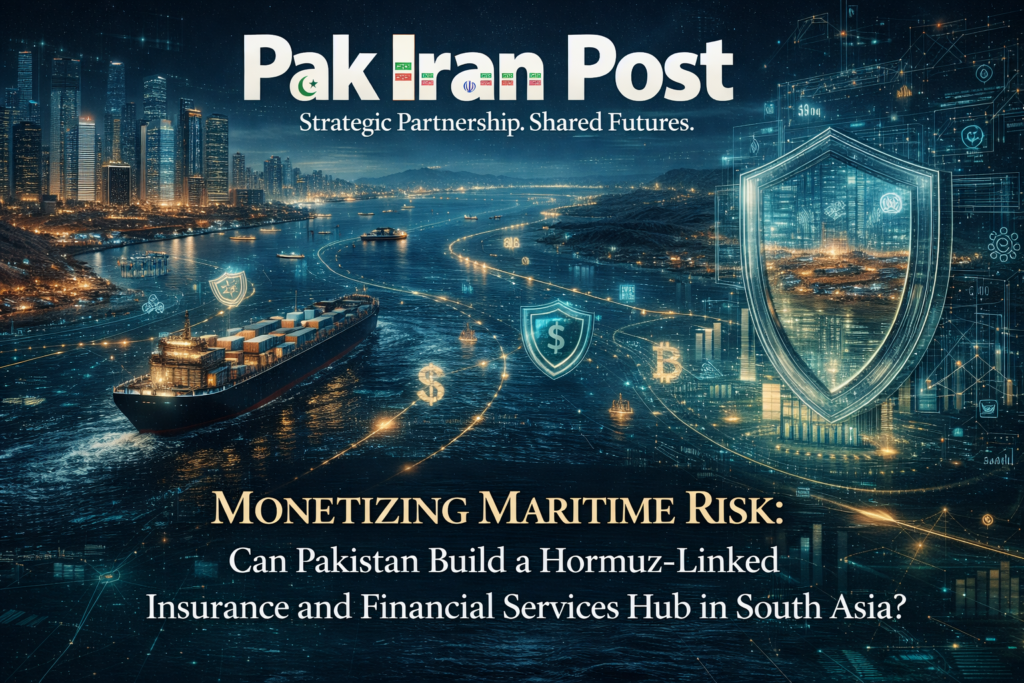
The transformation of the Strait of Hormuz from a passive transit corridor into a priced and risk-calibrated maritime artery represents one of the most consequential shifts in the global economic order. For decades, globalization rested on the assumption that key sea lanes would remain functionally open, with security treated as a public good underwritten by dominant naval powers. That assumption is now eroding. What is emerging instead is a system where insecurity is not merely a disruption but a monetizable asset class. Risk is being priced, securitized, and redistributed across global markets, creating new layers of financial intermediation that sit atop physical trade flows.
In this emerging paradigm, maritime insurance is no longer a technical back-end function but a central driver of trade economics. War risk premiums, political risk coverage, freight insurance, and reinsurance structures are increasingly determining the cost of moving energy and goods across volatile corridors. Each escalation, each naval incident, and each shift in geopolitical alignment feeds directly into insurance pricing models. The Strait of Hormuz, carrying a significant share of global oil flows, has become the epicenter of this transformation. As premiums rise, the cost is transmitted across supply chains, influencing inflation, fiscal balances, and monetary policy in both importing and exporting countries.
For Pakistan, this transformation presents an opportunity that has been largely overlooked in traditional policy frameworks. The country has historically engaged with global trade as a consumer of logistics and energy services rather than as a producer of financial intermediation. This must change. The financialization of maritime risk creates a pathway for Pakistan to enter a high-value segment of the global economy without the need for heavy industrial capital. What is required instead is institutional capacity, regulatory reform, and strategic positioning.
The first step in this transformation is recognizing that maritime risk is now a tradable commodity. Insurance markets, particularly those centered in London and the Gulf, are already recalibrating their models to account for persistent instability in the Gulf region. War risk premiums for vessels transiting near Iran have surged during periods of tension, creating windfall profits for insurers while increasing costs for global trade. Pakistan can position itself within this value chain by developing a specialized maritime insurance and reinsurance ecosystem that captures a portion of these flows.
This requires a fundamental restructuring of Pakistan’s financial sector. Domestic insurance companies must be incentivized to expand beyond traditional life and property coverage into complex risk instruments. Regulatory bodies must develop frameworks that allow for the pricing of geopolitical risk, supported by data analytics and scenario modeling. Collaboration with international insurers is essential, not only for capital but also for technical expertise. Joint ventures with established firms in the Gulf and Europe can accelerate capability development while ensuring compliance with global standards.
At the same time, Pakistan must invest in building a robust reinsurance capacity. Reinsurance is where significant value is captured in the insurance chain, allowing firms to spread risk across global portfolios. Currently, Pakistan’s reliance on foreign reinsurers results in capital outflows and limits domestic value capture. Establishing a sovereign-backed reinsurance facility, potentially in partnership with regional allies, could anchor a domestic ecosystem while enhancing resilience against external shocks.
The development of a Hormuz-linked financial services hub also requires integration with physical infrastructure. The proximity of Gwadar Port provides a strategic advantage that must be fully leveraged. Gwadar can serve not only as a logistics hub but also as a financial node where shipping, insurance, and trade finance converge. Establishing a dedicated financial zone within Gwadar, with regulatory autonomy and tax incentives, can attract global players seeking proximity to emerging maritime risk markets.
Digital infrastructure is another critical component. The pricing of maritime risk increasingly relies on real-time data, including vessel tracking, geopolitical developments, and environmental conditions. Pakistan must invest in digital platforms that integrate these data streams, enabling domestic firms to participate in global risk modeling. Fintech solutions can further enhance efficiency, allowing for the rapid issuance of policies, claims processing, and risk assessment.
However, the pursuit of this strategy is not without challenges. The most significant constraint arises from the geopolitical environment. Pakistan’s proximity to Iran, combined with its relationships with the United States and Gulf countries, creates a complex web of obligations and sensitivities. Engaging in Hormuz-linked financial activities risks exposure to sanctions, particularly if transactions involve Iranian entities. This necessitates a carefully calibrated approach that prioritizes compliance while preserving strategic flexibility.
One potential pathway is to focus on multilateral frameworks that distribute risk and responsibility across multiple actors. By participating in international insurance pools or regional risk-sharing arrangements, Pakistan can reduce direct exposure while still capturing value. Transparency and adherence to international financial regulations are essential to maintaining credibility and avoiding isolation from global markets.
The economic benefits of successfully executing this strategy are substantial. Maritime insurance and related financial services represent a high-margin sector with strong growth potential. Even a modest share of the Hormuz-linked market could generate significant foreign exchange earnings, contributing to the stabilization of Pakistan’s external accounts. This aligns with broader macroeconomic objectives, including the reduction of current account deficits and the strengthening of foreign exchange reserves.
From an IMF-level perspective, the development of a maritime financial services hub can be framed as part of a broader strategy of export diversification. Pakistan’s reliance on traditional exports such as textiles has exposed it to external shocks and limited value addition. Moving into financial services represents a shift toward knowledge-based exports with higher resilience and scalability. This requires investment in human capital, including specialized training in finance, risk management, and data analytics.
Aggressive policy action is required to realize this vision. The government must prioritize regulatory reform, including the modernization of insurance laws and the establishment of clear guidelines for international partnerships. Fiscal incentives should be targeted toward sectors that contribute to the development of the maritime financial ecosystem. Public-private partnerships can mobilize capital and expertise, while sovereign backing can provide the confidence needed to attract foreign investment.
Institutional coordination is critical. The central bank, financial regulators, and relevant ministries must work in tandem to ensure policy coherence. A dedicated task force focused on maritime financialization can provide strategic direction and monitor progress. Engagement with international institutions, including the IMF and World Bank, can provide technical assistance and enhance credibility.
The window of opportunity is narrow. As other regional players recognize the potential of maritime risk markets, competition will intensify. Gulf financial centers, with their established infrastructure and capital base, are well positioned to dominate this space. Pakistan must act decisively to carve out a niche before the market becomes saturated.
Ultimately, the financialization of the Strait of Hormuz represents a broader shift in the global economic order, where control over risk translates into economic power. For Pakistan, the challenge is to move beyond traditional paradigms and embrace this new reality. By positioning itself as a hub for maritime insurance and financial services, Pakistan can transform a geopolitical challenge into a geoeconomic opportunity, securing a more resilient and diversified economic future.
A Public Service Message