
The River of Time: Iran as a Trans Normative Confluence of Memory, Identity, and Influence

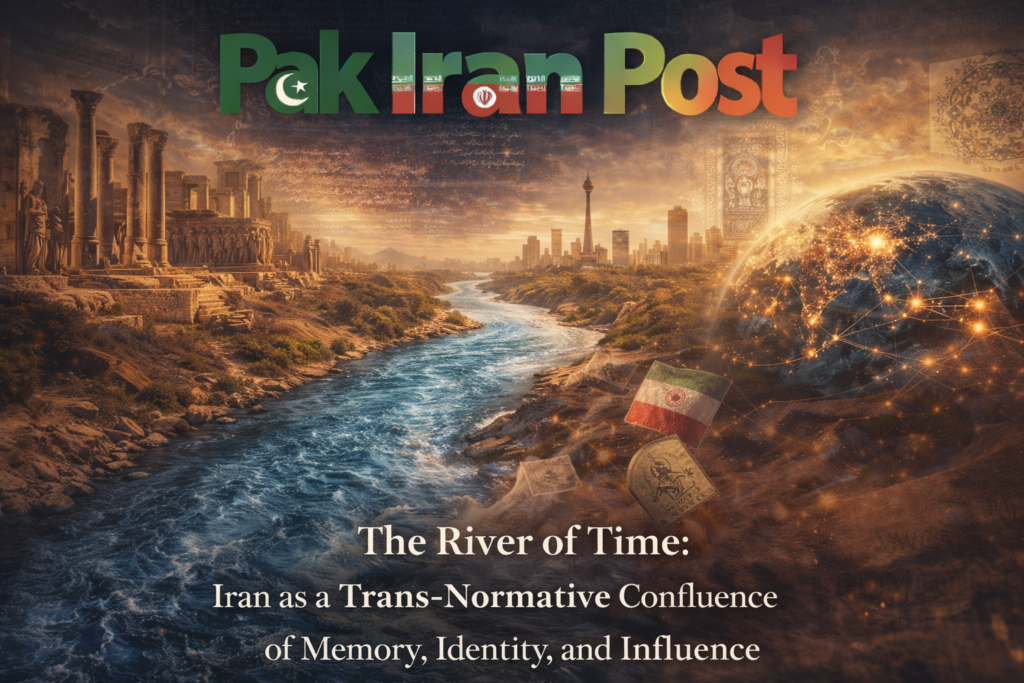
Iran today flows like a river that carries the sediment of centuries, a living confluence of memory, culture, and identity that continuously reshapes the political and philosophical landscapes of the Middle East and beyond. To perceive Iran solely through the lenses of diplomacy, energy, or military capability is to observe only the surface of a river without appreciating the currents beneath, the sediment that informs its course, and the sources from which it springs. The river metaphor allows for a trans normative understanding of Iran’s rise, suggesting that influence is not merely material or strategic but temporal, symbolic, and conceptual. Iran’s identity, constructed across millennia of history, philosophy, art, and religion, constitutes a flowing matrix of narratives and meanings, shaping regional perceptions and global discourses.
In the contemporary context, the river of Iran functions as a conduit for the circulation of norms, values, and epistemic frameworks that challenge conventional structures of power. By flowing through contested geographies, by interacting with other rivers of influence, and by depositing the sediment of memory into broader cultural and political terrains, Iran exemplifies a form of power that is trans normative in character. It demonstrates that influence can emerge from the sustained construction and dissemination of identity, narrative coherence, and historical legitimacy. To comprehend Iran’s significance in this way requires engagement with theoretical frameworks that illuminate the deeper currents of its emergence. Hegelian dialectics provides insight into the process by which historical contradictions and tensions generate new syntheses, allowing Iran to negotiate between past and present, tradition and modernity, resistance and accommodation. Derridean deconstruction challenges established binary distinctions in global politics, revealing how the discourse surrounding Iran is constructed and contested. Paul Ricoeur’s philosophy of memory and time illuminates how collective memory shapes identity and informs action across generations.
Through the lens of Hegelian dialectics, Iran’s engagement with global powers can be seen as a series of contradictions and resolutions in which its identity, agency, and strategic vision are continually recalibrated. Iran’s historical narrative interacts with pressures from external powers, sanctions, and shifting alliances to produce emergent strategies that balance autonomy and influence. This dialectical process demonstrates that power is not static; it evolves as actors negotiate between structural constraints and the possibilities generated by their own historical and cultural capital. Derridean deconstruction allows observers to analyze how the discourse surrounding Iran’s actions, intentions, and legitimacy is both produced and challenged. By deconstructing assumptions embedded in international media, policy debates, and academic scholarship, one can discern how Iran actively shapes and reshapes the narratives in which it is embedded, asserting agency in spaces that are often dominated by others’ interpretations.
Ricoeur’s work on memory and time emphasizes that identity is constructed through the interplay of recollection, narrative, and projection into the future. Iran’s historical memory, including pre-modern Persian civilization, Islamic revolutionary experience, and contemporary statecraft, constitutes a reservoir of normative and symbolic authority. These memories inform how Iran perceives itself and how it seeks to influence others, shaping regional expectations, cultural resonance, and the moral economy of global interactions. The river metaphor highlights that Iran’s influence is continuous, cumulative, and generative. It is not episodic or contingent but flows through history, carrying sediment that nourishes interactions with other societies and shapes the temporal horizon of action.
For Pakistan, understanding Iran as a river provides opportunities to engage strategically, culturally, and philosophically in ways that conventional geopolitics may overlook. Pakistan’s own historical, cultural, and geopolitical position situates it as a tributary, a society capable of contributing to and benefiting from Iran’s trans normative currents. By aligning its engagement along epistemic, cultural, and policy dimensions, Pakistan can participate in shaping the river’s flows, ensuring that its own identity, interests, and narratives are represented in the broader regional discourse. Such engagement transcends transactional diplomacy and positions Pakistan as a co-creator in a network of meaning and influence.
Several avenues for Pakistan to engage with Iran’s trans normative influence emerge from this conceptual framework. Firstly, epistemic collaboration can be pursued through joint academic programs, research initiatives, and think-tank exchanges. These initiatives can focus on historical memory, cultural studies, philosophy, and regional identity, providing platforms for intellectual dialogue and co-production of knowledge that inform policy and strategic decisions. Secondly, cultural diplomacy can be structured to emphasize shared heritage, literary traditions, artistic expression, and philosophical inquiry, deepening people-to-people connections while reinforcing Pakistan’s role as a meaningful interlocutor in the region. Thirdly, narrative policy frameworks can be designed to integrate historical memory, cultural resonance, and symbolic authority into Pakistan’s engagement strategies, ensuring that communication, media, and public diplomacy are aligned with the deeper currents of influence flowing from Iran.
Iran’s river carries sediment that is both historical and contemporary. Its revolutionary identity, Persian cultural heritage, and philosophical traditions interact with modern global norms and practices to produce a layered and multifaceted influence. This confluence of memory and identity is particularly relevant for Pakistan as it seeks to navigate the complexities of regional security, energy diplomacy, and economic integration. By participating in Iran’s cultural, epistemic, and policy flows, Pakistan can amplify its own influence, diversify its strategic partnerships, and deepen its role as a constructive actor in the multipolar order.
The trans normative perspective also emphasizes the ethical dimensions of engagement. Iran’s river is not simply a channel for projecting power but also a conduit for moral, cultural, and intellectual influence. For Pakistan, participation in these currents entails responsibilities: preserving the integrity of shared narratives, fostering inclusive dialogue, and avoiding the instrumentalization of culture and identity for narrow political gains.
The revival and expansion of energy corridors, collaborative technology initiatives, and regional connectivity projects can serve as material expressions of epistemic and cultural alignment. These initiatives allow Pakistan to leverage Iran’s historical and symbolic significance while addressing pressing domestic needs, such as energy security, economic growth, and industrial development. By framing such initiatives within a trans normative discourse, Pakistan can signal its commitment to shared historical identity, regional solidarity, and culturally grounded cooperation.
The river metaphor also underscores the importance of temporality in policy formulation. Long-term strategic thinking becomes imperative when one recognizes that influence, identity, and cultural authority are cumulative. Pakistan’s engagement with Iran should be conceived not as episodic interventions but as sustained participation in flows that evolve over decades and centuries. Education, research, cultural exchange, and policy dialogue can be structured with an eye to intergenerational impact, ensuring that both societies contribute to a shared river of memory, knowledge, and normative authority.
By understanding Iran as a river of time, Pakistan can also anticipate emergent challenges and opportunities. Just as rivers encounter obstacles, shifts in climate, and changing landscapes, Iran’s influence interacts with sanctions, regional rivalries, and global realignments. Pakistan’s strategic positioning allows it to serve as a mediator, translator, and conduit for stabilizing these flows, ensuring that disruptions do not undermine regional coherence. By cultivating expertise in historical memory, cultural diplomacy, and transnormative reasoning, Pakistan can provide intellectual infrastructure that enables adaptive responses to evolving geopolitical conditions.
The concept of the river of time also encourages Pakistan to think beyond immediate transactional benefits. Influence is measured not merely by short-term economic gains or strategic concessions but by the capacity to shape narratives, inform regional identity, and contribute to enduring cultural and epistemic legacies. By actively participating in the confluence of memory, identity, and influence embodied by Iran, Pakistan positions itself as a thoughtful and principled actor, capable of shaping the norms and frameworks that guide regional and global interactions.
Practical policy measures aligned with this vision include establishing joint institutes of historical and cultural research, promoting literary and philosophical exchanges, creating collaborative media platforms that highlight shared heritage, and integrating reasoning into regional policy dialogues. Pakistan can leverage digital technologies to document, share, and analyze cultural, historical, and intellectual resources, facilitating broader participation from scholars, policymakers, and the public. Such initiatives strengthen the epistemic foundations of cooperation and create durable channels for influence that extend beyond formal diplomacy.
In addition, Pakistan can develop frameworks for ethical engagement, ensuring that joint initiatives respect local traditions, cultural sensitivities, and the intellectual integrity of both societies. By promoting collaborative scholarship, joint publications, and regional knowledge networks, Pakistan contributes to a river of shared ideas and norms that reinforce stability, trust, and mutual understanding. This approach situates Pakistan not as a passive observer but as an active participant in shaping the flows of influence and meaning in the region.
The river of time metaphor also emphasizes the interplay between continuity and change. Iran’s influence is grounded in centuries of cultural and philosophical development, yet it continuously adapts to the shifting demands of global politics, technological transformation, and regional dynamics. Pakistan’s engagement must similarly balance respect for historical continuity with adaptive innovation, ensuring that policies, collaborations, and initiatives remain relevant and responsive. This dynamic engagement fosters resilience, strengthens regional integration, and positions Pakistan as a strategic partner capable of contributing meaningfully to the evolving multipolar order.
By participating in the currents represented by Iran, Pakistan can also amplify its soft power. Cultural diplomacy, educational collaboration, and media engagement provide channels for extending influence while reinforcing shared historical and philosophical bonds. By aligning policy initiatives with the symbolic and epistemic dimensions of Iran’s river, Pakistan strengthens its credibility, enhances its strategic autonomy, and deepens its ability to shape regional discourse.
The river metaphor further suggests that influence is cumulative, multidimensional, and interdependent. Pakistan’s contributions to shared initiatives, whether in education, research, cultural exchange, or policy dialogue, enhance the overall flow and direction of regional dynamics. By integrating philosophical reflection with strategic action, Pakistan ensures that its participation is meaningful, sustainable, and resonant with deeper currents of memory, identity, and normative authority.
Ultimately, understanding Iran as a river of time provides Pakistan with a framework for engagement that transcends conventional diplomacy. It highlights the importance of historical memory, cultural resonance, epistemic collaboration, and ethical responsibility in shaping regional influence. By actively participating Pakistan positions itself as a thoughtful, principled, and strategic actor capable of contributing to the long-term stability, coherence, and cultural richness of the region.
The river flows continuously, carrying sediment, shaping landscapes, and connecting past, present, and future. Iran’s influence is similarly continuous, multifaceted, and generative. Pakistan’s engagement must recognize and align with these qualities, ensuring that its policies, initiatives, and collaborations contribute to shared prosperity, cultural vibrancy, and strategic coherence. By embracing a this approach, Pakistan not only strengthens its relationship with Iran but also asserts its own role in shaping the regional and global order, leveraging the river of time to secure enduring influence, stability, and partnership in a complex and evolving world.
A Public Service Message