
Frontier Economies Reshape Survival Amid Climate And Inflation Pressures

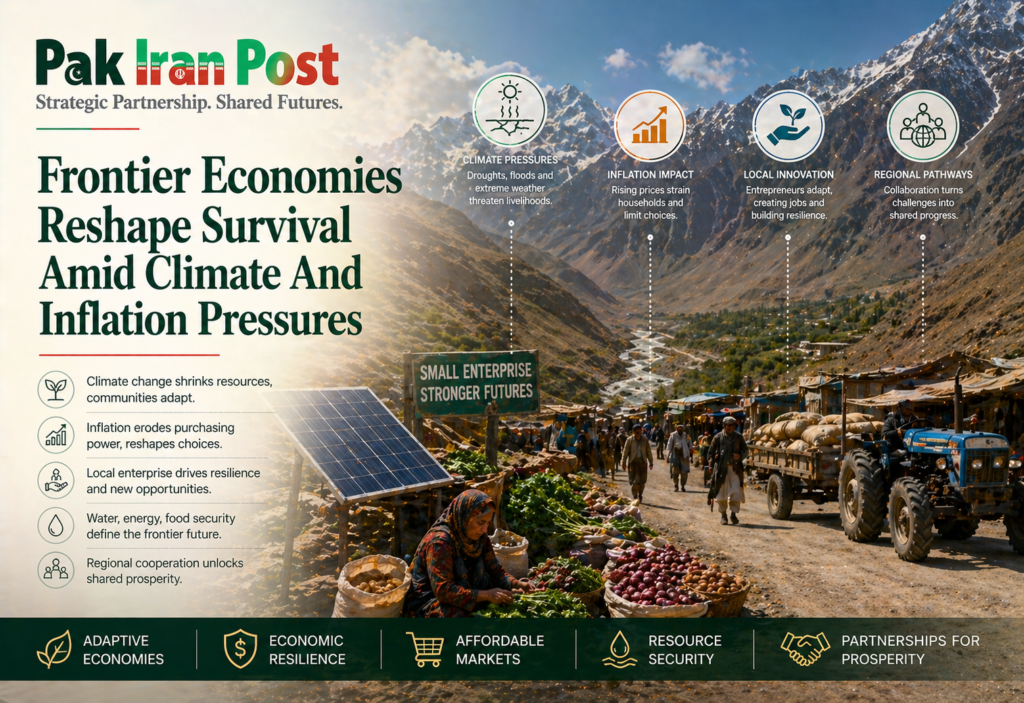
Borders are often imagined as lines of separation, but in practice they are zones of adaptation. Nowhere is this more visible than in the frontier districts along Pakistan’s western edge adjoining Iran, where geography, climate stress and inflation are converging into a single slow transformation of how people live, trade and survive. Here, the economy is not defined by growth charts or national budgets. It is defined by rainfall, fuel prices, livestock health, border access, and the fragile predictability of supply routes that can change overnight with policy decisions made far away.
In these districts, macroeconomic theory feels distant. What matters is whether wheat arrives on time, whether fertiliser is affordable before planting season, whether diesel is available for irrigation pumps, whether animals survive drought cycles, and whether informal trade routes remain open enough to sustain household income. The state is present, but unevenly. Markets exist, but imperfectly. What fills the gap is a dense web of microeconomic improvisation shaped by necessity rather than design.
Climate stress is the most fundamental driver of this transformation. Recurrent droughts in Balochistan, shifting rainfall patterns, rising temperatures and groundwater depletion have altered the viability of traditional agriculture. Wheat yields fluctuate unpredictably. Pastoral routes that once supported stable livestock cycles now face shrinking grazing land. Water scarcity forces households to invest in deeper wells, longer transport distances and higher energy costs. These are not abstract environmental risks; they are immediate economic constraints that determine whether families remain in farming or shift into trade and migration.
Inflation compounds the pressure. Rising food prices in urban Pakistan echo sharply in frontier regions where incomes are lower and markets thinner. When flour, cooking oil or sugar becomes expensive in Karachi or Lahore, the shock is amplified in border towns where supply chains are longer and incomes more fragile. Fertiliser prices, tied to global energy markets and domestic distribution inefficiencies, directly influence planting decisions. A farmer does not consult policy briefs; he calculates whether the cost of inputs exceeds the expected harvest value. Increasingly, the answer is uncertain.
In this environment, cross-border proximity becomes both opportunity and necessity. The Pakistan–Iran frontier provides access to alternative supply channels for fuel, food items, livestock and basic commodities. These flows are not uniform or fully legalised, but they form a functional safety valve for communities under pressure. When domestic prices spike or shortages emerge, cross-border alternatives often fill the gap. The result is a hybrid economy where legality and survival frequently overlap without clear boundaries.
Livestock trade is one of the most important pillars of this frontier economy. Animals move in response to seasonal conditions, fodder availability and market demand. During drought cycles, herders may shift livestock across informal routes to access grazing or sell animals before losses increase. During festival seasons, demand spikes create cross-border price differentials that encourage movement. This trade supports incomes but also exposes vulnerabilities. Disease control systems are weak, veterinary services inconsistent, and market information asymmetrical. Yet despite these risks, livestock remains one of the most reliable assets in an otherwise unstable economic landscape.
Fertiliser access reveals another dimension of frontier economics. Agricultural productivity depends heavily on timely fertiliser application, yet distribution bottlenecks, price volatility and transport costs often delay availability in remote districts. Farmers then face difficult choices: reduce input use and accept lower yields, incur debt to purchase fertiliser at inflated prices, or seek alternative sources through informal markets. Each option carries risk. The decision is not purely economic; it is existential. A missed season can determine household survival for months.
Fuel availability is equally central. Diesel powers irrigation pumps, transport vehicles, generators and small-scale industry. When formal supply chains tighten due to pricing policies or import constraints, households turn to alternative sources. This creates a parallel fuel economy that is deeply embedded in frontier life. It is not merely a black market phenomenon; it is an infrastructure substitute in regions where formal energy systems are unreliable or unaffordable.
Migration patterns are also shifting under these pressures. Younger populations increasingly view frontier agriculture as economically uncertain. Seasonal migration to urban centres, Gulf labour markets or commercial trading routes has become a survival strategy. Remittances now play a stabilising role in many households, substituting for volatile agricultural income. This alters social structures as well. Traditional agrarian cycles weaken, while cash-based household economies expand.
Gender roles within these economies are evolving in subtle but important ways. Women often manage household budgeting under conditions of scarcity, allocate food resources during inflation spikes, and engage in home-based income activities such as embroidery, dairy processing or small-scale retail. In some cases, they also participate indirectly in trade networks through family connections. These contributions are frequently under-acknowledged in formal policy discourse, yet they are central to household resilience.
Border commerce itself is increasingly shaped by informal logistics networks. Small transport operators, intermediaries and local traders coordinate movement of goods across difficult terrain and fragmented regulatory systems. Trust, reputation and kinship often matter more than formal contracts. Information travels through social networks faster than official channels. A change in checkpoint policy or price differential can be transmitted within hours through mobile messaging systems, altering trade flows almost instantly.
Inflation and climate stress together create what economists might call a “resilience economy,” although for residents it is simply life. This economy is characterised by flexibility, informality and constant adaptation. Households diversify income sources, combining agriculture, livestock, trade, migration and remittances. Risk is distributed rather than eliminated. The goal is not growth maximisation but survival stability.
Policy responses have struggled to match this complexity. National planning frameworks often assume formal market participation, stable infrastructure and predictable enforcement. Frontier realities do not conform to these assumptions. Enforcement-heavy approaches to informal trade frequently disrupt livelihoods without replacing lost income channels. Conversely, laissez-faire tolerance without regulation can entrench inequality and reduce state revenue capture. The policy challenge lies in finding a middle ground that recognises the functional role of informal systems while gradually integrating them into formal structures.
Some emerging approaches show promise. Cross-border market days, simplified customs procedures for small traders, veterinary cooperation zones, and regulated fuel quotas for designated districts can reduce friction while preserving oversight. Digital identification and mobile-based payment systems offer potential for transparency, although connectivity gaps and trust deficits remain barriers. Infrastructure investment in roads, cold storage, water management and local energy generation could significantly alter economic resilience if sustained over time.
However, structural issues cannot be ignored. Frontier economies remain vulnerable to political uncertainty, security incidents and abrupt regulatory changes. These shocks can instantly disrupt trade flows and household income. Predictability is often more valuable than policy generosity. Traders and households consistently prioritise stability over marginal gains. When rules change frequently, informal systems tend to strengthen because they are more adaptable than formal institutions.
Media coverage of these regions often fails to capture this complexity. Urban-centric reporting tends to focus on security incidents, smuggling narratives or crisis events. The slow economic adaptation of households under climate and inflation pressure receives less attention. Social media is beginning to change this, with local voices documenting water shortages, livestock losses and market fluctuations in real time. This has created a more immediate but also more fragmented understanding of frontier life.
Iranian border regions face parallel dynamics. Sistan and Baluchestan province experiences similar climate stress, water scarcity and economic marginalisation. Informal trade networks operate across both sides of the border, reflecting shared environmental and economic pressures rather than purely political alignment. This symmetry suggests that frontier economies are shaped more by geography than by state ideology.
The broader implication is that Pakistan–Iran frontier economies are not peripheral to national development; they are early indicators of systemic stress and adaptation. Climate change, inflation and supply chain volatility are not abstract macro trends in these regions. They are lived realities that reshape behaviour faster than national policy cycles can respond.
In the long term, resilience will depend on whether states can transition from episodic intervention to sustained engagement. This means recognising informal economies not as anomalies to be eliminated but as systems to be understood and gradually formalised where possible. It also means investing in climate adaptation infrastructure, particularly water management, renewable energy, veterinary services and transport connectivity.
It requires acknowledging that economic survival in frontier regions is already highly diversified. The question is not whether people are adapting, but whether policy frameworks will adapt with them. If they do not, informal systems will continue to expand as primary providers of stability.
The frontier economy is therefore not a marginal story. It is a concentrated expression of broader regional vulnerabilities. Inflation exposes governance weaknesses. Climate stress exposes infrastructure gaps. Informal trade exposes regulatory inefficiencies. Migration exposes labour market distortions. Together, they form a system that is both fragile and remarkably adaptive.
The lesson is simple but uncomfortable. In Pakistan’s western frontier, survival is already a form of economic policy. The state’s role is not to replace this system overnight, but to ensure it does not remain permanently trapped in informality. Stability in these regions will not come from grand projects alone, but from steady, granular improvements in how people access food, water, energy and markets.
Until then, the frontier will continue to function as it always has: not as a boundary, but as a working economy of necessity, shaped by climate, constrained by inflation, and sustained by the quiet intelligence of those who live within it.
A Public Service Message