Sanctions Energy And Strategic Dependency Across Emerging Pakistan Iran Regional Realignments

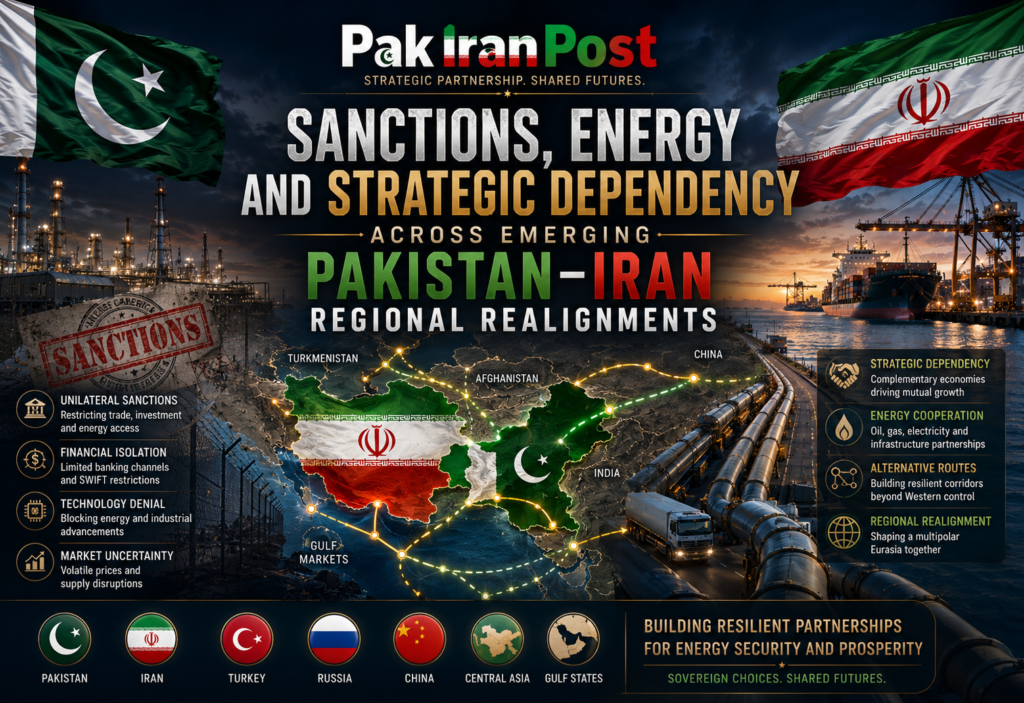
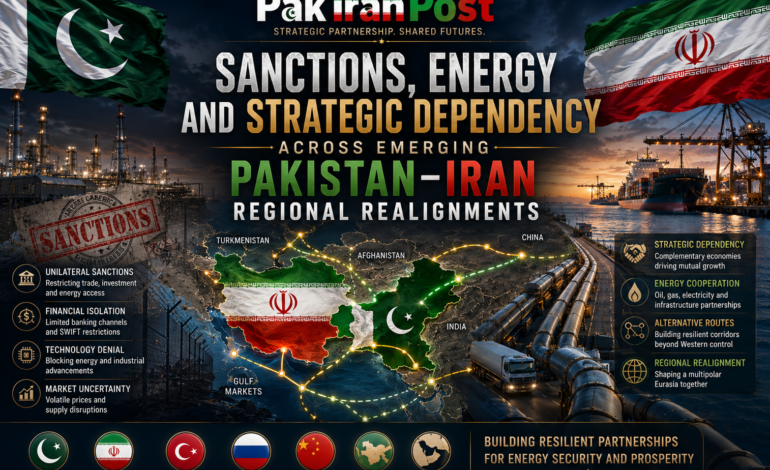
The Iran Pakistan gas pipeline was once imagined as a technical infrastructure project linking adjacent geographies through commercial energy interdependence. Today it has become something considerably larger, more fragile, and infinitely more geopolitical. The pipeline now exists not merely beneath the terrain of South Asia and West Asia, but within the architecture of sanctions diplomacy, financial coercion, strategic dependency, and competing visions of regional order. It has evolved into a symbolic fault line separating sovereign energy imperatives from the coercive mechanisms of global geopolitical management. In many respects, the future of the pipeline is no longer about gas. It is about who possesses the authority to determine which states may trade, integrate, connect, and industrialize within an increasingly fragmented international system.
Pakistan’s prolonged energy crisis has transformed energy security from a developmental concern into an existential state imperative. Electricity shortages, industrial disruptions, inflationary pressures, currency depreciation, and expanding circular debt have collectively weakened the state’s fiscal and political stability. Imported fuel dependency has deepened structural vulnerabilities precisely at a moment when the global energy market is undergoing violent geopolitical fragmentation. Islamabad’s energy dilemma therefore reflects a wider crisis of strategic dependency in which external supply chains, sanctions regimes, and international financing institutions collectively constrain sovereign policy flexibility.
Iran, meanwhile, occupies an equally paradoxical position within the contemporary energy order. It possesses some of the world’s largest gas reserves, yet remains structurally constrained by sanctions designed to isolate it from formal global financial and commercial systems. The consequence is an extraordinary geopolitical contradiction. A sanctions isolated energy giant sits adjacent to an energy deficient neighboring state, while both remain unable to operationalize a pipeline that would otherwise appear economically inevitable. Geography favors integration. Politics obstructs it. Sanctions weaponize the gap between the two.
The contemporary discourse surrounding the Iran Pakistan pipeline frequently obscures this structural contradiction beneath technocratic explanations involving delayed financing, regulatory hesitation, pricing disagreements, or commercial viability. Yet these explanations conceal the deeper reality that the project has been transformed into an arena where sovereignty itself is negotiated. The pipeline is no longer evaluated solely through economics. It is assessed through strategic allegiance. Its viability depends less upon engineering capacity than upon geopolitical permission.
Recent developments have once again revealed the project’s fragile geopolitical condition. Pakistan has reportedly explored shelving the pipeline through legal and diplomatic mechanisms while simultaneously leaving open the possibility of revival should sanctions waivers emerge from future diplomatic engagement between Tehran and Washington. (Energy Update) The language itself reveals the extraordinary condition of dependent sovereignty in which states publicly discuss national energy infrastructure only within the conditional framework of external approval. Islamabad’s position reflects not merely caution but strategic entrapment. Pakistan cannot fully abandon the project because its energy crisis continues to intensify. Yet it cannot fully operationalize the project without risking financial and diplomatic repercussions from the United States and broader Western financial institutions.
This dilemma reveals the evolution of sanctions from targeted economic restrictions into comprehensive instruments of geopolitical behavioral regulation. Modern sanctions no longer simply punish states. They reorganize regional connectivity patterns, reshape trade routes, redirect capital flows, and influence infrastructural decisions across entire regions. The Iran Pakistan pipeline demonstrates how sanctions increasingly function as mechanisms through which geopolitical hierarchies are maintained within the global energy order.
Washington’s strategic opposition to the pipeline has historically been framed through the language of non proliferation, regional security, and sanctions compliance. Yet beneath these official narratives lies a broader geopolitical logic concerning energy alignment and regional influence. Energy infrastructure produces long term interdependence. Pipelines create durable strategic relationships because they bind economies through geography rather than transient market transactions. For precisely this reason, pipeline politics has always been deeply geopolitical. States connected through pipelines gradually develop overlapping security calculations, coordinated economic interests, and mutual dependency structures resistant to external pressure.
The Iran Pakistan pipeline therefore threatens more than sanctions architecture. It threatens the broader logic of geopolitical compartmentalization through which regional integration remains selectively permitted or obstructed according to wider strategic interests. A fully operational energy corridor connecting Iran and Pakistan could eventually intersect with Chinese connectivity ambitions, Russian Eurasian trade recalibrations, and broader continental integration projects stretching beyond Western dominated maritime trade systems. What appears superficially as an energy project therefore possesses the latent potential to contribute toward a wider Eurasian strategic architecture.
China’s growing presence within Pakistan further intensifies these geopolitical calculations. Beijing’s infrastructural ambitions under regional connectivity frameworks have already transformed Pakistan into a central node within wider continental logistics and trade networks. The possibility that Iranian energy could eventually integrate into these corridors generates concern among policymakers seeking to limit the consolidation of alternative geopolitical alignments across Eurasia. In this context, the pipeline becomes inseparable from broader debates surrounding the future distribution of power within the international system.
At the same time, Pakistan’s internal energy realities are themselves evolving in contradictory directions. On one side, severe electricity shortages and industrial energy deficits continue to create demand for affordable and geographically proximate gas supplies. Business communities inside Pakistan increasingly argue that reliance upon imported liquefied natural gas has become economically unsustainable amid currency instability and rising import costs. (Business Recorder) On the other side, changing energy consumption patterns, expensive long term LNG agreements, and the rapid expansion of solar adoption have complicated the economics of future gas demand. Discussions surrounding LNG oversupply, underutilized gas infrastructure, and expensive capacity payments now increasingly shape Pakistan’s domestic energy discourse. (Reddit)
This contradiction reveals the deeper fragmentation of the contemporary global energy transition. Renewable expansion has not eliminated fossil dependency. Instead it has produced overlapping and unstable transitional phases where states simultaneously pursue solar expansion, LNG procurement, coal usage, and pipeline diplomacy. Pakistan embodies this transitional instability. Renewable energy growth may reduce future gas dependency, yet industrialization and urbanization continue to require stable baseload energy supplies that renewables alone cannot yet fully provide.
Iranian gas therefore retains strategic relevance precisely because of its geographic proximity and potential affordability. Tehran has repeatedly emphasized that its side of the pipeline infrastructure remains substantially complete. (Reuters) Iranian policymakers increasingly frame the project not merely as commercial cooperation but as evidence that regional states can construct independent economic partnerships despite sanctions pressure. The pipeline has therefore acquired ideological symbolism within Iranian strategic discourse. It represents resistance against economic isolation and proof that sanctions cannot permanently prevent regional integration.
Yet Pakistan’s political establishment remains acutely aware that overt defiance of sanctions could trigger financial repercussions extending far beyond energy policy. Islamabad’s dependence upon IMF programs, Gulf financial assistance, Western export markets, and broader international financial credibility significantly constrains policy maneuverability. This structural dependency explains why Pakistan repeatedly attempts to maintain strategic ambiguity regarding the pipeline. It neither fully abandons nor fully activates the project. Instead it preserves a condition of suspended possibility.
The result is a peculiar form of geopolitical paralysis where strategic logic supports integration while financial vulnerability obstructs implementation. This paralysis reflects the broader condition of many middle powers operating within an increasingly fragmented international order. States seek autonomy yet remain dependent upon external financial systems controlled by rival geopolitical actors. Energy policy therefore becomes inseparable from monetary hierarchy and financial governance.
Simultaneously, emerging geopolitical developments may gradually reshape the environment surrounding the pipeline. Recent diplomatic engagement between Iran and the United States has revived speculative discussions regarding possible sanctions relief and renewed energy negotiations. (Pakistan Today) While substantial breakthroughs remain uncertain, even limited diplomatic openings significantly alter regional strategic calculations. Markets respond not merely to actual policy changes but to anticipated geopolitical possibilities. Consequently, discussions surrounding sanctions easing have already revived interest within Pakistan’s business and strategic communities regarding the pipeline’s future viability.
Moreover, global geopolitical fragmentation is increasingly weakening the universality of Western sanctions enforcement. Russia’s confrontation with the West, China’s growing advocacy for alternative financial arrangements, BRICS expansion debates, and the emergence of regional payment systems collectively indicate the gradual erosion of singular financial dominance. This does not imply the immediate collapse of sanctions effectiveness. The dollar centered financial system remains extraordinarily powerful. However, it does suggest that regional actors are increasingly exploring mechanisms to reduce exposure to geopolitical financial vulnerability.
Within this broader context, the Iran Pakistan pipeline acquires renewed strategic relevance as part of a wider debate surrounding post Western connectivity and continental integration. Energy corridors, trade routes, digital payment systems, and regional infrastructure increasingly form the foundation of emerging geopolitical blocs. Control over connectivity has become as strategically important as control over territory itself. Infrastructure now functions as geopolitical architecture.
The media narratives surrounding the pipeline often fail to capture this structural transformation. International reporting frequently reduces the issue to sanctions compliance or bilateral disagreement while overlooking the wider geopolitical restructuring occurring beneath the surface. Meanwhile regional discourse often romanticizes the pipeline as a simple solution to Pakistan’s energy crisis without adequately confronting the immense geopolitical and financial complexities surrounding implementation. Both narratives remain incomplete because they isolate economics from geopolitics when, in reality, the two have become inseparable.
The deeper question facing Pakistan is therefore not whether Iranian gas is economically beneficial. The deeper question concerns whether Islamabad can construct a sufficiently diversified foreign policy and financial strategy capable of pursuing selective regional integration without triggering destabilizing external repercussions. This requires a level of strategic coherence that Pakistani policymaking has historically struggled to sustain due to institutional fragmentation, short term crisis management, and fluctuating civil military dynamics.
For Pakistan, the path forward requires abandoning the false binary between absolute alignment and reckless defiance. Islamabad must instead pursue calibrated multi vector energy diplomacy. Such a strategy would involve maintaining cooperative relations with Gulf energy suppliers while simultaneously expanding regional energy engagement with Iran where feasible. Diversification rather than exclusivity must become the governing principle of Pakistani energy strategy.
Pakistan must also accelerate investment in energy infrastructure capable of supporting hybrid transitional models integrating renewables, LNG, regional pipeline connectivity, and localized electricity transmission networks. Energy resilience in the twenty first century will depend not upon singular dependence but upon diversified interdependence. States vulnerable to geopolitical shocks cannot afford rigid energy architectures.
Equally important is the necessity of developing alternative financial mechanisms capable of reducing exposure to sanctions related disruption. Bilateral currency arrangements, barter based trade mechanisms, regional payment systems, and limited localized settlement structures may gradually create strategic flexibility even if complete de dollarization remains unrealistic in the short term. Financial sovereignty and energy sovereignty increasingly overlap within the contemporary geopolitical environment.
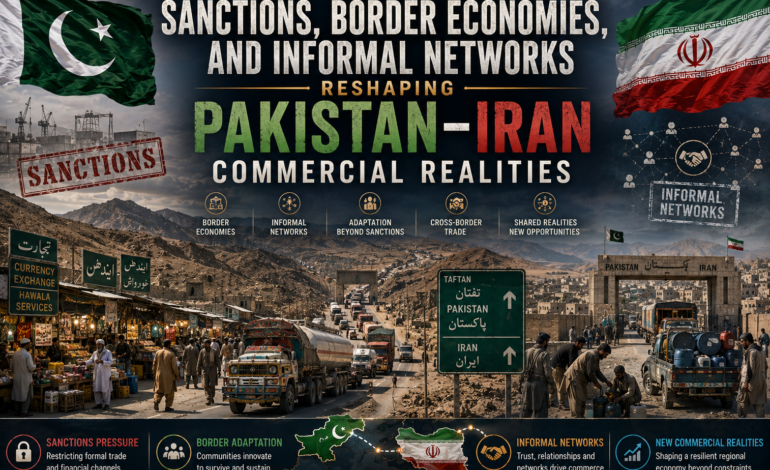
Pakistan must additionally recognize that border regions adjacent to Iran possess enormous unrealized economic potential. Rather than allowing sanctions induced informal economies and smuggling networks to dominate cross border interaction, Islamabad and Tehran should pursue regulated border market integration, industrial zones, and infrastructure development designed to formalize economic cooperation. Economic marginalization in frontier regions often generates security instability. Integration may therefore contribute simultaneously toward economic development and border stabilization.
Finally, policymakers must understand that the future international order will likely be defined not by absolute blocs but by fluid and overlapping networks of strategic alignment. Middle powers such as Pakistan will increasingly survive through strategic hedging rather than rigid allegiance. The ability to balance competing external relationships while preserving internal policy autonomy will become the defining feature of successful statecraft in the emerging multipolar environment.
The Iran Pakistan pipeline therefore represents far more than delayed infrastructure. It embodies the central geopolitical tension of the contemporary age. Regional geography increasingly demands integration while geopolitical fragmentation obstructs it. Energy interdependence promises stability while sanctions architecture enforces separation. Sovereign necessity collides with external coercion. The pipeline remains unfinished because the international order itself remains unfinished.
In that unresolved space between dependency and autonomy, Pakistan’s future strategic trajectory will ultimately be determined.
A Public Service Message