
Maritime Shock Economy Redefines Pakistan Iran Corridor

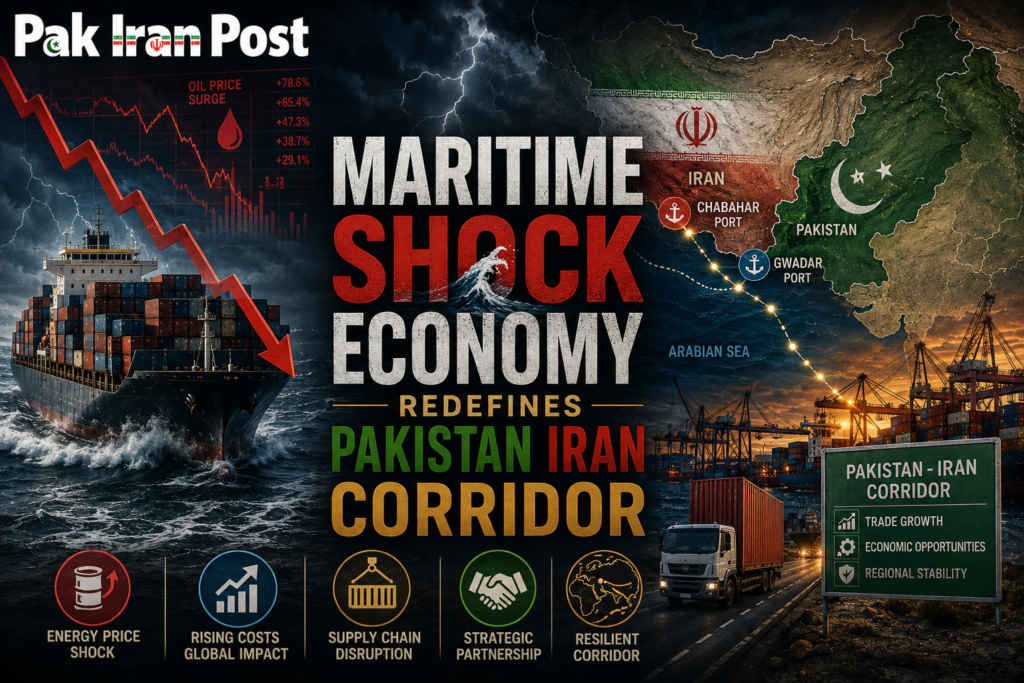
The Pakistan–Iran geo-economic interface is increasingly being reshaped by a less visible but structurally decisive variable: the growing instability of maritime energy corridors and the resulting transformation of regional trade into what can be described as a shock-responsive economic system. In 2026, this system is no longer operating under assumptions of predictable shipping costs, stable insurance regimes, or linear supply chain efficiency. Instead, it is functioning under conditions of intermittent disruption, geopolitical risk amplification, and rapidly repriced energy logistics, all of which are redefining the strategic relevance of proximate overland and hybrid trade routes between neighbouring states.
At the centre of this transformation lies the Persian Gulf and adjacent maritime chokepoints, where episodic security tensions, fluctuating naval risk perceptions, and insurance premium volatility have introduced a structural instability into global energy transportation. For import dependent economies such as Pakistan, which rely heavily on imported petroleum and LNG supplies routed through these maritime channels, the consequence is not merely cost inflation but systemic exposure to supply uncertainty. This exposure is now being interpreted within policy circles not as a temporary disruption but as a persistent condition of the global energy order.
Within this evolving environment, the Pakistan–Iran corridor acquires renewed strategic visibility. Geographical adjacency, traditionally viewed as a secondary consideration in energy procurement decisions dominated by global price signals, is now re-emerging as a risk mitigating factor. The logic is increasingly simple, if maritime routes are unstable, proximity becomes a form of insurance. Yet this logic is immediately constrained by the financial and regulatory architecture governing both states, particularly the sanctions regime affecting Iran and the external financial oversight mechanisms shaping Pakistan’s macroeconomic policy space.
Iran’s position in this system is structurally paradoxical. It possesses significant energy export capacity and geographic proximity to major import dependent economies, yet remains partially excluded from conventional global financial clearing systems. This exclusion has incentivised the development of adaptive trade mechanisms, including non dollar denominated exchanges, barter linked arrangements, and regionally concentrated export channels. These mechanisms allow partial continuity of energy exports, but they do not fully integrate into formal global trade systems, thereby limiting scale and predictability.
Pakistan, by contrast, operates within a tightly constrained macroeconomic environment shaped by external financing dependencies, including engagement with the International Monetary Fund and associated fiscal discipline requirements. These constraints influence not only budgetary policy but also external trade behaviour, particularly in sectors such as energy where large scale import commitments must be reconciled with balance of payments stability, currency management, and compliance with international financial governance standards. The result is a structural tension between energy security needs and financial governance obligations.
The interaction of these two systems produces a corridor that is simultaneously necessary and constrained. Energy demand in Pakistan is structurally persistent, driven by population growth, industrial consumption, and agricultural energy requirements. Energy supply in Iran is structurally available, but partially inaccessible through formal channels. The gap between these two conditions is increasingly filled by a combination of diplomatic signalling, limited trade arrangements, and informal or semi formal exchange mechanisms that operate at the margins of regulatory visibility.
Maritime disruption acts as an accelerant in this system. Each episode of shipping instability, whether triggered by regional security tensions or global risk repricing, increases the relative attractiveness of land adjacent or short haul energy alternatives. However, the activation of such alternatives is not automatic. It is mediated by sanction exposure calculations, financial compliance risks, and the availability of settlement mechanisms that can operate without triggering external financial system penalties. This mediation creates a lag between economic necessity and operational implementation.
Within policy establishments, particularly in Islamabad, this lag is increasingly recognised as a strategic vulnerability. Energy planners are confronted with a scenario in which global market volatility increases the urgency of diversification, while financial governance constraints reduce the number of viable diversification pathways. This creates a narrowing policy corridor in which decision making is dominated by risk avoidance rather than strategic expansion. As a result, energy security policy becomes reactive rather than transformative.
At the same time, informal trade ecosystems along the Pakistan–Iran border continue to demonstrate adaptive resilience. These systems operate through localised networks that are responsive to price differentials, seasonal demand, and enforcement intensity. While they do not substitute for large scale energy infrastructure, they do provide a stabilising buffer that partially absorbs shocks generated by formal market disruptions. However, their integration into national economic planning remains limited due to concerns over traceability, revenue leakage, and external compliance exposure.
The maritime shock economy is therefore producing a dual structure of trade behaviour. At the formal level, energy transactions remain governed by strict compliance frameworks, contractual rigidity, and external financial oversight. At the informal level, adaptive exchange mechanisms respond dynamically to disruptions, creating a parallel system of economic adjustment. The gap between these two systems is where much of the current Pakistan–Iran economic interaction is being reshaped.
From a geopolitical perspective, this duality introduces both opportunity and constraint. On one hand, it enhances regional resilience by enabling alternative pathways for energy and goods flows during periods of maritime instability. On the other hand, it increases systemic opacity, making it more difficult for external actors and domestic institutions to fully map trade flows and assess macroeconomic exposure. This opacity has implications for both fiscal governance and international financial relations.
For Iran, maritime instability in global energy routes reinforces the strategic value of overland and neighbouring export corridors. The ability to redirect energy flows through proximate economies becomes a form of geopolitical insurance against maritime disruption. However, this strategy remains limited by the willingness of neighbouring states to absorb sanction sensitive transactions within their own financial systems. Pakistan’s constrained compliance environment limits the scalability of such arrangements, resulting in partial rather than systemic integration.
For Pakistan, maritime instability highlights a structural vulnerability in energy security architecture. Heavy reliance on imported energy routed through volatile maritime corridors creates exposure not only to price shocks but also to physical supply uncertainty. In principle, this should strengthen the strategic case for diversification toward proximate sources. In practice, however, diversification is constrained by external financial conditionalities and sanction related risks, producing a persistent gap between strategic necessity and operational feasibility.
International financial institutions and external stakeholders observe this dynamic through the lens of systemic risk management. The concern is not only the stability of individual bilateral arrangements but also the potential emergence of fragmented regional trade systems that operate outside conventional financial transparency frameworks. While such systems may enhance short term resilience, they may also complicate long term macroeconomic monitoring and financial governance coordination.
From an investor standpoint, the maritime shock economy introduces a distinctive risk configuration. Energy and logistics investments in the region are increasingly shaped not by long term demand stability but by short term volatility cycles driven by geopolitical events. This creates an environment in which investment returns are highly sensitive to timing, policy shifts, and regulatory recalibrations. Infrastructure assets linked to energy storage, logistics rerouting, and border trade facilitation become more relevant under these conditions, but they remain exposed to regulatory unpredictability.
The establishment level concern in Pakistan is increasingly centred on how to maintain macroeconomic stability while responding to structural shifts in global energy logistics. The IMF aligned fiscal framework limits fiscal space for large scale energy subsidies or unhedged import expansion, while domestic political economy pressures demand stable and affordable energy supply. Navigating this contradiction requires incremental rather than abrupt policy adjustments, with emphasis on sequencing reforms and preserving optionality in external energy partnerships.
At the same time, the evolution of maritime instability suggests that energy geopolitics is entering a phase where physical geography and route security are regaining prominence over purely financial optimisation models. In such a phase, adjacency becomes a strategic variable once again, but only if it can be operationalised within acceptable financial governance parameters. This is precisely where the Pakistan–Iran corridor remains structurally incomplete.
In the medium term, the most likely outcome is not full corridor activation nor systemic decoupling, but a sustained condition of adaptive partial engagement. Energy flows will continue to be discussed, selectively implemented, and periodically constrained by external shocks and financial governance limits. Maritime instability will continue to elevate the strategic relevance of the corridor, but without resolving the underlying structural constraints that prevent full-scale integration.
Ultimately, the maritime shock economy is not simply disrupting existing trade patterns; it is reshaping the underlying logic of regional energy connectivity. In this emerging order, Pakistan–Iran economic interaction exists as a pressure-responsive system, continuously adjusting to external shocks while remaining structurally constrained by financial governance frameworks and geopolitical risk structures. The result is a corridor that is increasingly central in strategic discourse, yet persistently partial in operational reality.
A Public Service Message