
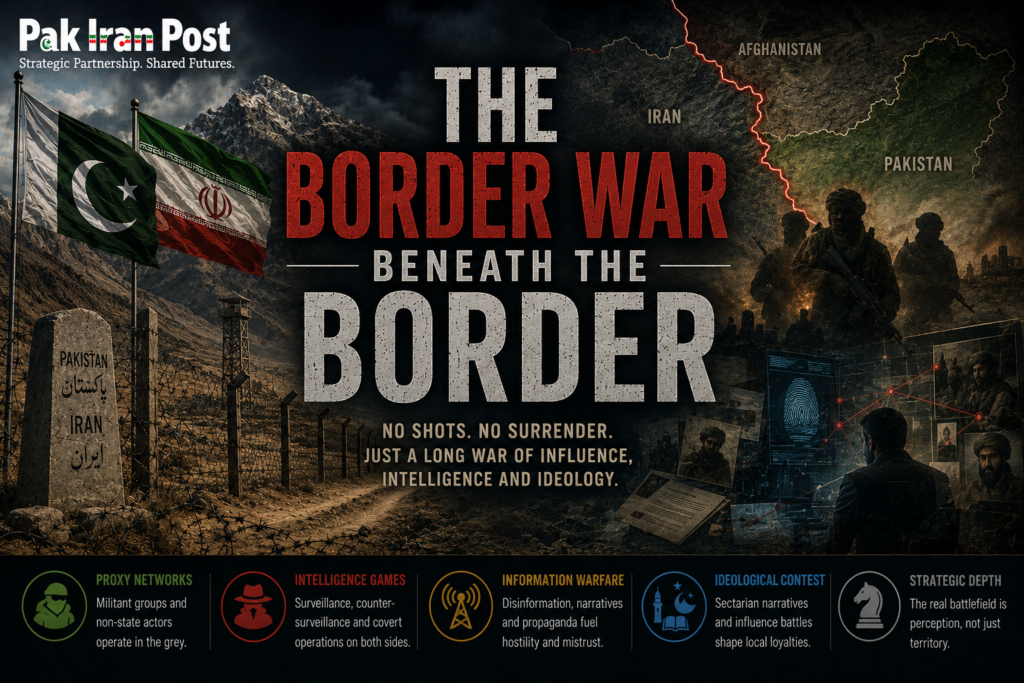
The Border War Beneath the Border

For years Pakistan and Iran have preferred to describe violence in their Baloch regions as a series of incidents. A convoy is ambushed, a police post attacked, a patrol disappears, a checkpoint is bombed, a border district is sealed, a note of protest is exchanged, and the machinery of official explanation begins again. Militants are condemned, sovereignty is invoked, hostile foreign hands are blamed, and both states promise that security cooperation will be strengthened. Then the frontier returns to its old rhythm of suspicion and neglect until the next attack. This method of narration has been politically convenient because it allows Islamabad and Tehran to preserve the fiction that the violence is episodic, manageable, and largely domestic. Yet the record of the past two years suggests something more serious. What both states are confronting is no longer a collection of discrete attacks on opposite sides of a border. It is a cross border security theatre in which insurgency, counterinsurgency, trade, diplomacy, and state legitimacy are becoming entangled in ways neither capital can afford to treat as temporary.
The most obvious evidence is that the frontier itself has ceased to behave like a passive line. It has become an active strategic space, one in which militant organisations, security agencies, smugglers, traders, local tribes, transport networks, and rival diplomatic narratives overlap. In January 2024 Iran launched missile and drone strikes into Pakistani territory, saying it had targeted bases of Jaish al Adl, a Sunni militant group operating from the Baloch belt straddling Iran and Pakistan. Islamabad responded within days with strikes inside Iran, saying it had hit camps linked to Baloch separatist organisations. It was the most serious military exchange between the two countries in years, not because either side wanted war, but because both had already lost confidence in the idea that militancy could be contained through polite bilateral complaints. Once two neighbouring states begin firing across a frontier in the name of pre empting non state actors, the question is no longer whether militancy is a domestic law and order problem. The question is whether the borderland has already become a shared security theatre whose instability can trigger interstate consequences.
That shift matters because it changes the policy unit of analysis. Pakistan has long treated Baloch militancy primarily through the grammar of internal security. Iran has treated unrest in Sistan and Baluchestan through a similarly internal lens, mixing counterterrorism, coercive policing, and claims of foreign subversion. Each approach contains part of the truth. Both states do face violent groups that attack security personnel, state installations, and civilians. Pakistan’s Baloch Liberation Army has intensified attacks on rail, road, and urban targets, including the spectacular wave of coordinated violence across Balochistan this year and the bombing of a shuttle train in Quetta. Iran, for its part, has repeatedly faced deadly attacks from Jaish al Adl in its impoverished southeastern province, including assaults on Revolutionary Guards positions and ambushes of police units. Yet the insistence on keeping these theatres conceptually separate has become increasingly artificial. The same frontier belt now carries insurgent movement, sanctuary claims, arms flows, refugee routes, informal commerce, and retaliatory state pressure. A security failure on one side rapidly becomes a diplomatic grievance on the other. A militant sanctuary allegation can become a missile strike. A border closure can become a trade shock. A customs post can become both an economic node and a target.
The temptation in both capitals is to respond to this with harder security language. More fencing, more raids, more intelligence sweeps, more accusations of foreign sponsorship, more punitive pressure on border communities. There is no doubt that states have a duty to suppress armed groups that bomb trains, attack workers, kill police, or attempt to seize state facilities. But the danger is that Pakistan and Iran are drifting toward a framework in which cross border Baloch militancy is seen only through the lens of kinetic management. That is insufficient not because force is never necessary, but because the conflict ecology in which militancy feeds is far wider than the battlefield incidents that dominate headlines. Baloch insurgent violence survives not only through ideology and weaponry but through a durable political economy of neglect, exclusion, coercion, and frontier distortion. A borderland repeatedly treated as a security buffer rather than a civic space eventually produces the very pathologies that security doctrine then cites to justify more control.
This is where the current moment becomes especially dangerous. Pakistan’s recent diplomatic rise as a mediator in the U.S.-Iran de escalation process has created a superficial impression that bilateral tensions with Tehran are now more manageable. In one sense that is true. The two states have powerful incentives not to rupture relations while trade, border management, and post crisis regional diplomacy remain in flux. But diplomacy at the top can conceal deterioration at the frontier. If anything, the new strategic environment raises the stakes of not addressing Baloch militancy as a shared theatre. Pakistan wants to expand trade with Iran, protect Gwadar, stabilise its western flank, and present itself as a credible conduit between the Gulf, Central Asia, and the Levant. Iran, under pressure to convert diplomatic breathing space into economic recovery, wants secure border trade, fewer insurgent shocks in Sistan and Baluchestan, and a reduction in the reputational damage caused by recurrent unrest in one of its poorest provinces. Both sides therefore need the frontier not merely to be quiet, but to be governable. That is a far more demanding standard than the occasional exchange of intelligence or the ritual reopening of border crossings after an incident.
The core problem is that the frontier is governed by three incompatible logics at once. The first is the security logic of both states, which sees the region as a corridor of infiltration, smuggling, separatism, and hostile intelligence activity. The second is the survival logic of local populations, for whom formal employment is scarce, public services are weak, and cross border movement, informal trade, fuel smuggling, transport work, and kinship networks are not criminal exceptions but ordinary mechanisms of life. The third is the strategic commerce logic now favoured by capitals and outside partners, in which Balochistan and Sistan-Baluchestan are imagined as corridors for ports, customs zones, highways, energy lines, and regional connectivity. These logics collide constantly. A state that securitises a livelihood route in the name of border control may unintentionally destroy one of the few income streams available to local communities. A commercial corridor built without local political settlement becomes an asset to be extorted, sabotaged, or symbolically attacked. A counterinsurgency operation that treats whole populations as suspect may produce tactical gains while deepening the social reservoir from which future militants recruit.
Pakistan’s experience in Balochistan demonstrates the dilemma. The province is rich in minerals, geostrategically central, and rhetorically indispensable to every conversation about connectivity, CPEC, Gwadar, and regional trade. Yet it remains Pakistan’s poorest province, marked by weak service delivery, chronic underrepresentation, enforced disappearance allegations, securitised governance, and a long history of distrust between the centre and peripheral populations. In such an environment militancy is not simply a military phenomenon. It is also a political language, however violent and indefensible its expression, produced by the conviction among many local actors that the province is governed for extraction, not inclusion. This does not justify attacks on civilians, labourers, teachers, rail passengers, or infrastructure. It does explain why kinetic operations alone have repeatedly failed to extinguish the insurgency. They suppress cells, disrupt networks, and impose costs. They do not answer the underlying question of why the state still struggles to convert sovereignty into legitimacy in a province that is central to its strategic imagination.
Iran’s Sistan and Baluchestan presents a different but related pattern. It is among Iran’s poorest and most marginalised provinces, with a predominantly Sunni Baluch population living under a Shia majoritarian state that has historically viewed the region through the prism of smuggling, militancy, and sectarian vulnerability. Jaish al Adl’s attacks on Iranian security personnel are real and lethal, but Tehran’s answer has often been heavily securitised repression accompanied by the claim that unrest is externally manipulated. That narrative is not wholly fabricated; regional intelligence competition is real, and Iran’s borderlands are deeply penetrated by illicit networks. But the exclusive emphasis on foreign conspiracy can become a way of refusing to confront local grievance. The result is a familiar cycle. Militancy justifies harsher policing; harsher policing deepens alienation; alienation becomes the recruitment soil for militancy. The state then reads the resulting violence as proof that the region requires even more exceptional control.
What turns these parallel failures into a shared theatre is the border itself. Militants exploit it not necessarily because it is ungoverned in a total sense, but because it is governed unevenly. Some stretches are fenced, patrolled, and surveilled. Others remain porous through terrain, kinship, corruption, and the sheer impossibility of sealing a vast impoverished frontier where the line often cuts through communities rather than separating coherent national spaces. Both states know this. Both periodically accuse the other of failing to prevent sanctuaries. Yet neither has built the institutional depth required for sustained joint mitigation. Intelligence coordination is intermittent, crisis driven, and vulnerable to political mistrust. Border mechanisms are activated after spectacular attacks, then allowed to decay. Trade facilitation and security planning remain poorly integrated. There is still no credible sense that Islamabad and Tehran share a common operating picture of the frontier rather than two competing national stories about it.
The consequences are no longer confined to security forces. Trade routes, customs depots, energy lines, road traffic, and labour movement all now sit inside the threat envelope. This is why Baloch militancy can no longer be analysed as an isolated insurgent question. If Gwadar is attacked, if workers’ camps are hit, if roads linking border markets are repeatedly closed, if customs nodes are treated as soft targets, then the issue becomes one of state reliability. Investors do not care whether a route is disrupted by separatists, smugglers, or a diplomatic standoff triggered by a cross border strike. They care whether cargo can move, insurance can be priced, personnel can be protected, and project timelines can survive. Commerce judges states by operational steadiness, not by the sophistication of their security narratives.
This matters acutely for Pakistan. Islamabad’s regional economic ambitions are increasingly tied to western connectivity. It wants Gwadar to be more than a symbolic port. It wants border trade with Iran regularised rather than episodic. It wants CPEC’s security reputation repaired after years of attacks on Chinese workers and infrastructure. It wants to present Balochistan not as a zone of insurgent veto but as a corridor of controlled opportunity linking Pakistan to the Gulf, Iran, and beyond. None of that is credible if the province remains vulnerable to recurrent insurgent shocks and if cross border militancy can at any moment trigger a new cycle of accusations with Tehran. The same is true for Iran. If Tehran hopes to use the southeastern flank as a commercial gateway and a buffer against regional instability, it cannot afford a province that repeatedly generates security headlines, retaliatory state violence, and fresh evidence of centre periphery fracture.
There is also a more subtle risk. The more both states fail to stabilise the frontier, the more they invite outside actors to define the story for them. Pakistan already frames Baloch militancy partly through the language of external sponsorship, especially Indian support for separatist violence. Iran has long spoken of foreign backed terror in Sistan and Baluchestan. Whether particular claims are true in whole, part, or not at all, the structural effect is the same: the frontier becomes a theatre in which domestic weakness is translated into geopolitical accusation. That may be tactically useful. It rallies national opinion and externalises blame. But it also deforms policy. Once every attack is narrated primarily as foreign sabotage, the incentive to reform local governance weakens. Militancy becomes something done to the state from outside rather than something also nourished by the state’s own failures inside.
The tragedy is that both Pakistan and Iran have enough evidence by now to know that the existing model does not work. The tit for tat strikes of January 2024 were supposed to shock the relationship into greater seriousness. Instead they produced the familiar pattern of de escalation at the top without structural repair below. There were visits, assurances, restored diplomatic channels, and promises of enhanced security cooperation. Yet the underlying violence did not recede into irrelevance. In Pakistan, the BLA and related networks continued to escalate attacks, including highly coordinated operations designed not merely to kill but to humiliate the state by demonstrating reach across districts and urban centres. In Iran, Jaish al Adl remained capable of mounting serious attacks on security positions in Sistan and Baluchestan. If the post strike period still produced this level of violence, the lesson is not that dialogue failed. It is that dialogue without institutional follow through merely resets the clock until the next rupture.
What would institutional follow through look like? It would begin by abandoning the illusion that a joint framework means a few more intelligence exchanges and a photo opportunity at the border. A real Pakistan-Iran stabilisation compact would have to combine security cooperation with protected commerce and local political concessions. Those elements are often discussed separately because states prefer the cleaner language of security. In reality they are inseparable. Intelligence coordination without local economic relief simply produces more efficient repression in a socially combustible environment. Trade facilitation without security discipline creates profitable targets for militants. Border development without political representation risks looking like extraction under guard.
The first requirement is a disciplined bilateral protocol for handling cross border accusations. At present the frontier remains vulnerable to escalation because allegations of sanctuary, infiltration, or shelling can move rapidly into public recrimination. Both states need a standing mechanism, insulated as far as possible from daily diplomatic mood swings, through which intelligence claims can be tabled, verified, contested, and acted upon before they harden into public confrontation. This should include direct military to military channels, a time bound evidence sharing procedure, and a rule against public attribution until a joint review window has been exhausted except in cases of immediate emergency. The aim is not to suppress truth but to prevent every frontier incident from becoming a test of nationalist theatre.
The second requirement is the creation of protected trade corridors rather than the current model of trade as an afterthought to security. If border markets, customs terminals, and transport routes are serious national priorities, they must be secured as such. That means dedicated corridor protection units trained not merely in checkpoint policing but in convoy security, route surveillance, emergency medical response, and rapid reopening protocols after attacks. It also means mapping which stretches of the frontier are economically indispensable and designing layered protection around them rather than spreading security resources thinly across symbolic infrastructure while actual commerce remains exposed. Protected trade routes would not end militancy, but they would reduce the ability of insurgents to convert every attack into a broader narrative of state incapacity.
Third, both states need to confront the economic contradiction at the heart of the borderland. For large sections of the local population, informal trade and smuggling are not peripheral criminal activities but the de facto welfare system of a neglected frontier. States can either continue criminalising that reality while quietly depending on it to absorb unemployment, or they can formalise parts of it through licensed border markets, fuel trade quotas, simplified customs for small traders, and local transport permits. Formalisation would not eliminate illicit flows, but it would begin to shift the incentive structure. A community with legal stakes in cross border commerce is not automatically loyal to the state, but it is less likely to see every security crackdown as an assault on survival itself.
Fourth, there must be a political correction inside the provinces themselves. No stabilisation framework can work if Baloch regions remain governed primarily through intelligence files, coercive visibility, and elite brokerage. Pakistan, especially, has to decide whether Balochistan is a security colony or a political unit of the federation. That means not merely more development spending announced from Islamabad, but local representation that is meaningful enough to shape resource distribution, policing priorities, compensation mechanisms, and oversight of disappearances and detentions. Iran faces an analogous challenge in Sistan and Baluchestan, where Sunni Baluch grievances over representation, discrimination, and poverty cannot be indefinitely answered by executions, raids, and anti terror rhetoric. Militancy will not disappear because states become kinder. But it will remain easier to recruit, justify, and hide as long as populations believe they are ruled rather than represented.
None of this is easy, and none of it guarantees success. Militant organisations are adaptive. Some are ideologically hardened. Some are embedded in criminal economies. Some benefit from external sympathy, diaspora support, or regional intelligence games. A joint stabilisation framework would therefore have to accept that the goal is not total pacification in the near term but a reduction in the frontier’s capacity to generate cascading crises. The standard should be modest but meaningful: fewer cross border sanctuary accusations, faster intelligence handling, reduced disruption to trade, more resilient transport corridors, and a measurable shift in local economic participation. In other words, the objective is not to solve Baloch militancy once and for all. It is to stop the borderland from functioning as a permanent spoiler of diplomacy, commerce, and state legitimacy.
There is one further reason this matters now. Pakistan and Iran are both entering a period in which external partners will judge them not only by their diplomatic posture but by their capacity to govern difficult peripheries. Pakistan wants foreign investment, Gulf confidence, Chinese reassurance, and regional trade credibility. Iran wants sanctions relief translated into actual economic openings and a reduction in the perception that its southeastern flank is a chronic liability. In both cases the Baloch frontier is no longer peripheral to strategic image. It is central to it. A state that cannot keep trains safe, secure workers’ camps, protect customs corridors, and prevent frontier incidents from becoming missile exchanges will struggle to convince outsiders that its grander connectivity ambitions are more than cartographic optimism.
The deepest issue, however, is one of legitimacy. States often assume legitimacy is produced by control. In frontier regions the opposite can be true. Control without political settlement becomes brittle. It requires constant demonstrations of force, and every insurgent attack becomes not just a tactical problem but a symbolic humiliation. This is one reason Baloch militancy has such disproportionate strategic effect. It does not need to overthrow the state to wound it. It only needs to show that heavily securitised territories remain penetrable, that economic corridors remain vulnerable, and that governments claiming strategic mastery still cannot prevent spectacular disruption. Every train bombing, every coordinated raid, every cross border strike exposes the gap between the state’s language of authority and its lived performance of governance.
Pakistan and Iran therefore face a choice they have postponed for too long. They can continue treating insurgent violence in their Baloch regions as a sequence of attacks to be managed through retaliation, accusation, and temporary bilateral repair. If they do, the pattern is already visible: more violence, more closures, more diplomatic strain, and more strategic projects forced to operate under the shadow of a frontier that neither state truly governs. Or they can recognise that the borderland has become a single security theatre whose stabilisation requires a more adult bargain between sovereignty and candour. Such a bargain would acknowledge that neither capital can kill its way out of the problem, that local populations cannot be permanently treated as suspect communities, and that trade corridors protected only by force remain vulnerable so long as the politics beneath them remain broken.
That recognition would not require sentimentality toward insurgents, nor naïveté about the reality of violent anti state groups. It would require something harder: the admission that the frontier’s instability is not an accidental interruption of national strategy but one of the places where national strategy is being tested most brutally. The Pakistan-Iran border is no longer just a line separating two troubled provinces. It is a mirror in which both states can see the limits of their current method. They have securitised without settling, traded without stabilising, and centralised without persuading. Militancy has exploited each failure.
If Islamabad and Tehran are serious about preventing the next frontier crisis from becoming another diplomatic rupture, then the next year should not be spent merely on fresh declarations of brotherhood or fresh promises to punish terrorists. It should be spent building a joint stabilisation architecture with real operating rules: protected commercial corridors, institutionalised intelligence channels, local economic concessions, de escalation procedures for border incidents, and a measurable programme of political inclusion in the districts that have for too long existed only as buffer zones in national imagination. Without that, Baloch militancy will continue to do what it has already begun to do. It will function not only as an insurgency against two states, but as a strategic spoiler capable of sabotaging pipelines, ports, highways, diplomatic openings, and the very claim of both governments that they can turn geography into advantage.
The frontier is no longer warning Islamabad and Tehran in subtle terms. It has already fired missiles into their assumptions. The question now is whether they will keep reading the violence as a series of episodes, or finally recognise that the theatre has already been built around them.
A Public Service Message