
Tehran at the Crossroads: Economic Strain, Sanctions, and the Dynamics of Nuclear Posturing

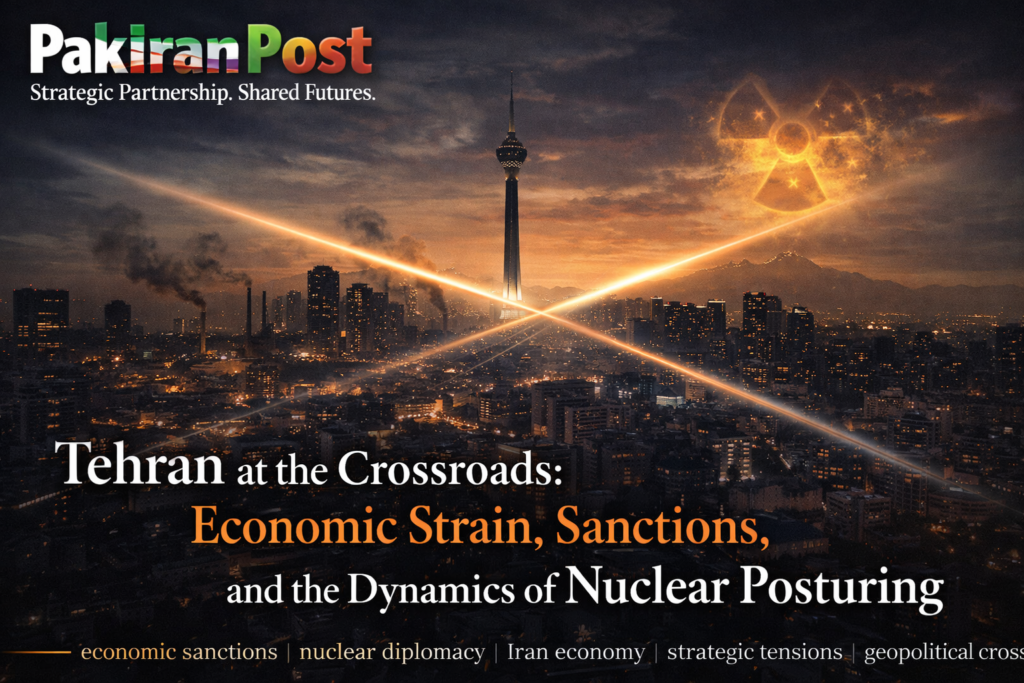
Iran’s economic and strategic calculus in 2026 is at a critical inflection point, shaped by a convergence of international sanctions, regional rivalries, and the domestic imperative to maintain both political stability and international leverage. The combination of oil export restrictions, financial pressure from Western and Gulf actors, and the persistent threat of military confrontation has compelled Tehran to recalibrate its approach to nuclear policy, economic engagement, and regional diplomacy. For Pakistan, understanding the implications of this recalibration is essential, as the interplay between Iran’s economic stress, nuclear brinkmanship, and regional influence directly affects Islamabad’s energy security, border management, and diplomatic posture in a highly volatile environment. The current juncture represents a multi-dimensional challenge, encompassing the strategic, economic, technological, and political domains, each of which has immediate and long-term consequences for Pakistan’s regional positioning.
The Iranian economy, heavily reliant on hydrocarbon exports, has experienced recurrent disruptions as sanctions have intensified over the past decade. In 2026, the combination of U.S. secondary sanctions, pressure from European financial institutions, and competitive dynamics within global energy markets has led to a significant contraction in export revenues. The reduction in oil and gas income directly affects Tehran’s fiscal capacity to sustain domestic programs, military expenditure, and regional influence operations. This economic squeeze has a cascading impact on Tehran’s policy options. The leadership is compelled to pursue strategic leverage that can offset the financial shortfall, including nuclear brinkmanship, control over critical maritime chokepoints such as Hormuz and Bab al-Mandeb, and pressure tactics aimed at extracting concessions from regional rivals and global powers. For Pakistan, which relies on stable energy supplies and cross-border trade corridors with Iran, these dynamics create both uncertainty and operational risk, requiring proactive engagement and contingency planning.
Nuclear brinkmanship has become a central component of Tehran’s strategic toolkit. The development and demonstration of nuclear capabilities serve multiple functions: signaling deterrence to external powers, consolidating internal political legitimacy, and enhancing bargaining power in diplomatic negotiations. The potential for nuclear escalation, even as a calculated signaling mechanism, has direct implications for regional security. Pakistan’s policy planners must consider not only the technical aspects of Iran’s nuclear capabilities but also the broader strategic psychology, including Tehran’s propensity to link nuclear signaling with economic or geopolitical objectives. The implications extend to the defense posture along Pakistan’s western frontier, intelligence gathering priorities, and regional diplomatic engagement, particularly in maintaining equilibrium with Gulf states and other nuclear-capable actors in the region.
The economic dimension of Iran’s current position is intricately linked with its nuclear policy. By projecting nuclear resolve, Tehran seeks to dissuade further punitive measures, safeguard its remaining export capacity, and maintain leverage in international negotiations. The recalibration of foreign policy under these pressures is visible in Iran’s approach to cross-border trade, infrastructure development, and regional energy projects. The country has sought to secure alternative revenue streams through bilateral agreements with countries willing to circumvent sanctions regimes, leveraging geopolitical alignment and strategic interdependence to sustain critical economic functions. Pakistan, sharing both a border and energy needs with Iran, is strategically positioned to engage in these economic dialogues while balancing international expectations and domestic imperatives. This creates an opportunity for Islamabad to navigate a fine line between fostering energy security and avoiding entanglement in potential escalatory cycles.
The maritime dimension, particularly Tehran’s leverage over the Strait of Hormuz and Bab al-Mandeb, further complicates the strategic landscape. Control over these chokepoints enables Iran to influence global energy flows, disrupt adversary logistics, and exert indirect pressure on Gulf economies. For Pakistan, the operational implications include the potential disruption of maritime trade routes, increased volatility in energy prices, and a heightened need for strategic coordination with both regional and international partners. The possibility of Iran utilizing its maritime influence as a bargaining chip in response to economic stress underscores the interconnection between economic resilience, nuclear signaling, and regional security calculus. Pakistan’s policy response must therefore integrate maritime risk assessment into broader energy security and economic planning frameworks.
Iran’s domestic political environment is also a key factor in understanding the nexus between economic pressure and nuclear brinkmanship. Internal dissent, public unrest due to inflation and economic contraction, and factional competition within the political establishment compel Tehran to adopt assertive external strategies that can reinforce domestic legitimacy. Nuclear signaling and regional posturing serve as tools to consolidate political support, divert attention from domestic challenges, and strengthen Iran’s negotiating position internationally. Pakistan, observing these dynamics, must recognize that the implications for border security, cross-border economic activity, and regional stability are influenced not only by Tehran’s external calculations but also by internal socio-political pressures that may escalate unpredictably.
The interaction between Iran’s economic stress and regional rivalries further amplifies the strategic complexity. Relations with Saudi Arabia, the UAE, and other Gulf actors are increasingly transactional, with competition over energy markets, influence in Yemen, and geopolitical positioning shaping the broader security environment. Iran’s nuclear brinkmanship is therefore intertwined with regional power projection, proxy engagement, and strategic signaling, creating a multi-layered challenge for Pakistan, which seeks to maintain balanced relations with both Tehran and Riyadh while safeguarding its economic and security interests. The balancing act requires nuanced diplomacy, intelligence-driven policy formulation, and contingency planning to address the cascading consequences of any escalation in nuclear or regional tension.
Technological factors play an essential role in this recalibration. Iran’s nuclear capabilities, missile program, and cyber infrastructure are integral to its strategic posture, providing leverage that can be operationalized in both deterrent and coercive frameworks. Pakistan’s strategic planners must therefore evaluate not only the immediate military risks but also the indirect implications of technology diffusion, regional defense posturing, and potential proxy adaptation of advanced systems. The operational lessons from Iran’s deployment of asymmetric capabilities in Syria, Yemen, and Iraq offer critical insights into the possible extension of these tactics into the South Asian context, particularly along Pakistan’s western borders where monitoring and interdiction are challenging.
The regional economic dimension is closely connected to Pakistan’s policy calculus. Iran’s pressure on energy exports, fluctuating crude prices, and sanctions-induced scarcity have a direct impact on Islamabad’s energy procurement strategy, including reliance on cross-border gas pipelines, imports, and storage infrastructure. The potential for disruption in these supplies creates both operational and fiscal stress, requiring Pakistan to explore alternative sourcing, diversify trade relationships, and engage diplomatically to stabilize bilateral energy flows. Moreover, Tehran’s economic recalibration and nuclear signaling influence regional investor confidence, cross-border infrastructure projects, and long-term economic planning in neighboring states, emphasizing the interdependence of security, diplomacy, and economic policy.
Pakistan’s diplomatic positioning is further complicated by the interlinked pressures of U.S. sanctions, Gulf competition, and regional alliances. While Pakistan seeks to maintain a neutral posture in the Iran-Saudi rivalry, Tehran’s assertive nuclear signaling and economic pressures necessitate calibrated engagement to prevent spillover risks. Islamabad must balance strategic patience with proactive diplomacy, leveraging economic interdependence, cross-border trade facilitation, and intelligence cooperation to manage potential crises while maintaining credibility with multiple stakeholders. The policy challenge is magnified by the fluidity of regional alignments, historical sensitivities, and evolving military capabilities that intersect across the Middle East and South Asia.
The social dimension is equally significant. Economic stress in Iran has the potential to exacerbate migration flows, cross-border smuggling, and local unrest in border regions. Pakistan’s border communities in Balochistan and Khyber Pakhtunkhwa may face indirect effects, including increased trafficking, pressure on local resources, and security challenges arising from displaced populations. Anticipating and managing these socio-economic spillovers is an essential component of Pakistan’s holistic strategy, requiring coordination among defense, economic, and social development agencies to ensure resilience against both immediate and long-term pressures.
In conclusion, Iran’s current trajectory, defined by economic pressure, sanctions-induced contraction, and nuclear brinkmanship, represents a complex strategic challenge with multi-dimensional implications for Pakistan. The convergence of energy dependence, border security, regional alliances, and technological proliferation demands a comprehensive, anticipatory, and adaptive approach. Pakistan’s strategy must integrate economic planning, defense preparedness, diplomatic engagement, and social resilience into a coherent framework capable of mitigating risks while preserving national interests. The interplay between Tehran’s economic stress and nuclear signaling is not an isolated phenomenon but a structural factor shaping regional security, energy markets, and geopolitical alignment in South Asia. By understanding the full spectrum of Iran’s strategic calculations, Islamabad can navigate the emerging regional fault lines with prudence, foresight, and operational readiness, ensuring that Pakistan remains both secure and influential in an increasingly complex and volatile environment.
A Public Service Message