
Shaping Regional Security Architecture: Pakistan’s Strategic Role in a Post-Conflict Gulf

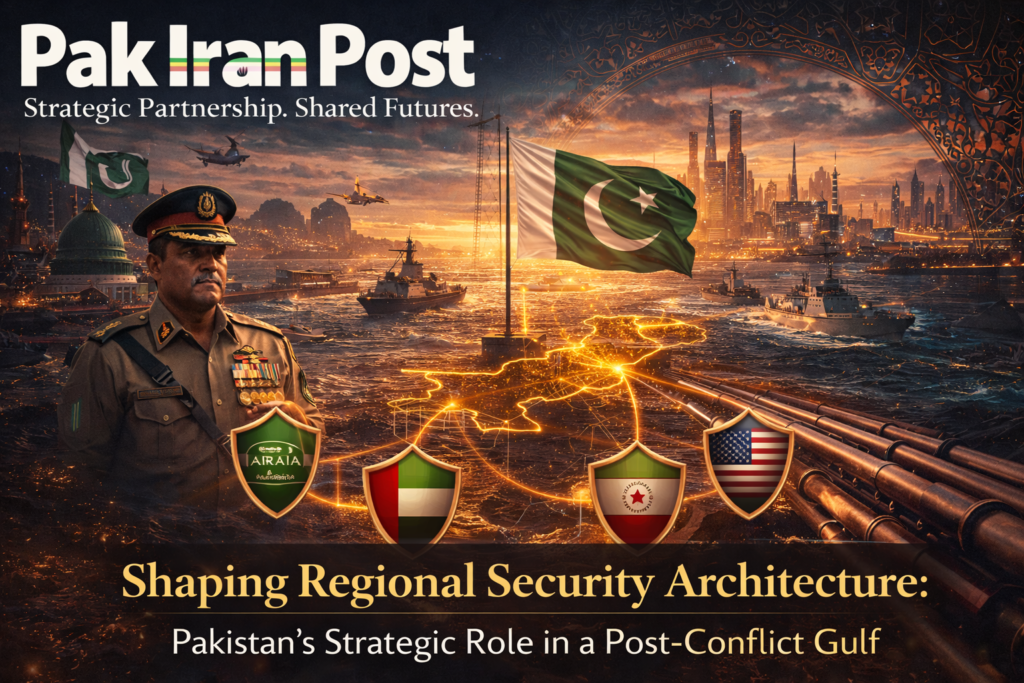
The Gulf region is entering a period of unprecedented transformation, with the fallout of ongoing conflicts creating both risks and opportunities for regional and global actors. The interplay of great power competition, regional rivalries, and the monetization of strategic chokepoints such as the Strait of Hormuz has fundamentally altered the security landscape. For Pakistan, this moment represents a historic opportunity to assert itself as a stabilizing actor, consolidate influence, and convert strategic proximity into tangible national advantage. The question before Islamabad is how to navigate a complex, high-stakes environment to secure energy flows, enhance economic stability, and establish itself as an indispensable player in shaping the emerging post-conflict regional security architecture.
Pakistan’s historical experience in regional balancing provides a unique foundation for engagement. Islamabad has cultivated relationships with Iran, Gulf states, China, and the United States over decades, combining diplomatic channels, defense cooperation, and economic partnerships. This historical positioning provides leverage to act as a mediator and operational partner in the restructuring of Gulf security frameworks. The post-conflict environment is characterized by the emergence of new transit regimes, regional coordination on energy flows, and the establishment of selective access frameworks. These developments create opportunities for Pakistan to embed itself within decision-making structures, influence corridor management, and participate in the design of emerging regional security norms.
The first imperative is to secure Pakistan’s role in energy and transit corridor governance. The Strait of Hormuz, previously considered a global commons, is now being monetized through transit fees, security levies, and insurance regimes. Iran’s initiative to transform strategic geography into sovereign revenue highlights the growing intersection of energy security and economic leverage. Pakistan must negotiate participation in these frameworks to ensure uninterrupted access to energy imports, a share in revenue flows, and influence over corridor management decisions. This requires sustained diplomacy, formalized agreements, and integration of infrastructure such as Gwadar Port into regional energy distribution networks.
Gwadar Port is central to Pakistan’s strategic approach. Its deep-water capacity, strategic location, and integration into the China-Pakistan Economic Corridor enable it to function as a hub for transshipment, energy storage, and commercial logistics. By connecting Gwadar to regional energy corridors, Pakistan can capture value from both commercial and strategic flows. Investments in port capacity, modern logistics infrastructure, and energy handling facilities are essential to enable Pakistan to operate as a reliable, capable, and recognized partner in post-conflict regional trade and energy security.
Security integration is equally critical. Pakistan’s navy, coast guard, and intelligence agencies must participate in maritime security operations, corridor monitoring, and risk mitigation measures. Joint exercises, intelligence sharing, and operational coordination with Gulf states and Iran enhance Pakistan’s credibility and provide reassurance to commercial actors. A robust security posture reduces insurance costs, mitigates risks of supply disruption, and positions Pakistan as a credible facilitator of stability in one of the most strategically sensitive regions in the world.
Diplomacy underpins Pakistan’s ability to balance competing interests. The country must maintain strong relationships with Iran, Gulf states, China, and the United States simultaneously. This requires transparent multilateral engagement, adherence to international norms, and the presentation of Pakistan’s role as stabilizing rather than partisan. By emphasizing neutrality, operational competence, and facilitation, Islamabad can secure strategic space, influence regional outcomes, and prevent overexposure or alignment perceptions that could trigger sanctions or diplomatic friction.
Economic integration complements strategic and security efforts. Participation in corridor management enables Pakistan to generate revenue from shipping facilitation, insurance underwriting, and logistical services. The integration of Gwadar into regional networks strengthens Pakistan’s geoeconomic relevance, enhances foreign exchange reserves, and reduces vulnerabilities from energy price shocks. Combined with energy diversification strategies, including the revitalization of the Iran-Pakistan gas pipeline, investment in LNG infrastructure, and exploration of renewable energy options, Pakistan can mitigate dependence on a single source while reinforcing long-term fiscal stability.
Institutional capacity is essential for sustained influence. Pakistan must establish dedicated centers for energy, maritime, and security coordination. These institutions should integrate expertise in international law, naval operations, energy economics, and diplomatic engagement. By institutionalizing policy, operational oversight, and strategic planning, Pakistan ensures continuity across administrations, enables rapid response to emerging crises, and strengthens its credibility as a reliable regional partner. Human capital development, through specialized training programs and operational exercises, further reinforces Pakistan’s capability to manage complex multilateral arrangements.
Technology is a force multiplier. Real-time vessel tracking, predictive analytics, secure communication platforms, and cyber defense mechanisms enhance Pakistan’s ability to manage corridors effectively. Digital logistics platforms enable efficient energy distribution, risk management, and operational coordination with regional partners. Investments in satellite surveillance, maritime domain awareness, and secure data integration strengthen Pakistan’s operational credibility and ensure that it is capable of executing high-stakes missions in real time.
Risk management is central to Pakistan’s strategy. The Gulf remains volatile, and miscalculations could have cascaded economic, diplomatic, and security consequences. Pakistan must maintain alternative energy routes, develop contingency supply chains, and preserve diplomatic backchannels to mitigate potential disruptions. Scenario planning, stress testing, and multilateral coordination reduce the probability of adverse outcomes while ensuring that Pakistan remains a stabilizing actor rather than a passive victim of regional turbulence.
Policy recommendations for Islamabad are multifaceted. Immediate steps include negotiating formal agreements for participation in energy corridor governance, integrating Gwadar Port into regional logistics and energy networks, and establishing operational protocols for maritime security and corridor monitoring. Pakistan must invest in infrastructure modernization, digital logistics platforms, and port capacity enhancement. Security coordination should include joint exercises, intelligence sharing, and contingency planning. Diplomatic initiatives must focus on maintaining equilibrium among competing powers while promoting Pakistan’s neutral and stabilizing role. Long-term strategies include institutional capacity building, human capital development, energy diversification, and technological investment to sustain credibility and influence over decades.
The strategic dividends of this approach are significant. By embedding itself in the design and management of regional security architectures, Pakistan gains leverage over energy flows, enhances regional credibility, and secures tangible economic benefits. Active participation in corridor management and energy security strengthens bargaining power with global powers, ensures access to critical energy and trade resources, and reinforces Pakistan’s standing in multilateral forums. These outcomes collectively elevate Pakistan’s regional relevance and global diplomatic stature.
The geostrategic implications extend beyond immediate operational gains. Pakistan’s ability to mediate, facilitate, and secure corridors demonstrates the capacity of regional actors to influence high-stakes outcomes in a multipolar world. Successful implementation reinforces Pakistan’s autonomy, strengthens its negotiation leverage, and positions it as a credible stabilizer in regional security frameworks. The credibility achieved through sustained engagement enables Pakistan to participate in shaping norms, protocols, and operational standards for regional energy and security coordination, creating long-term strategic influence.
Execution requires a phased and systematic approach. Phase one focuses on securing formal recognition as a partner in corridor governance, establishing operational protocols, and initiating infrastructure development. Phase two emphasizes security coordination, joint exercises, and technology integration to ensure operational readiness and reliability. Phase three consolidates institutional capacity, human capital development, and long-term strategic planning, ensuring continuity and resilience in Pakistan’s role. This phased strategy ensures that engagement is credible, structured, and capable of producing measurable economic, diplomatic, and strategic outcomes.
International collaboration enhances legitimacy and operational efficiency. Engagement with China, the United States, and multilateral institutions provides technical expertise, investment, and diplomatic support. Multilateral engagement ensures alignment with global norms, facilitates operational coordination, and reduces vulnerability to unilateral pressures. This approach positions Pakistan as a responsible actor capable of integrating national priorities with regional and global objectives. By leveraging international partnerships, Pakistan strengthens its operational credibility and secures long-term strategic influence.
In conclusion, the post-conflict Gulf environment presents Pakistan with a historic opportunity to convert vulnerability into strategic advantage. By integrating diplomacy, security coordination, infrastructure development, and economic policy, Pakistan can assert itself as a central actor in shaping regional security architecture. Participation in corridor management, energy stabilization, and maritime oversight ensures national resilience, strengthens foreign exchange reserves, and elevates Pakistan’s diplomatic stature.
Pakistan’s success will be measured by its ability to institutionalize influence, operationalize infrastructure, and generate tangible economic and strategic benefits. By adopting a proactive, technology-enabled, and diplomatically nuanced approach, Islamabad can shape outcomes in the Gulf, secure access to critical energy and trade flows, and emerge as a recognized regional power broker. The effective integration of diplomacy, security, economic strategy, and technology transforms Pakistan from a reactive observer into an architect of stability, capable of navigating complex geopolitics and producing durable national advantage.
This is a strategic inflection point for Pakistan. By embracing the opportunity to participate in post-conflict Gulf security architecture, Islamabad strengthens its autonomy, consolidates regional influence, and enhances its economic and diplomatic resilience. Active engagement ensures that Pakistan emerges from regional turbulence not as a peripheral actor but as a central node in the design of regional stability, energy security, and strategic connectivity. By converting challenge into opportunity, Pakistan secures long-term relevance, operational credibility, and sustainable national advantage in a highly dynamic regional environment.