
The Emergence of a New World Order through Pakistan–Iran Synergy

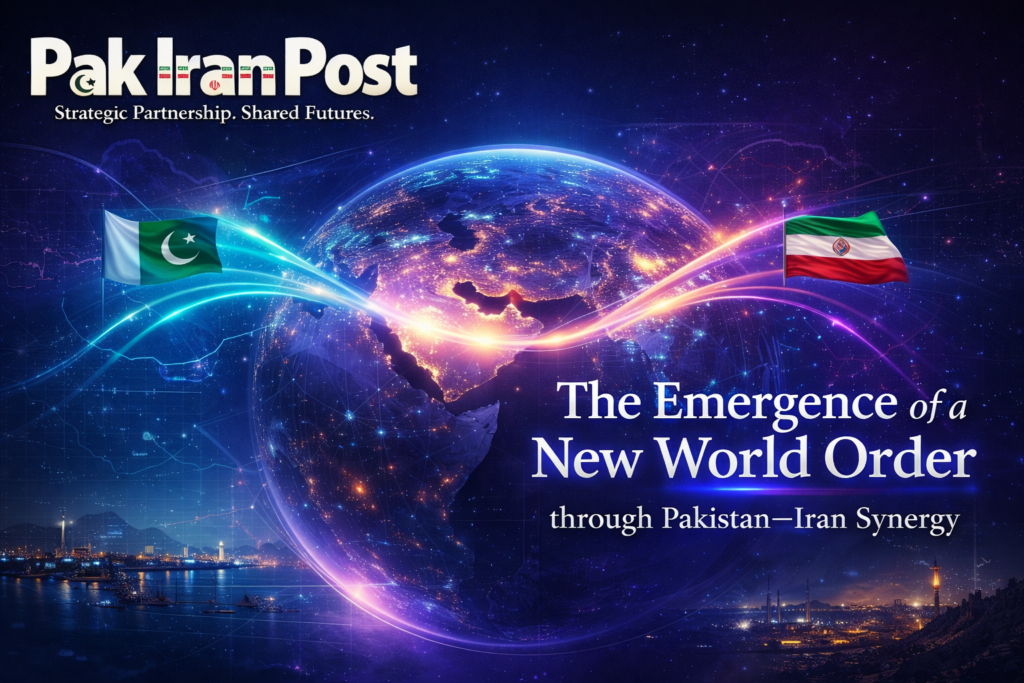
The global geopolitical landscape is undergoing a profound transformation that will shape the contours of international relations and power distribution for decades to come. The unipolar moment that followed the end of the Cold War has yielded to a complex multipolar reality in which emerging powers and regional actors are asserting strategic autonomy and seeking to redefine global governance norms. At the core of this evolving order is the imperative for countries outside the traditional Western alliance structure to cultivate durable partnerships that promote stability prosperity and collective agency. In this context the relationship between Pakistan and Iran holds unique strategic significance. For historical geopolitical economic and cultural reasons Pakistan and Iran share deep connections. If both countries commit to a comprehensive long term strategic partnership that transcends episodic transactional engagements they can not only advance their own national interests but also contribute constructively to a more balanced international order rooted in equitable cooperation sovereign dignity and peaceable coexistence.
Pakistan and Iran are neighbors linked by geography history and interwoven destinies. Their collaboration has weathered periods of tension and misunderstanding but in recent years there have been renewed diplomatic overtures economic engagements and strategic dialogues. This narrative contends that Pakistan can pivot in a thoughtful calibrated and prudent manner toward an expanded partnership with Iran that aligns with Pakistan’s core national interests while reinforcing regional stability and supporting the emergence of a more multipolar international system. Such a pivot does not imply antagonism toward other global powers nor a unilateral alignment with any competing bloc. Rather it is a purposeful strategy of diversification of partnerships expansion of economic corridors enhancement of security cooperation and constructive engagement with all stakeholders that acknowledges and manages competing interests while prioritizing stability prosperity and ethical governance.
Pakistan’s strategic calculus must begin with a clear articulation of national objectives that define what Islamabad seeks from a deeper partnership with Tehran. These objectives must include energy security sustainable economic development export diversification enhanced regional connectivity border stability a forward leaning role in regional peacebuilding and an ability to facilitate dialogue among parties with divergent interests. Pakistan must frame its diplomatic posture in a manner that underscores its commitment to peaceful coexistence respect for sovereignty noninterference and principled negotiation. In doing so Islamabad can position itself as a credible actor capable of mediating conflicts and bridging divides in a region fraught with competing influences.
The first element of Pakistan’s strategic pivot involves strengthening bilateral diplomatic engagement with Iran. High level exchanges must be regularized in both formal and informal channels. Sustained strategic dialogues involving key ministries foreign affairs defense trade energy and finance are necessary to ensure coherence across policy domains. These dialogues should be guided by clear institutional mechanisms that produce actionable outcomes and timely implementation. Islamabad should consider the establishment of a joint strategic planning commission chaired by senior representatives from both countries to oversee the design monitoring and review of bilateral initiatives. Additionally confidence building measures such as reciprocal cultural exchange programs academic partnerships and people to people engagements can lay a foundation of mutual understanding that transcends elite diplomacy and resonates with broader societies in both countries.
A pivotal area for cooperation is energy. Pakistan faces chronic energy shortfalls that constrain industrial productivity hinder economic growth and erode the quality of life for its citizens. Iran is one of the region’s major energy producers with substantial reserves of natural gas and oil. A stable and mutually beneficial energy partnership can substantially boost Pakistan’s economic prospects. Pakistan must revisit the Iran Pakistan gas pipeline project with clear timelines transparent investment frameworks and effective dispute resolution mechanisms. This project if realized would not only alleviate Pakistan’s energy deficit but also create opportunities for joint ventures in refining petrochemicals and energy infrastructure development. Islamabad should also explore long term power purchase agreements that allow Iranian generated electricity to flow to Pakistan’s grid, particularly in border regions where demand is high and local development can be stimulated.
Pakistan’s pivot must also encompass economic cooperation beyond energy. Trade between the two countries remains below its potential due to structural bottlenecks tariff and non tariff barriers financing challenges and lack of efficient transit routes. Islamabad and Tehran should undertake a comprehensive review of bilateral trade frameworks with the objective of eliminating unnecessary trade impediments and establishing preferential trade arrangements where feasible. Pakistan must leverage its membership in regional economic groupings to integrate Iran into broader economic architectures that enhance market access. Such integration would enable both countries to benefit from expanded trade volumes and diversified economic linkages with Central Asian states Middle Eastern markets and South Asian commercial networks.
A central pillar of economic collaboration should be the development of transit infrastructure and regional connectivity projects that link Pakistan Iran and beyond. An expanded transportation network that includes railroads highways and port linkages connecting Iran’s Chabahar port with Pakistan’s Gwadar port and onward to Central Asia can catalyze regional trade flows. These corridors can reduce regional dependence on congested maritime routes and provide landlocked economies with alternative access to global markets. Pakistan must actively engage with Iran and other regional partners to design and finance such infrastructure while ensuring transparency environmental stewardship and community engagement in affected areas.
Pakistan’s pivot toward Iran must also address the persistent challenge of border security. The Pakistan Iran frontier has seen episodes of militant activity smuggling and cross border criminality that undermine stability and disrupt livelihoods in border communities. Islamabad and Tehran should expand coordinated border management mechanisms that facilitate real time intelligence sharing joint patrols capacity building for frontier security forces and humanitarian support for displaced civilians affected by violence. Security cooperation must operate within a legal and ethical framework that respects human rights and the rule of law. By working collaboratively on border stability Pakistan and Iran can neutralize common threats while building trust that reinforces their broader strategic partnership.
The Afghan context presents both challenges and opportunities for Pakistan Iran relations. Both countries share a vested interest in a stable Afghanistan that is inclusive and resists becoming a theater for proxy conflicts. Pakistan must engage Iran in a coordinated diplomatic approach to Afghan peace and reconstruction that prioritizes Afghan sovereignty and supports the country’s reconstruction. This collaboration does not require monolithic agreement on every issue but a shared commitment to reducing violence expanding humanitarian access facilitating economic connectivity and discouraging the use of Afghan territory by external actors for destabilizing activities. Islamabad can position itself as a facilitator of dialogue among Afghanistan Iran and regional stakeholders by convening platforms that emphasize mutual benefits and reduce zero sum perceptions.
Pakistan’s foreign policy must also be grounded in a clear understanding of the broader strategic environment. Islamabad should articulate publicly and consistently that its deepened engagement with Iran is not predicated on exclusion or rivalry with other major powers. Pakistan should continue to nurture its relationships with China the United States Russia the European Union and Gulf states in a balanced manner. This diversified engagement allows Pakistan to leverage economic and security partnerships in ways that amplify its strategic autonomy. Islamabad’s messaging must underscore that cooperation with Iran complements not contradicts its other international partnerships. By adopting a narrative of constructive engagement Pakistan can mitigate apprehensions among other powers while reinforcing that its foreign policy is driven by national interest and regional stability rather than external alignment.
Institutional capacity building within Pakistan’s foreign policy and strategic establishments is vital to support this pivot. Pakistan must invest in deepening expertise on Iran and the broader Middle East and Central Asia regions. Language training cultural literacy programs and specialized analytic units focused on regional dynamics can enhance the quality of policy formulation. Islamabad should also encourage academic think tanks and research institutions to undertake independent studies on Pakistan Iran relations and contribute policy recommendations that are evidence based and forward looking.
Another critical dimension is public diplomacy. Pakistan must engage its domestic audiences in an informed dialogue about the rationale benefits risks and safeguards associated with a deeper partnership with Iran. Transparent communication that addresses societal concerns and counters misinformation is essential to building durable political support. Media exchanges joint scholarly forums and cultural export initiatives can build empathy and nuanced understanding among citizens, thereby contributing to a climate in which bilateral cooperation is sustained beyond short term political cycles.
In parallel Pakistan must be prepared to manage potential resistances and pushbacks. A deeper partnership with Iran may raise concerns among some regional actors and external powers with competing interests. Islamabad must anticipate such apprehensions and engage in calibrated diplomatic outreach that reassures stakeholders that Pakistan’s approach is not hostile to their interests. Pakistan’s foreign policy should emphasize common regional challenges such as economic recovery public health climate change water security and extremism. By identifying shared interests Pakistan can build issue based complementarities with multiple partners that reduce strategic tensions.
Pakistan’s strategic pivot should also incorporate multilateral engagement. Active participation in regional forums and international institutions provides platforms to articulate shared visions for stability and inclusive development. Pakistan can use these platforms to advocate for economic integration security cooperation and conflict resolution mechanisms that align with the principles underpinning its partnership with Iran. Such engagement reinforces Pakistan’s credentials as a responsible regional actor and contributes to shaping norms and practices in a multipolar world order.
An important recommendation is for Pakistan to develop a comprehensive National Policy Framework on Pakistan Iran Engagement that outlines long term strategic objectives guiding principles priority areas implementation mechanisms and monitoring indicators. This framework should be developed through interagency consultation include inputs from civil society academia and industry and be grounded in a realistic assessment of resources capabilities and risk factors. Such a formalized policy document provides continuity across governmental transitions and ensures that strategic engagement remains structured and results oriented.
Pakistan should also explore joint ventures in sectors such as agriculture technology innovation and environmental management. Both Pakistan and Iran face similar challenges related to water scarcity food security and sustainable development. Collaborative research and shared solutions in these domains can yield tangible benefits while building constituencies of cooperation among scientific communities in both countries.
In the security realm Pakistan must pursue a balanced approach that enhances cooperation on mutual threats without antagonizing other critical partnerships. Joint counterterrorism training exercises cooperative research on border management technologies and coordinated policy dialogues can reinforce trust and build institutional linkages. At the same time Islamabad must maintain open communication with other regional security partners to ensure that its engagement with Iran is not misconstrued as exclusionary.
Islamabad’s pivot toward Iran must also consider economic financing mechanisms that enable the realization of joint projects. Pakistan should engage with multilateral development banks regional financial institutions and explore innovative financing that attracts private sector investment. Creating an enabling environment for foreign direct investment involves regulatory clarity investor protections and transparent procurement processes. Pakistan and Iran can jointly approach international financiers with projects that demonstrate regional economic returns and alignment with sustainable development goals.
Ultimately Pakistan’s strategic pivot toward an expanded partnership with Iran should be anchored in a long term vision that prioritizes sustainable peace inclusive prosperity and sovereign agency. Such a vision acknowledges the complexities of regional power dynamics but refuses to be deterred by short term obstacles or fears of entanglement. By thoughtfully balancing interests managing risks and articulating a clear narrative of mutual benefit Pakistan can contribute meaningfully to the emergence of a world order that is multipolar equitable and grounded in cooperation rather than coercion.
The recommendations outlined here provide a roadmap for Islamabad to pursue a meticulous purposeful and principled engagement with Tehran. Regularized high level diplomatic engagement structured economic cooperation robust security collaboration enhanced connectivity initiatives transparent public diplomacy diversified global partnerships institutional capacity building and a formalized strategic policy framework are central to this pivot. By embracing such an approach Pakistan can strengthen its own national foundations and act as a force for stability and constructive transformation in a region of immense geostrategic significance.
In a world that is searching for balance and looking to new constellations of power emerging actors must rise to the challenge of shaping outcomes that reflect shared humanity and collective advancement. Pakistan and Iran through an inclusive partnership can be architects of a chapter in global affairs that redefines norms of cooperation fosters sustainable development and contributes to a future in which nations large and small find space to prosper in dignity and peace.
A Public Service Message