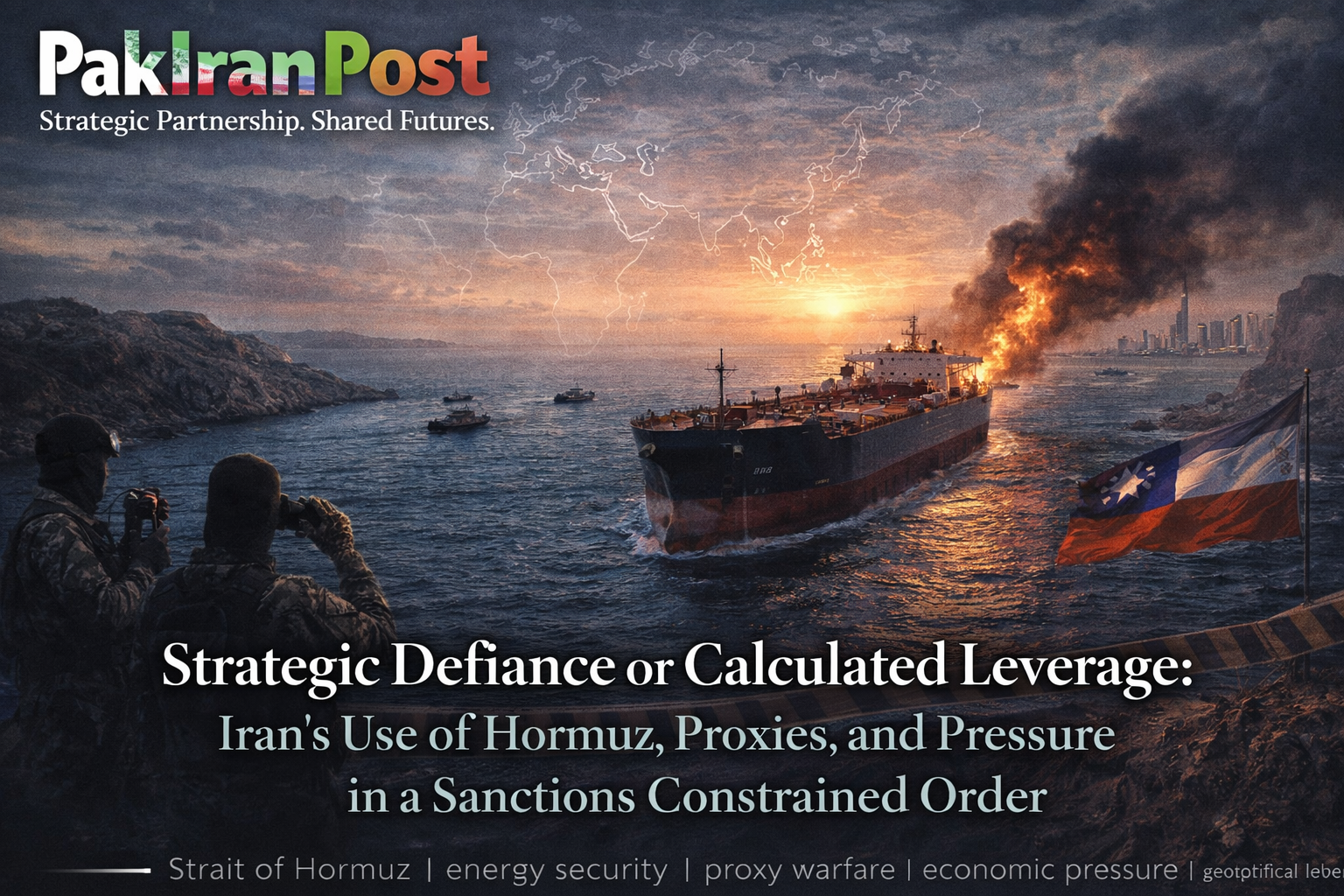

Sectarian Spillover and Internal Stability: Pakistan’s Fragile Social Contract in an Era of Regional Conflagration


Pakistan’s internal stability has long been shaped by a delicate equilibrium between ideological plurality, external geopolitical pressures, and the state’s intermittent efforts to enforce cohesion through coercive and narrative instruments. In moments of regional turbulence, particularly when Iran becomes a focal point of wider Middle Eastern confrontation, this equilibrium is repeatedly tested. The escalation cycles of 2026 have once again exposed how external conflicts, when filtered through Pakistan’s domestic religious and political textures, can generate internal reverberations far more destabilising than the original geopolitical shocks themselves.
The concept of sectarian spillover is often misunderstood as a direct mechanical transfer of foreign conflict into domestic violence. In reality, it is a more complex, mediated process in which external geopolitical polarization reshapes domestic narratives, reactivates dormant identities, and intensifies pre-existing social cleavages. Pakistan, with its historically layered sectarian composition, becomes particularly susceptible to such reactivation when regional alignments acquire ideological coloration.
The Iran-related regional escalation does not affect Pakistan solely through diplomatic alignment pressures or border security concerns; it penetrates through discursive channels, particularly religious symbolism, transnational identity networks, and media amplification. These channels are not neutral conduits of information but active sites of interpretation and contestation. As regional actors frame their conflicts in existential and theological terms, these narratives inevitably resonate within Pakistan’s own sectarian landscape, where historical memory and contemporary grievance often intersect.
At the structural level, Pakistan’s sectarian composition is not inherently destabilizing. Sunni and Shia communities have coexisted within a broader national framework for decades, and episodes of violence, while serious, have not translated into sustained fragmentation. However, the fragility lies not in demographic distribution but in the politicization of identity under conditions of external amplification. When regional conflicts intensify, domestic actors often reinterpret global events through local sectarian lenses, transforming geopolitical disputes into symbolic struggles over legitimacy and belonging.
The Iran–Saudi Arabia rivalry, which has periodically defined Middle Eastern geopolitics, has historically functioned as an external amplifier of sectarian sentiment in South Asia. Financial flows, religious seminaries, ideological networks, and media ecosystems have all contributed to embedding external narratives within domestic discourse. Pakistan’s position as both a recipient of Gulf financial influence and a neighbor to Iran creates a dual exposure that is structurally difficult to neutralize.
The 2026 escalation has intensified this dual exposure. As Iran becomes more deeply involved in regional confrontation, and as counter-alignments harden across the Gulf, Pakistan finds itself under renewed pressure to interpret its foreign policy posture in binary terms. Neutrality, once a viable diplomatic strategy, becomes increasingly difficult to maintain in an environment where external actors demand clarity of alignment. This external pressure then cascades inward, where domestic constituencies interpret state positioning through sectarian or ideological frameworks.
The most dangerous aspect of this dynamic is its recursive nature. External polarization feeds domestic polarization, which in turn constrains foreign policy flexibility, further reinforcing external perceptions of alignment. This feedback loop reduces the state’s ability to maintain ambiguity, which has historically been one of Pakistan’s key diplomatic survival mechanisms.
Economic stress acts as a powerful accelerant in this process. Energy price shocks, inflationary pressures, and austerity measures disproportionately affect lower-income populations, creating a general environment of grievance. While economic hardship does not inherently produce sectarian violence, it creates a reservoir of discontent that can be mobilized by ideologically framed narratives. In such environments, sectarian identity becomes a readily available interpretive framework for otherwise structural economic suffering.
This convergence of economic distress and ideological framing is particularly significant in Pakistan’s urban peripheries and semi-urban districts, where institutional trust is weaker and social mobility is constrained. Here, religious institutions often serve not only as spiritual centers but also as social service providers, political intermediaries, and identity anchors. When these institutions become embedded within broader transnational ideological networks, the boundary between local grievance and global narrative becomes increasingly porous.
The state’s response to sectarian risk has historically oscillated between coercive containment and episodic reform. Security operations have succeeded in suppressing large-scale organized violence, particularly through targeted crackdowns on militant networks. However, these measures have not fundamentally altered the underlying conditions that allow sectarian narratives to persist. The absence of sustained investment in educational reform, curriculum diversification, and civic identity formation has left significant space for parallel ideological ecosystems to develop.
Foreign influence further complicates this landscape. Financial and ideological support from external actors, whether state or non-state, has historically played a role in shaping religious institutions within Pakistan. While regulatory frameworks have been strengthened in recent years, enforcement remains uneven, and the transnational nature of ideological networks makes comprehensive control extremely difficult. In periods of regional escalation, these networks become more active, amplifying external narratives within domestic spaces.
Media ecosystems, particularly digital platforms, have added a new layer of complexity. The rapid circulation of unverified information, emotionally charged content, and ideologically framed narratives accelerates the pace at which external conflicts are internalized. Unlike traditional media, digital platforms do not require institutional mediation, allowing transnational narratives to bypass conventional gatekeeping structures. This creates a situation in which geopolitical events are instantly refracted through domestic identity politics.
Despite these risks, it is important to recognize that sectarian spillover is not deterministic. Pakistan has repeatedly demonstrated resilience in containing localized outbreaks of sectarian violence, even during periods of intense regional tension. This resilience is rooted in a combination of state capacity, societal interdependence, and the pragmatic recognition among most communities that prolonged internal conflict is incompatible with national stability.
The critical question, therefore, is not whether sectarian spillover can be prevented entirely, but whether its intensity and scope can be contained within manageable limits. This requires a shift from reactive security paradigms to proactive resilience-building strategies. At the institutional level, this involves strengthening regulatory oversight of religious financing, improving transparency in seminaries and religious organizations, and ensuring that external ideological influence does not translate into domestic political mobilization.
At the narrative level, the state faces an equally important challenge. National identity in Pakistan has often oscillated between ideological and civic definitions. In moments of external pressure, ideological definitions tend to dominate, narrowing the space for pluralistic interpretations of citizenship. A more resilient framework would emphasize constitutional citizenship, shared economic futures, and interdependence across sectarian lines, thereby reducing the salience of external ideological imports.
Education remains the most critical long-term vector of stability. Without substantive reform in curricula that continues to reproduce narrow historical and ideological narratives, the structural conditions for sectarian susceptibility will persist. The development of critical thinking, historical contextualization, and civic responsibility is not merely an educational objective but a security imperative in a geopolitically volatile environment.
Pakistan’s foreign policy posture also plays a decisive role in shaping domestic sectarian dynamics. The more the state is perceived as aligned with any particular regional bloc, the more likely it is that domestic actors will interpret internal identity through that external alignment. Maintaining credible neutrality, therefore, is not only a diplomatic necessity but also an internal security strategy. However, neutrality must be actively constructed through consistent diplomatic signaling, diversified partnerships, and credible mediation roles.
In this context, Pakistan’s potential role as a mediator between competing regional powers becomes strategically significant. By positioning itself as a bridge rather than a proxy, Pakistan can reduce the domestic amplification of external conflicts. Mediation is not merely an external diplomatic function; it is an internal stabilizing mechanism that reduces the penetration of polarized narratives into domestic discourse.
Ultimately, sectarian spillover in Pakistan is best understood not as an external imposition but as an internal amplification of external signals. The state’s capacity to filter, interpret, and manage these signals determines the extent to which regional conflicts translate into domestic instability. The 2026 crisis underscores the urgency of strengthening these filtering mechanisms.
Pakistan’s internal stability will therefore depend less on the absence of regional conflict and more on the robustness of its institutional, narrative, and economic buffers. In a fragmented global order where external crises are increasingly frequent and interconnected, internal resilience becomes the defining attribute of sovereignty. The challenge is not to eliminate exposure to external shocks, but to ensure that such shocks do not fracture the internal cohesion of the state.
A Public Service Message