
Energy Security vs Sanctions Compliance: Pakistan’s Strategic Dilemma in the Age of Fragmented Global Order


Pakistan’s contemporary energy dilemma is no longer a technical question of supply shortages or pricing volatility; it has evolved into a structural confrontation between geopolitical alignment and economic survival. The re-emergence of Iran as both a potential energy partner and a sanctioned state actor, particularly in the volatile environment of 2026, has forced Islamabad into an increasingly narrow corridor of strategic choices. Within this corridor, every option carries cost, and every alignment generates external friction. The result is a condition of permanent energy insecurity masked as diplomatic balancing.
At the heart of this dilemma lies a paradox that defines much of the Global South’s interaction with the Western-led financial order: the very systems that provide economic stabilization—IMF programs, World Bank financing, access to dollar liquidity—are also structurally incompatible with the most geographically rational sources of energy supply. Iran, sharing a long porous border and possessing one of the world’s largest natural gas reserves, represents the most economically efficient supplier for Pakistan’s chronic energy deficit. Yet Iran is also embedded within a sanctions architecture designed to restrict its integration into global energy markets. Pakistan’s dilemma is therefore not simply one of procurement but of systemic contradiction.
The Iran–Pakistan gas pipeline, conceived decades ago as a project of regional interdependence, now exists as a suspended instrument of geopolitical tension. Its economic logic remains intact. Pakistan’s industrial base, urban consumption clusters, and agricultural mechanization cycles are structurally dependent on subsidized energy inputs. Imported liquefied natural gas, indexed to volatile spot markets in Europe and East Asia, exposes the country to external price shocks that translate directly into fiscal stress, currency depreciation, and inflationary spirals. Iranian pipeline gas, by contrast, offers predictable pricing, reduced transportation costs, and geographical proximity that minimizes logistical exposure.
Yet economic rationality has been consistently subordinated to geopolitical constraint. The United States sanctions regime, particularly secondary sanctions targeting third-party entities engaging with Iran’s energy sector, creates a compliance environment that extends far beyond bilateral relations. For Pakistan, a country that relies on International Monetary Fund disbursements, World Bank development financing, and continuous rollover of commercial debt, the risk of financial isolation is not theoretical. It is existential.
The sanctions compliance architecture functions not merely as a legal constraint but as a financial discipline mechanism. Any deviation from its parameters risks triggering capital flight, credit downgrades, and disruptions in external financing flows. Pakistan’s repeated balance-of-payments crises, its dependence on short-term external borrowing, and its chronic foreign exchange shortages render it particularly sensitive to such shocks. In this sense, energy policy cannot be decoupled from macro-financial stability.
However, the cost of strict compliance is increasingly visible in domestic economic stress. The disruption of global energy markets following heightened instability in the Middle East in 2026 has exposed Pakistan’s vulnerability to imported inflation. Oil prices have oscillated sharply, breaching thresholds that significantly widen the country’s import bill. Liquefied natural gas procurement on spot markets has become increasingly expensive, forcing policymakers into emergency procurement cycles that lack long-term planning coherence. Each incremental increase in global energy prices transmits almost instantaneously into domestic fuel adjustments, industrial costs, and transport inflation.
The macroeconomic consequences are cumulative. Higher import bills widen the current account deficit, exerting downward pressure on the rupee. Currency depreciation then amplifies the domestic cost of all imported commodities, creating a feedback loop between external volatility and internal price instability. Inflation, already structurally embedded in Pakistan’s economy, becomes further entrenched through cost-push mechanisms. The fiscal response—whether through subsidies or pass-through pricing—becomes politically constrained, as both options carry social and political costs.
Within this tightening environment, the Iranian pipeline option re-emerges periodically as a policy temptation. Yet each re-emergence collides with the same structural barrier: the incompatibility between sanctions compliance and energy diversification. Even when geopolitical conditions appear temporarily conducive, such as brief diplomatic thawing between Tehran and Western capitals, Pakistan’s policy space remains constrained by the unpredictability of sanction enforcement and the reputational risks associated with perceived non-compliance.
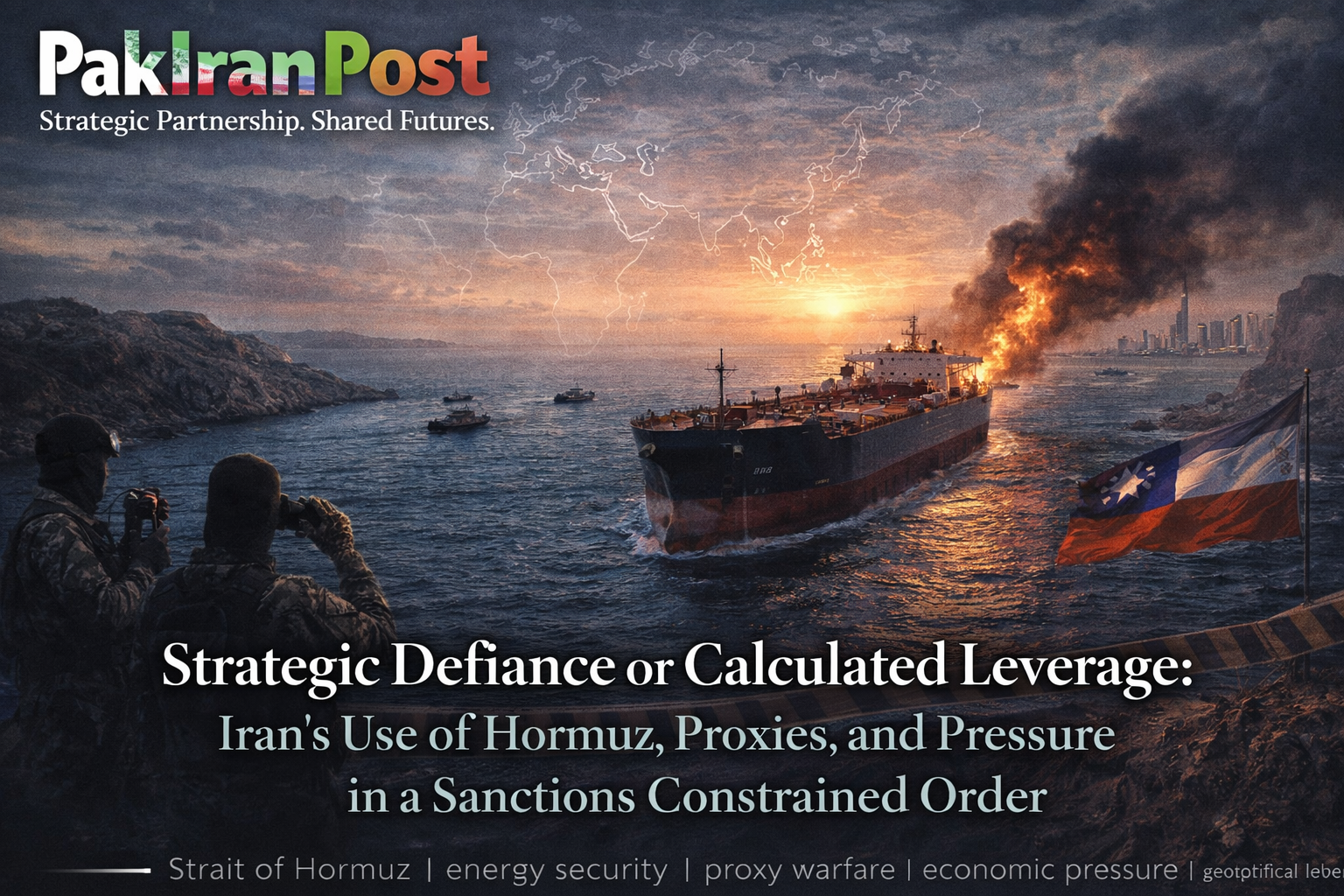
The deeper structural issue is that Pakistan’s energy strategy lacks insulation from geopolitical volatility. Unlike major economies that maintain diversified supply portfolios across multiple geopolitical blocs, Pakistan remains heavily exposed to maritime energy routes and dollar-denominated pricing systems. This creates a condition in which energy security is externally determined rather than domestically controlled. The Strait of Hormuz, global LNG benchmarks, and oil futures markets in distant financial centers collectively determine domestic price stability in Karachi, Lahore, and Islamabad.
The sanctions-energy nexus therefore produces a strategic trap. Compliance ensures financial continuity but locks Pakistan into expensive energy imports. Non-compliance may offer cheaper energy in the short term but risks financial isolation and macroeconomic instability. This is not a policy dilemma that can be resolved through incremental adjustments; it is a structural contradiction embedded in the architecture of global energy governance.
Attempts to resolve this contradiction through diplomatic hedging have yielded limited success. Pakistan’s traditional approach, maintaining formal neutrality while informally exploring bilateral energy cooperation, has repeatedly encountered enforcement barriers at the international level. Moreover, the increasing politicization of energy infrastructure under broader geopolitical competition between Western powers, China, and regional actors has reduced the effectiveness of ambiguity as a strategic tool.
A more durable resolution would require a reconfiguration of Pakistan’s energy matrix itself. Domestic energy diversification, including expansion of indigenous gas exploration, renewable energy deployment, and hydroelectric capacity enhancement, offers partial insulation but cannot fully substitute for imported hydrocarbons in the short to medium term. The structural composition of Pakistan’s industrial economy remains energy-intensive, particularly in textiles, manufacturing, and transport logistics.
China’s role under the China-Pakistan Economic Corridor framework introduces another layer of complexity. Chinese investment in energy infrastructure has already contributed to capacity expansion, particularly in coal and renewable sectors. However, Chinese financing is itself embedded within global financial systems that are indirectly influenced by sanctions regimes. As a result, even Beijing’s strategic support does not fully neutralize the constraints imposed by Western financial governance structures.
The broader implication is that Pakistan’s energy insecurity is not merely a function of domestic policy inefficiency but of systemic positioning within a fragmented global order. Energy flows are increasingly weaponized, financial systems are increasingly politicized, and infrastructure is increasingly subject to strategic interpretation. In such an environment, the traditional distinction between economics and geopolitics collapses.
The Iranian pipeline thus becomes more than an infrastructure project; it becomes a test case for the limits of sovereignty in a sanctions-driven global economy. If pursued, it challenges the boundaries of permissible economic behavior under Western financial oversight. If abandoned, it reinforces structural dependency on expensive and volatile energy markets. Neither outcome offers full autonomy.
The strategic question facing Pakistan is therefore not whether to prioritize energy security or sanctions compliance, but how to redefine the terms under which this trade-off is constructed. One possible pivot lies in multilateral energy engagement, embedding any Iran-related infrastructure within broader regional energy frameworks that include China, Central Asian republics, and potentially Gulf stakeholders. Such diversification could dilute the bilateral sanctions exposure by transforming the pipeline into a regional transit system rather than a bilateral transaction.
Another dimension involves financial engineering. The increasing fragmentation of global payment systems, including the emergence of alternative settlement mechanisms outside traditional dollar clearing systems, may gradually create space for limited energy trade de-dollarization. However, such transitions remain embryonic and carry their own systemic risks.
Ultimately, Pakistan’s energy dilemma reflects a broader condition facing mid-sized developing economies in the current global order: constrained sovereignty under conditions of financial interdependence. Energy, once a domain of physical geography, has become an extension of geopolitical alignment. Sanctions regimes have transformed from targeted punitive tools into structural determinants of economic possibility.
Pakistan’s challenge is therefore not merely to secure energy, but to secure strategic optionality. Without diversification of both energy sources and financial dependencies, the country will remain trapped in cycles of crisis management rather than long-term stability. The Iran question is only the most visible expression of this deeper structural vulnerability. The real issue is whether Pakistan can construct an energy architecture resilient enough to survive in a world where geopolitics increasingly dictates the price of electricity, fuel, and industrial survival.
A Public Service Message