
Economic Shock Transmission Mechanisms: How Global Energy Volatility Becomes Domestic Crisis in Pakistan


Pakistan’s economic fragility in the face of global energy shocks is neither accidental nor cyclical in the conventional sense. It is structural, deeply embedded in the country’s import-dependent energy architecture, weak currency dynamics, and constrained fiscal space. The escalation of global energy volatility in 2026, driven by geopolitical tensions surrounding Iran and the wider Middle East, has once again exposed the speed and intensity with which external shocks are transmitted into Pakistan’s domestic economy. What appears at first as a fluctuation in global oil markets rapidly transforms into inflation, fiscal stress, currency depreciation, and ultimately social unrest.
The transmission mechanism begins with Pakistan’s overwhelming reliance on imported energy. Crude oil, refined petroleum products, and liquefied natural gas constitute a significant share of total imports, making the country structurally sensitive to international price movements. Unlike diversified economies that hedge energy exposure through strategic reserves, long-term contracts, and domestic substitutes, Pakistan operates largely as a price-taker in volatile spot markets. This exposes the economy to abrupt cost adjustments whenever geopolitical instability disrupts supply chains or alters global risk premiums.
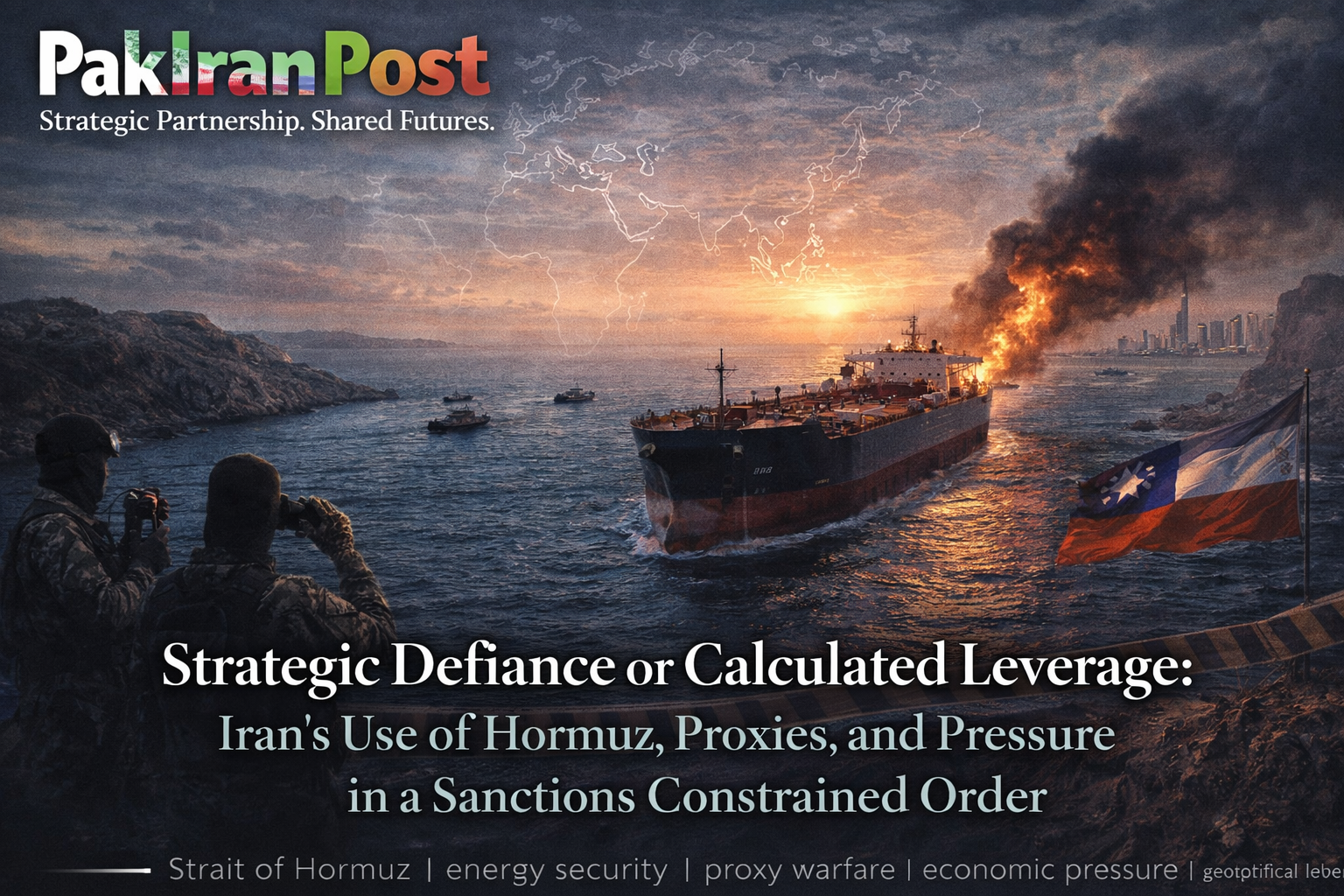
The 2026 energy shock, triggered by instability in the Strait of Hormuz and broader Iran-related tensions, has intensified this vulnerability. Even marginal disruptions in Middle Eastern supply routes translate into disproportionate price spikes in global markets, given the region’s centrality to global oil flows. As prices rise internationally, Pakistan’s import bill expands almost immediately, placing pressure on already strained foreign exchange reserves.
The second stage of transmission occurs through the external account. Rising import costs widen the current account deficit, increasing demand for foreign currency. Pakistan, operating under persistent external financing constraints, lacks sufficient reserves to smooth these imbalances. As demand for dollars increases, the rupee depreciates, often sharply and unpredictably. This depreciation is not merely a financial adjustment; it is a structural amplifier of imported inflation.
Currency depreciation feeds directly into domestic price levels because Pakistan imports a large proportion of its energy, machinery, edible oils, and intermediate industrial inputs. As the rupee weakens, the local currency cost of these imports rises, even if global prices remain stable. In the context of simultaneous global price increases, the effect becomes multiplicative rather than additive.
Inflation is therefore not a singular phenomenon but the cumulative outcome of multiple reinforcing channels. The most immediate transmission occurs through fuel prices. Diesel and petrol adjustments, often implemented through administrative pricing mechanisms, directly affect transportation costs across the economy. Since Pakistan’s logistics and supply chains are heavily road-dependent, fuel price increases cascade rapidly into the cost of food, manufactured goods, and services.
This cost-push inflation is particularly severe in economies like Pakistan where wage growth is structurally rigid and productivity gains are uneven. Households experience a decline in real purchasing power, while firms face rising input costs without corresponding increases in demand. The result is a contraction in consumption and investment simultaneously, creating stagflationary pressures.
Recent episodes of fuel price escalation in 2026 illustrate this mechanism clearly. Sharp increases in global oil prices, driven by supply uncertainty, were transmitted into domestic markets within weeks. Transport fares increased, agricultural costs rose due to higher diesel prices for irrigation and machinery, and industrial production costs escalated. The inflationary impulse did not remain confined to energy markets but permeated the entire economy.
The fiscal system acts as a secondary transmission channel. Governments in Pakistan face a structural dilemma: either pass on rising energy costs to consumers or absorb them through subsidies. Both options are economically costly. Subsidization increases fiscal deficits, forcing additional borrowing and further weakening macroeconomic stability. Full pass-through, on the other hand, accelerates inflation and triggers social discontent.
In 2026, fiscal authorities have increasingly opted for partial pass-through combined with targeted subsidies, but this hybrid model itself introduces distortions. It creates segmented pricing structures, inefficiencies in resource allocation, and leakage in subsidy distribution. Moreover, rising debt servicing costs limit fiscal space, making sustained intervention increasingly difficult.
Monetary policy transmission further amplifies the shock. As inflation rises, the central bank is compelled to tighten monetary policy through interest rate increases. Higher interest rates, while intended to stabilize inflation, also suppress investment and slow economic growth. In an economy already constrained by structural weaknesses, this tightening often exacerbates unemployment and reduces industrial expansion.
The financial sector responds to these shifts with increased risk aversion. Credit becomes more expensive and less accessible, particularly for small and medium enterprises that form the backbone of Pakistan’s non-agricultural economy. As liquidity tightens, business activity slows, reinforcing the broader economic contraction.
At the macro-structural level, these transmission channels interact in a reinforcing loop. Energy price shocks increase import bills, which weaken the currency, which increases inflation, which triggers monetary tightening, which slows growth, which reduces fiscal revenues, which further constrains the state’s ability to manage shocks. This circularity is what makes Pakistan’s vulnerability systemic rather than episodic.
The agricultural sector provides a particularly revealing case study of transmission dynamics. Diesel-powered irrigation, fertilizer production, and transport logistics mean that global energy prices directly affect agricultural output costs. As input costs rise, food inflation accelerates. Given that food constitutes a large share of household expenditure in Pakistan, the welfare impact is disproportionately severe for lower-income groups.
This food-energy inflation nexus is central to understanding the social dimension of economic shocks. Inflation in essential goods is not merely an economic indicator; it is a political variable. As real incomes decline, public dissatisfaction increases, often manifesting in protests, labor strikes, and political instability. Economic shocks thus transition into governance challenges.
External financing conditions further complicate transmission. Pakistan’s reliance on multilateral lenders and short-term external borrowing means that macroeconomic stabilization is frequently contingent on external conditionalities. These conditionalities often emphasize fiscal consolidation, subsidy reduction, and market-based pricing mechanisms. While economically rational in the long term, these measures intensify short-term social pressures during periods of external shock.
The 2026 energy crisis has also exposed the limits of Pakistan’s strategic reserves and contingency planning. Unlike advanced economies that maintain substantial petroleum reserves to buffer short-term disruptions, Pakistan’s storage capacity is limited. This lack of buffering capacity increases the immediacy of transmission from global markets to domestic consumers.
Another critical dimension is expectations. In economies with weak institutional credibility, inflationary expectations become self-fulfilling. When households and firms anticipate continued price increases, they adjust behavior accordingly, demanding higher wages and raising prices preemptively. This expectation-driven inflation makes stabilization more difficult and prolongs adjustment periods.
Despite this vulnerability, the transmission mechanism is not immutable. Structural reforms can significantly alter the speed and intensity of shock absorption. Energy diversification is the most direct mitigation strategy. Expanding renewable energy capacity reduces exposure to imported fossil fuels, while domestic gas exploration can partially substitute external dependence.
Recent investments in solar and hydropower have already demonstrated measurable impact in reducing marginal import dependence. However, these gains remain insufficient relative to the scale of overall energy demand. Industrial expansion continues to outpace the growth of domestic energy supply, maintaining structural import reliance.
Regional energy integration offers another potential buffer. Cross-border electricity trade, pipeline diversification, and long-term supply contracts could reduce exposure to spot market volatility. However, such arrangements are themselves subject to geopolitical constraints, particularly in a region characterized by fluctuating diplomatic alignments.
Structural economic reform is equally essential. A shift toward export-led growth could reduce vulnerability by improving foreign exchange earnings. However, this requires sustained improvements in productivity, governance, and industrial competitiveness, areas in which progress has been uneven.
Financial sector deepening is also critical. A more robust domestic capital market could reduce reliance on external borrowing and improve resilience against external shocks. However, financial deepening requires institutional credibility, regulatory stability, and investor confidence, all of which are still developing.
The broader implication is that Pakistan’s economic shock transmission is not simply a function of external volatility but of internal structural design. The global energy system acts as a shock generator, but domestic institutional weaknesses determine the amplitude of its impact.
In conclusion, the 2026 energy shock underscores a fundamental reality: Pakistan does not merely experience global volatility; it amplifies it. Until structural reforms reduce import dependence, stabilize the currency, and diversify energy sources, the economy will remain highly sensitive to external shocks. The challenge is not to eliminate exposurean impossible task in a globalized economybut to redesign the transmission channels so that external volatility does not automatically translate into domestic crisis.
A Public Service Message