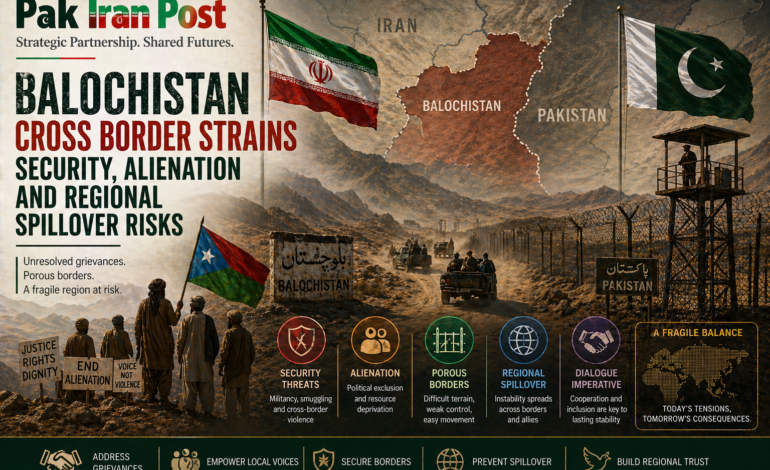
Balochistan Cross Border Strains Security Alienation and Regional Spillover Risks


Balochistan sits at the intersection of geography and geopolitics where the cartography of the modern state meets the friction of lived reality, and where the promise of connectivity is repeatedly interrupted by cycles of insecurity, underdevelopment, and contested sovereignty. In the evolving Pakistan–Iran frontier system, the province is no longer merely a peripheral administrative unit but a dynamic zone of interaction in which security logics, identity politics, resource extraction, and transnational mobility converge into a complex strategic environment that resists linear policy responses.
The contemporary condition of Balochistan must be understood as the accumulation of layered historical grievances intersecting with present-day structural constraints. Decades of uneven development have produced a socio-economic landscape where access to education, healthcare, and employment remains significantly below national averages, reinforcing perceptions of systemic exclusion. These perceptions are not only material but deeply symbolic, shaping how communities interpret the presence of the state and its institutions. In such contexts, governance is often experienced not as inclusion but as surveillance, regulation, or extraction, a perception that feeds into cycles of alienation.
This alienation is further complicated by the geopolitical positioning of Balochistan along the Pakistan–Iran border, where ethnic, linguistic, and familial continuities extend beyond formal territorial boundaries. The border, rather than acting as a rigid divider, functions as a porous social membrane through which people, goods, ideas, and grievances circulate. This permeability has historically enabled informal trade networks that sustain local economies, but it has also created opportunities for militant mobility and illicit economies that both states interpret through the lens of security threat perception. The result is a persistent tension between the economic necessity of openness and the political imperative of control.
In recent years, insurgency dynamics in the region have evolved from episodic armed confrontations to more networked and adaptive forms of resistance that exploit both physical terrain and informational ecosystems. These movements draw legitimacy, at least within their constituencies, from narratives of dispossession and political marginalisation, while states frame them as externally influenced destabilisation campaigns. The divergence between these narratives is not merely rhetorical; it shapes policy choices, military deployments, and diplomatic signalling between Islamabad and Tehran. Each side, while cooperating tactically on border management, simultaneously interprets instability through its own strategic anxieties.
The media environment has become a central battleground in this contest of interpretations. Traditional state-aligned media outlets tend to emphasise the language of security, sovereignty, and counterterrorism, often situating incidents of violence within broader regional proxy frameworks. In contrast, alternative digital platforms, including diaspora networks and localised social media channels, foreground themes of human rights violations, enforced disappearances, and economic deprivation. This fragmented media ecology produces competing epistemologies of conflict, where the same event is simultaneously narrated as counterinsurgency success, state repression, or resistance struggle depending on the observer’s positionality.
What is particularly significant in the current phase is the internationalisation of these narratives through digital amplification. The borderland condition of Balochistan is increasingly being interpreted not only within Pakistan–Iran bilateral discourse but also through broader global conversations on resource politics, minority rights, and infrastructural geopolitics, particularly in relation to major connectivity initiatives in the wider region. This external attention, while limited in policy impact, contributes to narrative intensification, as local grievances are reframed within global vocabularies of resistance and governance failure.
At the same time, both Pakistan and Iran have intensified border securitisation measures, including fencing projects, surveillance expansion, and coordinated patrol mechanisms. These measures are designed to stabilise the frontier, reduce militant mobility, and regulate informal crossings. However, securitisation carries its own paradoxes. While it may enhance state visibility and tactical control, it also disrupts traditional socio-economic networks that have historically underpinned borderland livelihoods. In many cases, these disruptions create new forms of economic precarity, which can unintentionally reinforce the very conditions that generate instability.
The governance challenge in Balochistan is therefore not solely a question of security architecture but of developmental integration. Infrastructure expansion, when disconnected from local participation, risks being perceived as externally imposed rather than collectively beneficial. Similarly, resource extraction projects that do not visibly translate into local welfare improvements tend to reinforce narratives of internal colonialism. This disconnect between macro-level development planning and micro-level lived experience remains one of the central contradictions of state policy in the region.
Cross-border dynamics with Iran introduce additional complexity. While both states share concerns over militancy and smuggling, their internal political economies and strategic priorities are not always aligned. Iran’s southeastern Sistan-Balochistan province mirrors many of the socio-economic challenges seen in Pakistani Balochistan, creating a transboundary zone of shared vulnerability. Yet cooperation is often constrained by mutual suspicions, differing threat perceptions, and broader regional geopolitical alignments. This produces a pattern of episodic coordination rather than sustained institutionalised governance of the border space.
The humanitarian dimension of the region is frequently overshadowed by security narratives, yet it remains central to understanding long-term stability. Patterns of displacement, both internal and cross-border, reflect not only conflict dynamics but also environmental stressors, including water scarcity, declining agricultural productivity, and climate variability. These factors are increasingly shaping migration decisions, particularly among younger populations seeking economic survival in urban centres or across borders. In the absence of structured mobility frameworks, such movements often occur through informal and precarious channels, increasing vulnerability to exploitation.
The role of non-state actors in shaping both insecurity and survival economies cannot be overlooked. Informal traders, transport networks, and community intermediaries operate within a grey zone of legality that is simultaneously essential for local livelihoods and problematic for state regulatory frameworks. Efforts to eliminate these networks without providing viable alternatives risk destabilising local economies further, thereby deepening the governance deficit. Conversely, attempts to formalise these economies require institutional trust that is currently limited.
From a strategic perspective, the Pakistan–Iran border region is increasingly being conceptualised not merely as a security frontier but as a potential corridor of connectivity linking South Asia with the Middle East. However, this potential remains constrained by persistent instability and lack of integrated planning. Infrastructure projects, energy cooperation proposals, and trade facilitation mechanisms all exist in varying stages of discussion, yet their implementation is repeatedly slowed by geopolitical uncertainty and domestic political constraints on both sides.
The central policy dilemma, therefore, lies in reconciling security imperatives with socio-economic inclusion. Overemphasis on coercive control risks perpetuating cycles of alienation, while insufficient regulation risks allowing non-state actors to dominate cross-border space. A sustainable approach requires a recalibration of governance that integrates local voices into development planning, strengthens institutional transparency, and recognises the socio-cultural fabric of border communities as a stabilising asset rather than a security liability.
In analytical terms, Balochistan functions as a barometer of broader state-society relations in frontier regions. The intensity of contestation in the province reflects not only local conditions but also the structural challenges of governing diverse, resource-rich, and geopolitically sensitive peripheries in a rapidly changing regional order. As climate pressures, economic uncertainties, and geopolitical rivalries intensify, such frontier zones are likely to become even more central to regional stability calculations.
Ultimately, the future trajectory of Balochistan within the Pakistan–Iran strategic space will depend on whether governance frameworks can move beyond reactive security paradigms toward more integrated models of political inclusion and economic redistribution. Without such a shift, the risk is not only continued instability but also the gradual entrenchment of a fragmented frontier landscape where state authority, local autonomy, and transnational networks coexist in uneasy and often volatile equilibrium.
A Public Service Message