
Water Stress and Border Stability the Emerging Security of Scarcity


Water scarcity in the Pakistan–Iran borderlands is no longer an environmental concern confined to agricultural cycles or seasonal planning, but an emerging structural force reshaping security, migration, governance, and bilateral relations. In the arid and semi-arid frontier zones stretching across Balochistan in Pakistan and Sistan Balochistan in Iran, water has increasingly transformed into a strategic commodity, one that silently dictates patterns of settlement, livelihood viability, and political stability. The emerging condition can be described as a slow onset security crisis, where ecological depletion interacts with weak institutional coordination to produce a long duration but low visibility instability.
The hydrological systems of this region are historically fragile. Rainfall variability, high evaporation rates, and limited surface water flows have always constrained agricultural productivity. However, what distinguishes the present phase is not merely scarcity but acceleration. Climate variability has intensified drought cycles, groundwater extraction has surpassed natural recharge rates, and traditional water management systems have been eroded by both technological change and institutional neglect. The result is a compounding deficit that is no longer cyclical but structural in nature.
In border districts such as Gwadar, Panjgur, Kech, Chagai, and across the Iranian side in Zahedan and surrounding areas, groundwater tables have dropped significantly over the past two decades. Wells that once sustained communities are now either drying or requiring deeper and costlier extraction mechanisms. This shift has altered rural economies fundamentally. Agriculture, once a primary livelihood source, is increasingly becoming non-viable in many pockets, forcing a transition toward informal labour, migration, and cross border mobility. In such conditions, water scarcity is not only an environmental stressor but a driver of demographic and economic reconfiguration.
The governance of water resources in this frontier zone remains fragmented. On the Pakistani side, water management falls across multiple provincial and federal institutions with limited coordination, while on the Iranian side, centralized planning often struggles to account for local variability in resource availability. Crucially, there is no comprehensive bilateral water sharing framework that addresses shared aquifers, seasonal streams, or drought contingency mechanisms between the two states. This institutional vacuum creates a governance gap where scarcity becomes politically interpreted rather than jointly managed.
In recent years, water has increasingly entered the discourse of security within both states, albeit in indirect ways. In Pakistan, water shortages in Balochistan are often framed within broader narratives of underdevelopment and provincial marginalisation. In Iran, water stress in Sistan Balochistan is similarly linked to internal migration pressures and socio-political dissatisfaction. While neither state explicitly frames water scarcity as a bilateral conflict issue, the cumulative effect of unaddressed scarcity contributes to a subtle but growing strain on cross border relations, particularly in the context of competing developmental priorities and infrastructure planning.
The media environment has played a significant role in shaping perceptions of water scarcity. Traditional media outlets often report drought conditions as episodic humanitarian crises, focusing on immediate relief needs such as tankers, emergency supplies, and short term aid interventions. However, digital media platforms, particularly local journalists and citizen reporting networks, increasingly frame water scarcity as a chronic governance failure. This shift in narrative has altered public perception, transforming what was once seen as an environmental condition into a symbol of state neglect and institutional inefficiency.
Social media discourse amplifies this transformation further. In both Pakistan and Iran, online narratives frequently link water scarcity to broader grievances including corruption, infrastructural neglect, and uneven regional development. In some cases, water shortages become symbolic representations of broader political dissatisfaction, where dry taps are interpreted not merely as infrastructural failures but as evidence of systemic exclusion. This symbolic amplification intensifies public pressure and contributes to politicisation of resource management.
From a security perspective, water scarcity has begun to intersect with migration dynamics in increasingly complex ways. As agricultural livelihoods collapse in drought affected zones, populations are compelled to move toward urban centres or attempt cross border migration in search of employment. These movements are rarely linear or regulated. Instead, they often occur through informal channels that expose migrants to exploitation, trafficking networks, and precarious labour conditions. In this sense, water scarcity indirectly contributes to human insecurity beyond its immediate environmental impact.
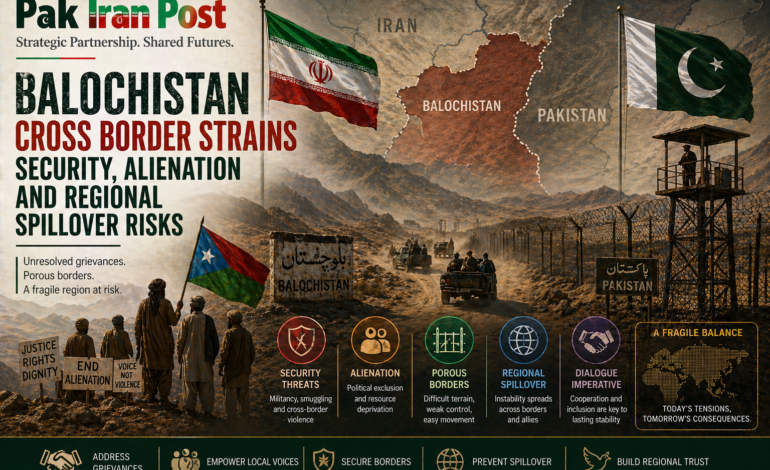
The relationship between water stress and border stability is particularly significant in the Pakistan–Iran context. The frontier region functions as both a physical and socio-economic continuum, where communities on both sides of the border share ecological vulnerabilities. Drought conditions do not respect administrative boundaries, and aquifer depletion affects cross border regions simultaneously. However, the absence of integrated hydrological monitoring or shared data systems prevents coordinated response strategies, resulting in parallel but disconnected national approaches to a shared environmental challenge.
Infrastructure development projects in the region, including dams, irrigation schemes, and desalination proposals, have been pursued independently by both states. While these projects aim to address domestic water shortages, they often lack consideration of transboundary ecological impacts. In some cases, upstream interventions alter downstream water availability, creating perceptions of inequity and fueling local grievances. Although these issues rarely escalate into formal diplomatic disputes, they contribute to an underlying atmosphere of mistrust and ecological competition.
Climate change acts as a threat multiplier in this context. Rising temperatures, shifting rainfall patterns, and increased frequency of drought events exacerbate existing vulnerabilities. Importantly, climate impacts are not evenly distributed. Marginalised rural communities, already lacking infrastructural resilience, are disproportionately affected. This uneven impact reinforces socio-economic inequality and accelerates rural depopulation, further weakening traditional water management systems that relied on communal coordination and local knowledge.
In addition to physical scarcity, governance scarcity has emerged as a critical issue. Institutional capacity to plan, monitor, and respond to water stress remains limited. Data gaps persist in groundwater measurement, rainfall tracking, and usage mapping. Without reliable hydrological data, policy responses tend to be reactive rather than anticipatory. This reactive governance model is particularly problematic in a region where environmental change is gradual but cumulative, requiring long term planning horizons rather than short term crisis response.
The political economy of water in the borderlands is also shaped by informal power structures. Local elites, landowners, and intermediaries often influence water distribution through access control, tanker supply networks, and irrigation prioritisation. These informal arrangements can mitigate scarcity in the short term but also reinforce inequities in access. Over time, such systems risk undermining institutional legitimacy by creating perceptions of unequal resource allocation.
Despite these challenges, water cooperation between Pakistan and Iran remains underdeveloped but not absent. There have been periodic discussions on environmental coordination, drought relief, and borderland development initiatives. However, these efforts remain fragmented and lack institutional continuity. The absence of a formalised bilateral water governance framework represents a missed opportunity for confidence building between the two states, particularly given their shared vulnerability to climate stress.
Media framing of water scarcity increasingly intersects with broader geopolitical narratives. In some instances, environmental stress is linked to regional connectivity projects, border securitisation measures, or development aid flows, thereby embedding ecological issues within larger strategic debates. This convergence of environmental and geopolitical narratives complicates policy communication, as water scarcity becomes simultaneously a humanitarian, developmental, and security issue.
The humanitarian dimension remains central. Communities facing chronic water shortages experience multidimensional deprivation, including health risks, food insecurity, and educational disruption. Women and children are often disproportionately affected due to their roles in water collection and household management. These gendered impacts are frequently underrepresented in policy discourse, despite being critical to understanding the full scope of water insecurity.
In the long term, the stability of the Pakistan–Iran border region will depend significantly on how water scarcity is managed. If addressed solely through fragmented national strategies and crisis response mechanisms, scarcity is likely to deepen socio-economic fragility and reinforce patterns of outmigration and informal cross border movement. Conversely, if approached through integrated hydrological governance, climate adaptation planning, and cooperative infrastructure development, water stress could become an area of regional collaboration rather than competition.
The central policy challenge is therefore not merely technical but political. It requires reconceptualising water not as a finite national asset to be defended, but as a shared ecological system requiring joint stewardship. In the absence of such a shift, water scarcity will continue to operate as a silent but powerful driver of instability in one of the most strategically sensitive frontier regions of South and West Asia.
A Public Service Message