
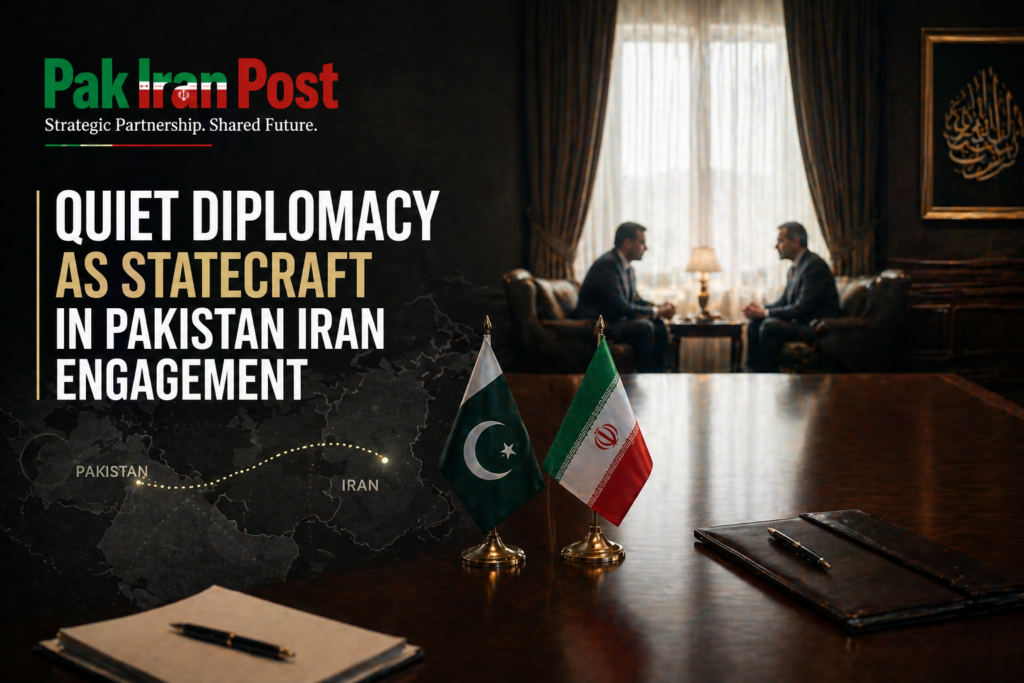
Quiet Diplomacy As Statecraft In Pakistan Iran Engagement

The idea of diplomacy as spectacle has become increasingly dominant in contemporary international relations, where summits are broadcast as performances, statements are designed for instantaneous media circulation, and policy signalling is often calibrated for digital amplification rather than institutional durability. In this environment, Pakistan Iran relations offer a revealing counter case, one in which visibility has rarely translated into stability and where episodic diplomatic visibility has often masked deeper structural stagnation. The argument for quiet diplomacy as statecraft is therefore not an aesthetic preference for discretion but a strategic necessity shaped by the constraints of geography, sanctions regimes, domestic political cycles, and the increasingly volatile media ecosystems that mediate bilateral perception.
At its core, quiet diplomacy is not the absence of engagement but the relocation of engagement away from performative arenas into structured, continuous, and technocratic channels. It privileges consistency over announcement, process over proclamation, and institutional memory over political improvisation. In the case of Pakistan and Iran, this approach is particularly relevant because the bilateral relationship is repeatedly disrupted not only by material incidents along the border but also by narrative escalations that transform localised events into geopolitical signals. The result is a cycle in which diplomacy becomes reactive, episodic, and excessively dependent on crisis management.
Recent years have underscored this pattern. Border incidents in Balochistan and Sistan have periodically triggered diplomatic exchanges that are intense but short lived, followed by rapid reversion to inertia once immediate tensions subside. Trade and energy cooperation is frequently reaffirmed at leadership level meetings, yet implementation remains constrained by financial restrictions, customs inefficiencies, and institutional fragmentation. Even when both sides express willingness to deepen engagement, the absence of continuous bureaucratic channels means that policy momentum dissipates quickly once political attention shifts elsewhere. Reports of renewed commitments to security and trade cooperation have emerged in successive years, yet structural transformation remains limited.)
In such a context, quiet diplomacy emerges as a corrective mechanism to what might be termed “attention deficit foreign policy.” It seeks to insulate bilateral engagement from the volatility of domestic political cycles and the distortions of media amplification. In Pakistan, where coalition politics and civil military coordination dynamics frequently shape foreign policy signalling, and in Iran, where regional strategic positioning intersects with sanctions driven economic constraints, the need for stable low visibility channels becomes particularly acute.
Quiet diplomacy operates through three interlinked logics. The first is institutional continuity. This requires the creation of permanent bilateral working structures that function independently of high level political transitions. These could include standing economic liaison units, border governance coordination desks, and technical committees on customs, energy, and transport logistics. The key feature of such structures is not their formality but their insulation from political interruption. Without institutional continuity, even well intentioned diplomatic initiatives remain vulnerable to disruption.
The second logic is frequency without visibility. Contrary to conventional diplomatic practice, where engagement is often tied to high profile meetings, quiet diplomacy relies on sustained low level interaction. This includes regular exchanges between technical officials, security coordinators, and economic regulators. The objective is to reduce the informational lag that often leads to misinterpretation of incidents along the border. In many cases, escalation between Pakistan and Iran has not been the result of strategic intent but of delayed verification and communication breakdowns at operational levels.
The third logic is narrative containment. In the contemporary media environment, where cross border incidents are rapidly amplified through both traditional and digital platforms, states often lose control over the interpretive framing of bilateral events. A minor security incident can quickly be reframed as evidence of broader strategic hostility, even when official policy remains cautious. Quiet diplomacy seeks to counter this by establishing pre agreed communication protocols that limit premature public signalling and ensure that initial responses are coordinated before becoming part of the public narrative cycle.
The importance of narrative containment becomes clearer when viewed against broader regional media dynamics. Pakistan Iran relations are frequently interpreted through external analytical lenses that emphasize proxy competition, sectarian geopolitics, or alignment shifts within the Gulf security architecture. These frames, while not entirely detached from regional realities, often exaggerate episodic tensions and understate long term patterns of pragmatic cooperation. As a result, policy space becomes constrained by perception management pressures, forcing governments to respond not only to events but to their mediated interpretations.
Quiet diplomacy does not attempt to eliminate media interpretation, which would be neither feasible nor desirable in open information systems. Instead, it seeks to reduce the gap between operational reality and narrative construction. By ensuring that technical coordination precedes public commentary, states can reduce the likelihood of misaligned signalling that escalates tensions unnecessarily.
Another dimension of quiet diplomacy is its compatibility with constrained financial and geopolitical environments. Iran operates under extensive sanctions regimes that limit its access to global financial systems, while Pakistan faces persistent macroeconomic constraints that shape its external engagement capacity. In such conditions, high visibility diplomatic initiatives that promise large scale economic transformation often fail to materialise, generating cycles of expectation and disappointment. Quiet diplomacy, by contrast, focuses on incremental, achievable outcomes such as customs facilitation, border market regulation, visa standardisation, and transport coordination.
These micro level interventions may appear modest, but they are structurally significant because they accumulate over time into functional interdependence. For example, improved customs coordination reduces transaction costs for cross border trade, while stable visa regimes facilitate predictable labour and business mobility. Over time, these incremental gains create constituencies of stability that are less vulnerable to political disruption.
There is also a security dimension to quiet diplomacy that is often overlooked. The Pakistan Iran border region has experienced recurring concerns related to militant mobility, smuggling networks, and localised armed incidents. While both states have periodically cooperated on security issues, responses have largely been reactive. A quiet diplomacy framework would embed security coordination into continuous operational exchanges, including shared incident databases, joint verification mechanisms, and routine intelligence deconfliction processes. This reduces the likelihood that isolated incidents escalate into broader diplomatic crises.
Importantly, quiet diplomacy does not imply strategic passivity. Rather, it represents a shift from episodic assertiveness to sustained management. In the context of Pakistan Iran relations, where historical mistrust coexists with geographic necessity, such a shift is particularly relevant. The two states are not strategic adversaries in the classical sense, but neither are they fully integrated partners. Their relationship exists in a liminal space defined by partial cooperation and recurrent friction. Quiet diplomacy is designed precisely for such intermediate relationships where neither confrontation nor full alignment is the dominant trajectory.
Critically, this approach also responds to the changing nature of international attention economies. In a world where foreign policy is increasingly mediated through rapid news cycles and social media amplification, states that rely excessively on performative diplomacy risk losing control over long term strategic narratives. Quiet diplomacy provides an alternative by decoupling substantive engagement from visibility. Success is measured not by headlines but by reduced incidents, smoother trade flows, and improved administrative coordination.
However, implementing quiet diplomacy requires overcoming significant institutional challenges. Bureaucratic inertia, inter agency fragmentation, and political incentives for visible diplomacy all act as constraints. Politicians often prefer high profile announcements that signal progress, even when structural conditions are not yet in place. Similarly, media ecosystems tend to prioritise visible diplomatic events over incremental administrative improvements. Overcoming these biases requires a deliberate revaluation of what constitutes diplomatic success.
In Pakistan Iran relations, this revaluation would involve redefining success metrics away from episodic agreements and towards operational indicators. These could include reductions in border incident response times, increases in regulated trade volumes, improvements in customs clearance efficiency, and the establishment of routine communication protocols between security agencies. Such metrics are less politically visible but more analytically meaningful.
The broader geopolitical context further reinforces the relevance of quiet diplomacy. As regional alignments in West and South Asia continue to evolve, and as external powers recalibrate their engagement strategies in the Middle East and surrounding regions, middle powers like Pakistan and Iran increasingly operate in environments of structural uncertainty. In such conditions, the ability to maintain stable bilateral relations without excessive external signalling becomes a strategic asset.
Ultimately, quiet diplomacy as statecraft is not a departure from traditional diplomacy but a recalibration of its temporal and operational logic. It recognises that in certain bilateral relationships, particularly those characterised by asymmetrical constraints and recurring volatility, stability is not achieved through dramatic breakthroughs but through sustained administrative continuity.
In the case of Pakistan and Iran, the challenge is not to redefine the relationship in ideological or civilizational terms, but to stabilise it in functional terms. Quiet diplomacy offers a pathway for doing so by shifting focus from visibility to continuity, from rhetoric to routine, and from episodic engagement to institutional permanence. In an era where diplomatic attention is increasingly fragmented, such an approach may represent not only a pragmatic choice but a necessary evolution in statecraft.
A Public Service Message