Sanctions Border Economies And Informal Networks Reshaping Pakistan Iran Commercial Realities

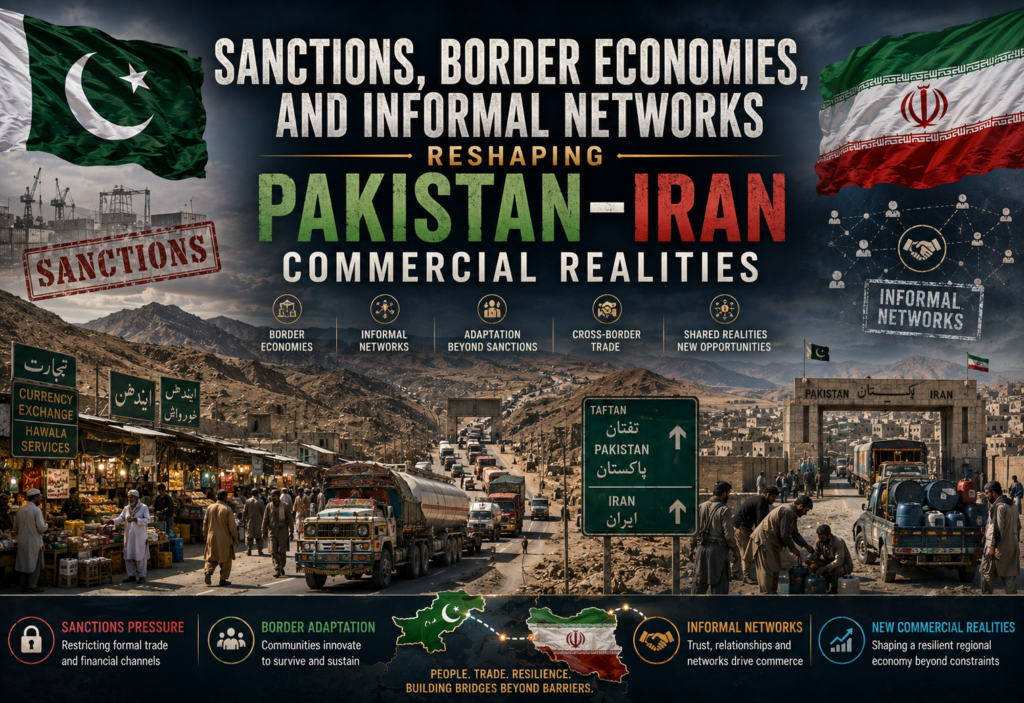
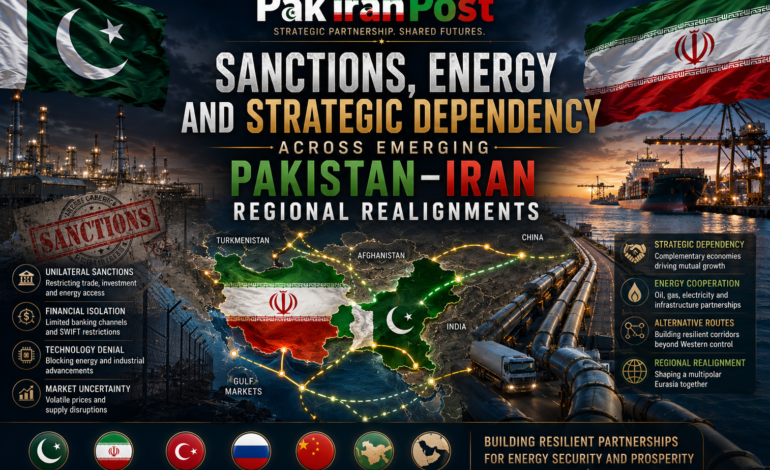
The frontier separating Pakistan and Iran has gradually evolved into one of the most revealing laboratories of twenty first century sanctions geopolitics. What appears on official maps as a sovereign border increasingly functions in practice as a fluid economic organism shaped less by formal state institutions than by adaptive survival systems, informal trade circuits, tribal affiliations, and sanctions induced commercial improvisation. Across the deserts and underdeveloped corridors of Balochistan, an alternative economy has emerged beyond the language of treaties, customs regulations, and official trade frameworks. This parallel economy is not merely criminality disguised as commerce. It is a structural consequence of geopolitical exclusion, economic asymmetry, and the weaponization of international finance.
Western sanctions imposed upon Iran were originally designed to isolate Tehran economically, restrict strategic financing, and weaken the regional projection of Iranian influence. Yet sanctions rarely remain confined to their declared objectives. Over time they reshape borderlands, distort local economies, generate parallel markets, and create alternative sovereignties operating beyond the reach of formal governance. The Pakistan Iran frontier demonstrates how sanctions economies frequently produce unintended regional ecosystems capable of surviving precisely because they operate outside conventional regulatory visibility.
In the barren expanses connecting Iran’s Sistan and Baluchestan province with Pakistan’s Balochistan region, informal fuel markets, undocumented commodity exchanges, currency arbitrage networks, and unregulated transport systems now sustain entire populations. For thousands living within these neglected frontier territories, sanctions are not abstract instruments of international diplomacy. They are daily economic realities shaping employment, mobility, food security, and survival itself. The sanctions economy has become embedded within the social architecture of the border.
Fuel smuggling remains perhaps the most visible dimension of this evolving parallel economy. Iranian fuel, heavily subsidized and therefore significantly cheaper than fuel available within Pakistan, enters border regions through intricate networks involving transporters, intermediaries, local tribal actors, and decentralized distribution chains. Tankers, modified vehicles, motorcycles, and small scale carriers move petroleum products across unofficial routes extending deep into Pakistani territory. These networks operate despite repeated crackdowns because the economic incentives sustaining them remain structurally powerful.
Recent estimates suggest that informal fuel trade continues to involve substantial daily cross border movement despite intensified enforcement measures. (arabnews.pk) The trade persists not because states lack awareness, but because local economies have become partially dependent upon it. Entire communities derive livelihoods from transport, resale, storage, and logistical facilitation connected to sanctions generated fuel commerce. Attempting to eliminate these systems without providing viable economic alternatives risks social destabilization in regions already characterized by poverty, unemployment, and chronic state neglect.
This reality exposes the central contradiction underlying sanctions policy. Sanctions seek to isolate states through formal economic restrictions, yet they often stimulate the emergence of decentralized informal systems operating outside regulatory oversight. Instead of eliminating commerce, sanctions frequently informalize it. Instead of strengthening governance, they may weaken institutional legitimacy by encouraging populations to rely upon unofficial economic structures for survival.
The Pakistan Iran border economy therefore represents not merely smuggling but the formation of what may be described as a parallel geo economic order. This order operates according to different rules than formal global commerce. Trust frequently matters more than contracts. Tribal affiliations substitute for legal guarantees. Cash circulation bypasses formal banking systems. Commodities move through adaptive logistical channels resistant to centralized monitoring. Economic authority becomes dispersed rather than institutionalized.
This transformation is especially significant because borderlands historically function as peripheral zones where state sovereignty remains unevenly enforced. In Balochistan, decades of underdevelopment, infrastructural neglect, insurgency concerns, and weak administrative penetration have produced conditions in which informal economies flourish naturally. Sanctions accelerated tendencies that already existed structurally within the frontier environment. The result is a hybrid economic landscape where legality becomes negotiable and governance becomes fragmented.
Pakistani authorities periodically launch anti smuggling campaigns and tighten border enforcement mechanisms. Yet these measures often produce only temporary disruption because they fail to address the deeper structural drivers of the informal economy. Local populations perceive many enforcement efforts not as governance reforms but as threats to economic survival. Consequently, crackdowns may generate resentment against state institutions while simultaneously increasing the profitability of underground trade routes.
Iran likewise maintains an ambivalent relationship with the border economy. Officially Tehran opposes unauthorized trade networks. In practice however sanctions pressure has incentivized tolerance toward certain forms of informal cross border commerce that generate hard currency inflows and alleviate economic pressure in peripheral provinces. This ambiguity reflects the adaptive logic of sanctions economies. States subjected to financial isolation gradually develop informal external arteries through which economic circulation continues despite formal restrictions.
The broader geopolitical implications of these parallel systems are profound. Informal trade networks reduce the effectiveness of sanctions while simultaneously weakening the authority of formal institutions. They generate opaque financial ecosystems difficult to regulate, tax, or monitor. Over time these systems may evolve into semi permanent alternative commercial architectures operating independently of conventional global economic governance.
This phenomenon is not unique to the Pakistan Iran border. Similar dynamics have emerged across multiple sanctions affected regions including Venezuela, Syria, Afghanistan, and parts of Russia linked trade systems following Western sanctions expansion. What distinguishes the Pakistan Iran case however is the intersection between sanctions economics and strategic geography. The border sits at the crossroads of South Asia, West Asia, and emerging Eurasian connectivity ambitions. Consequently, informal trade networks here possess broader regional significance extending beyond localized survival economies.
The rise of these systems also reflects the fragmentation of globalization itself. For decades, globalization was associated primarily with formal liberalized trade governed through multilateral institutions, transparent financial systems, and standardized regulatory frameworks. Yet contemporary geopolitical fragmentation increasingly produces alternative forms of globalization operating through informal networks, sanctions circumvention mechanisms, and decentralized commercial adaptation. The Pakistan Iran frontier illustrates this emerging phenomenon vividly.
Media narratives surrounding border trade frequently obscure these complexities beneath securitized language emphasizing smuggling, criminality, or border instability. Such framing simplifies a much deeper socio economic reality. Informal economies are not merely products of lawlessness. They are often rational adaptive responses within environments where formal economic participation remains inaccessible or insufficient. The residents of neglected frontier regions do not engage in sanctions induced trade primarily because of ideological loyalty or criminal ambition. They do so because alternative livelihoods remain structurally absent.
This distinction matters profoundly for policymakers. Excessive securitization of border economies without parallel developmental investment risks intensifying instability rather than reducing it. Border populations alienated economically and politically become increasingly vulnerable to insurgent recruitment, criminal exploitation, and anti state sentiment. Economic marginalization and security fragmentation frequently reinforce one another.
At the same time, the persistence of informal trade networks exposes the limitations of state centric economic governance in frontier environments. Modern borders are often imagined as rigid lines separating sovereign jurisdictions. In reality, many borders function as porous economic ecosystems where populations maintain historical commercial, familial, and cultural connections transcending formal political boundaries. The Pakistan Iran border embodies precisely this condition. Tribal linkages, kinship structures, and historical trade patterns continue to shape economic interaction regardless of official restrictions.
The growing role of digital communication technologies further complicates enforcement efforts. Mobile coordination, decentralized financial transfers, encrypted messaging platforms, and adaptive logistical systems increasingly allow informal traders to reorganize rapidly in response to enforcement actions. The sanctions economy therefore becomes technologically flexible even while remaining geographically rooted.
Recent inflationary pressures inside Pakistan have further increased the attractiveness of cheaper Iranian goods entering through informal channels. Currency depreciation, rising fuel prices, and declining purchasing power collectively expand demand for lower cost commodities sourced through border trade networks. Economic crisis therefore strengthens the social legitimacy of informal commerce within struggling communities.
Simultaneously, broader geopolitical shifts may gradually reshape the strategic environment surrounding sanctions economies. Growing debates concerning de dollarization, regional payment systems, and alternative trade mechanisms indicate increasing dissatisfaction among many states regarding the geopolitical weaponization of global finance. China and Russia have both intensified efforts to develop parallel commercial infrastructures reducing dependence upon Western controlled financial systems. Although such efforts remain incomplete, they contribute toward a wider atmosphere in which sanctions circumvention becomes increasingly normalized within parts of the international system.
For Pakistan, the challenge lies in transforming unmanaged informal economies into regulated frameworks of regional economic integration. Purely coercive approaches are unlikely to succeed sustainably. Islamabad instead requires a comprehensive frontier development strategy integrating economic formalization, infrastructural investment, customs modernization, and localized employment generation.
One potential pathway involves the expansion of regulated border markets operating under bilateral supervision. Properly institutionalized cross border commercial zones could gradually shift portions of informal trade into taxable and monitorable frameworks while preserving local livelihoods. Similar models have been implemented with varying degrees of success in other border regions globally. Such initiatives would require sustained diplomatic coordination between Islamabad and Tehran alongside significant investment in transportation infrastructure, customs management, and financial oversight mechanisms.
Equally important is the necessity of addressing the developmental vacuum within Balochistan itself. Frontier instability cannot be separated from chronic underinvestment in education, healthcare, transportation, and employment infrastructure. Border populations excluded from national economic growth naturally gravitate toward alternative survival systems. Development therefore constitutes not merely a social objective but a strategic security imperative.
Pakistan must additionally recognize that excessive dependence upon informal economies weakens long term state capacity. Untaxed commercial systems reduce fiscal revenues, undermine regulatory authority, and create environments vulnerable to criminal infiltration. Formalization is therefore essential. Yet formalization imposed without economic sensitivity risks provoking destabilization. Successful transition requires gradual integration rather than abrupt suppression.
Iran likewise possesses incentives to pursue greater economic institutionalization along the border. Formalized trade mechanisms would provide Tehran with more stable commercial channels while reducing the unpredictability associated with decentralized smuggling systems. Both states therefore share overlapping interests in replacing unmanaged economic informality with regulated interdependence.
The broader lesson emerging from the Pakistan Iran border is that sanctions rarely produce linear outcomes. Economic isolation policies frequently generate adaptive counter systems capable of reshaping entire regional environments. Informal economies become embedded within local survival structures, alternative sovereignties emerge in peripheral spaces, and borderlands transform into laboratories of geopolitical adaptation.
The sanctions economy now extending across the Pakistan Iran frontier reveals the gradual emergence of a world where parallel systems increasingly coexist beside formal globalization. Official institutions continue to dominate international finance and trade, yet beneath them alternative circuits of commerce, connectivity, and economic survival are expanding quietly. These systems remain fragmented, opaque, and unstable. Nevertheless, they demonstrate that geopolitical pressure rarely eliminates economic interaction entirely. More often it redirects commerce into less visible and less governable forms.
For Pakistan and Iran, the strategic challenge is therefore not merely controlling the border. It is deciding what kind of border should exist in the twenty first century. A militarized fault line defined by perpetual smuggling, underdevelopment, and insecurity will continue reproducing instability. A regulated economic frontier integrated through infrastructure, trade, and localized development could instead become a stabilizing corridor connecting adjacent regions historically divided more by geopolitics than geography.
Ultimately, the Pakistan Iran border economy reflects the unfinished transformation of the global order itself. Sanctions attempt to discipline states through exclusion. Yet exclusion generates adaptation. Informality becomes resilience. Borderlands become alternative commercial universes. And the very mechanisms designed to isolate economies frequently contribute toward the creation of decentralized systems operating increasingly beyond the reach of conventional geopolitical control.
A Public Service Message