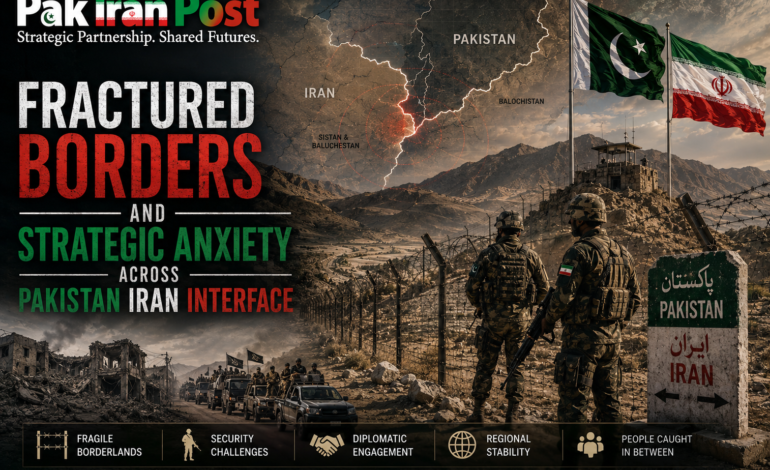
Fractured Borders and Strategic Anxiety Across Pakistan Iran Interface

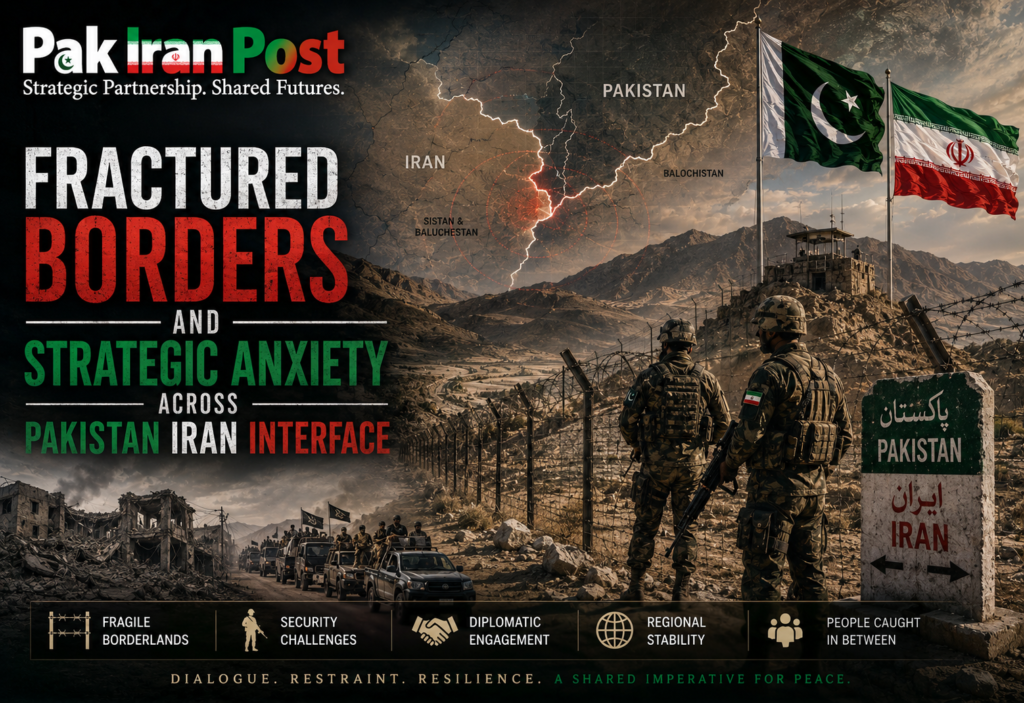
The Pakistan Iran frontier has gradually ceased to be a conventional cartographic boundary and increasingly resembles a political membrane through which insecurity, ideology, and displacement flow in unpredictable rhythms. What was once conceived as a marginal periphery of both states has now become a central node in a wider regional security architecture shaped by post Afghanistan fragmentation, the diffusion of non-state militancy, and the recalibration of Gulf and South Asian alignments.
The contemporary strategic condition along this interface cannot be adequately understood through classical interstate rivalry paradigms. Instead, it is more accurately interpreted as a condition of managed instability, in which both Islamabad and Tehran simultaneously cooperate and compete, while external shocks continuously reconfigure their threat perceptions. Militancy, sectarian memory, refugee mobility, and information warfare collectively constitute a hybrid ecosystem that resists linear policy responses.
In recent years, episodic cross border violence, particularly in the Sistan Baluchestan and Balochistan corridors, has reinforced a perception of porous sovereignty. Armed groups exploiting ethno nationalist grievances have demonstrated operational fluidity across terrain that is socially interconnected yet institutionally fragmented. The persistence of such networks indicates not merely a security deficit but a deeper structural condition in which state authority is unevenly distributed across geography, producing zones of partial governance.
At the same time, sectarian discourse remains an underlying but often strategically instrumentalized layer within this geopolitical configuration. The Iran Saudi rivalry, while not directly manifesting as a conventional proxy war on Pakistani soil, nevertheless shapes narrative framing, funding channels, and ideological articulation within localized religious ecosystems. These dynamics do not operate in isolation; they are embedded within a broader informational economy in which identity is continuously reconstructed through external stimuli and internal grievances.
The critical analytical challenge lies in recognizing that sectarian spillover does not function as a spontaneous social phenomenon alone, but as a form of transnational narrative circulation. It is activated selectively, amplified through digital and clerical infrastructures, and subsequently absorbed into domestic political discourse. This creates a feedback loop in which local incidents are refracted through regional ideological contestations, thereby magnifying their perceived strategic significance beyond their immediate scale.
Simultaneously, militant sanctuaries along the border cannot be understood purely as territorial safe havens. They constitute adaptive micro sovereignties embedded within complex socio-economic landscapes where survival economies, informal trade routes, and kinship structures intersect with insurgent logistics. These sanctuaries persist not only because of weak enforcement capacity, but because the border itself is socially lived rather than administratively enforced.
Cross border insurgency in this context reflects a transformation in militancy itself. It is no longer strictly hierarchical or territorially anchored. Instead, it operates as a distributed network of semi autonomous actors capable of rapid reconfiguration in response to pressure. The diffusion of such networks complicates bilateral trust, as attribution of responsibility becomes contested, delayed, or strategically reframed depending on domestic political exigencies.
Iranian and Pakistani security establishments have periodically accused each other of tolerating or failing to suppress these militant formations. However, empirical observation suggests a more nuanced reality. Both states have at various junctures engaged in limited cooperation, intelligence exchange, and tactical coordination, particularly when confronted with mutual escalation risks. This paradox of confrontation and cooperation defines the structural ambiguity of the relationship.
Within media narratives, this ambiguity is often reduced to binary interpretations either portraying the border as an arena of covert proxy competition or as a site of uncontrollable chaos. Both framings are analytically insufficient. The reality is better understood as a condition of calibrated instability, where neither full escalation nor complete stabilization is strategically feasible under current regional constraints.
Compounding this complexity is the issue of refugee movement, particularly Afghan displacement patterns that intersect with both Iranian and Pakistani territories. These movements are not temporary anomalies but long duration demographic transformations generated by decades of conflict, regime change, and economic collapse in Afghanistan. The presence of large refugee populations introduces additional layers of governance stress, particularly in urban labor markets, border administration, and internal security monitoring systems.
Refugees in this context occupy an ambiguous position within state narratives. They are simultaneously framed as humanitarian subjects requiring protection and as potential vectors of insecurity requiring regulation. This duality produces policy oscillation between inclusionary humanitarianism and exclusionary securitization. Such inconsistency undermines long term integration strategies and perpetuates cycles of vulnerability.
Recent developments at border crossings, including intensified repatriation efforts and intermittent closures, reflect a broader shift toward securitized mobility governance. However, these measures address symptoms rather than structural drivers. The underlying condition remains one of regional instability reproduction, where displacement is continuously regenerated by overlapping crises in governance, insurgency, and economic fragility.
From a strategic standpoint, the Pakistan Iran interface is increasingly shaped by a convergence of three interlinked pressures: fragmented militancy, demographic displacement, and narrative polarization. Each of these elements reinforces the others, producing a self-sustaining instability loop that resists conventional containment strategies.
Policy responses to this evolving environment require a fundamental shift in analytical framing. First, border security must be reconceptualized as integrated spatial governance rather than perimeter defence. This implies synchronized administrative mechanisms, shared intelligence infrastructures, and joint socio-economic development planning in border regions.
Second, militant networks must be addressed not solely through kinetic disruption but through disruption of their enabling ecosystems, including informal economies and digital communication pathways. Without addressing these underlying infrastructures, tactical successes will remain temporary and reversible.
Third, refugee governance must transition from episodic crisis management to institutionalized regional coordination frameworks. This includes harmonized documentation systems, labor mobility agreements, and long-term burden sharing arrangements that recognize displacement as a structural regional condition rather than an exceptional humanitarian event.
Finally, narrative competition between state and non-state actors must be addressed as a core component of security strategy. Information ecosystems have become central battlegrounds where legitimacy, identity, and threat perception are continuously constructed. Failure to engage at this level risks perpetuating cycles of misunderstanding and escalation.
In essence, the Pakistan Iran border is no longer a peripheral security concern. It has become a central laboratory for observing the transformation of sovereignty under conditions of transnational fragmentation. The stability of this interface will increasingly depend not on rigid boundary enforcement but on adaptive governance architectures capable of managing complexity rather than eliminating it.
The strategic future of the region will be determined less by decisive victories than by the capacity of states to operate within sustained ambiguity, where cooperation and competition coexist within the same institutional space. In this sense, the border is not merely a line of division but a dynamic field of negotiated order, continuously reshaped by forces that transcend both national jurisdictions and traditional policy instruments.
A Public Service Message