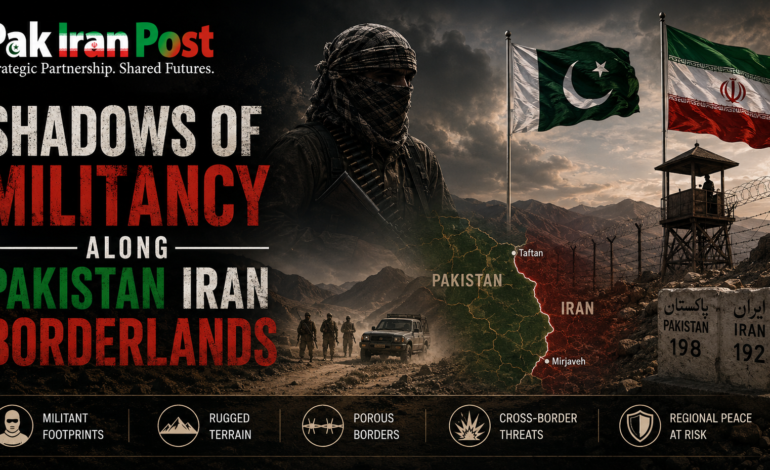
Shadows Of Militancy Along Pakistan Iran Borderlands


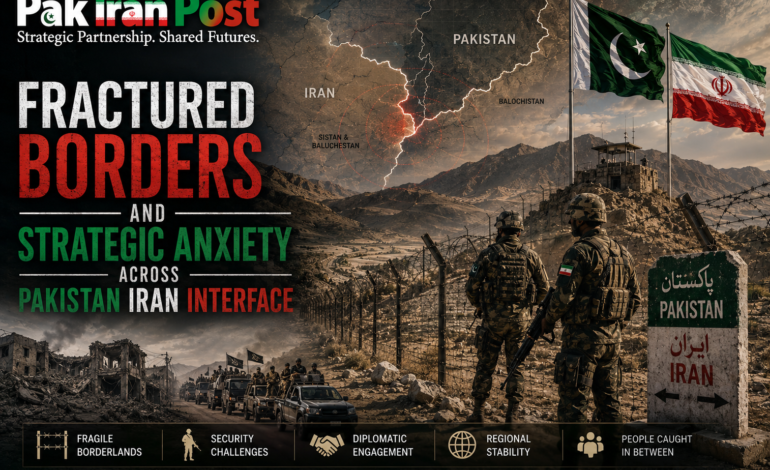
The Pakistan Iran frontier continues to evolve into one of the most intricate security theatres in South Asia and the broader Middle Eastern periphery, where conventional distinctions between state and non state violence, ideological and criminal networks, and domestic and transnational security threats increasingly collapse into a single continuum of instability. What emerges is not a clearly demarcated conflict zone but a layered geography of overlapping sovereignties, where authority is fragmented, enforcement is selective, and legitimacy is perpetually negotiated.
The persistence of militant activity across this interface is frequently interpreted through the narrow lens of border insecurity. Yet such an interpretation fails to capture the deeper structural transformation underway. Militancy in this region has ceased to function as a purely ideological or territorially anchored phenomenon. Instead, it has mutated into a fluid security ecology, sustained by adaptive networks that operate across tribal affiliations, informal economies, and transnational logistical corridors.
These networks derive resilience not only from ideological conviction but from the structural conditions of the borderlands themselves. The terrain stretching across Balochistan and Sistan Baluchestan is characterized by vast geographical permeability, limited infrastructural penetration, and historically embedded kinship systems that predate modern state formation. In such environments, state authority is not absent but unevenly distributed, producing what can be described as zones of partial governance where multiple forms of authority coexist without full consolidation.
Within this fragmented landscape, militant sanctuaries are less static havens and more dynamic ecosystems of concealment and mobility. Their operational survival depends on constant adaptation, shifting routes, and the strategic exploitation of jurisdictional ambiguity between Pakistani and Iranian enforcement structures. These sanctuaries are not merely geographic locations but relational spaces embedded within local economies, trade circuits, and social hierarchies.
The evolution of cross border insurgency in this context reflects a broader global trend in which militant organization is increasingly decentralized. Hierarchical command structures have given way to networked formations capable of rapid dispersion and reassembly. This transformation complicates traditional counter insurgency models, which remain largely predicated on identifiable leadership structures and territorially fixed adversaries.
In recent years, both Islamabad and Tehran have expressed heightened concern over the presence of militant groups operating along their shared frontier. Periodic military exchanges, intelligence driven operations, and diplomatic protests reflect an ongoing attempt to stabilize an inherently unstable environment. Yet these efforts are constrained by a paradox: the very conditions that enable cooperation also generate mistrust. Each state perceives the other through a prism of selective attribution, where militant activity is alternately framed as a domestic failure, a cross border spillover, or a strategically tolerated proxy.
This ambiguity is further intensified by the absence of a shared epistemic framework for defining militancy itself. Groups operating in these regions often defy neat categorization, oscillating between ideological insurgency, ethnic mobilization, and criminal entrepreneurship. As a result, policy responses frequently suffer from conceptual fragmentation, where different agencies interpret the same actors through incompatible analytical lenses.
Compounding this complexity is the role of external geopolitical pressures. Regional rivalries, shifting alignments in the Gulf, and broader contestations involving global powers indirectly shape the strategic environment in which Pakistan and Iran operate. While neither state serves as a direct proxy battlefield for these larger rivalries, their borderlands are nonetheless affected by the diffusion of resources, narratives, and ideological influences that originate beyond the immediate region.
Media narratives play a significant role in shaping public perception of these dynamics. In both countries, coverage of border militancy tends to oscillate between episodic alarmism and strategic silence. This inconsistency contributes to a fragmented information environment in which public understanding is shaped more by selective incidents than by systemic analysis. The absence of sustained, analytically grounded discourse allows episodic violence to disproportionately influence policy sentiment and diplomatic tone.
At the operational level, counter insurgency strategies have largely relied on kinetic responses, including targeted strikes, border fencing, and increased surveillance. While such measures may produce short term tactical disruption, they do not address the underlying ecosystem that sustains militant mobility. In many cases, they also risk displacing networks rather than dismantling them, leading to spatial redistribution rather than structural reduction of threat capacity.
A more durable approach requires rethinking militancy not as an isolated security challenge but as an embedded socio economic phenomenon. Informal cross border trade, economic deprivation in peripheral regions, and limited state service delivery all contribute to the resilience of non state armed actors. In such contexts, militancy often emerges not solely as ideological commitment but as an adaptive survival strategy within constrained environments.
Therefore, policy must shift from a purely deterrent framework to one that integrates developmental, infrastructural, and governance dimensions into security planning. Border regions require not only military oversight but also sustained investment in education, health infrastructure, legal economic opportunities, and administrative integration. Without such interventions, security measures risk addressing symptoms rather than causes.
At the bilateral level, Pakistan and Iran face a strategic imperative to move beyond episodic crisis management toward institutionalized border governance mechanisms. This includes the development of joint monitoring frameworks, synchronized intelligence sharing protocols, and coordinated response architectures capable of addressing cross border threats in real time. However, institutional cooperation alone is insufficient unless accompanied by a parallel effort to harmonize threat perception and reduce narrative divergence.
One of the most significant obstacles to durable cooperation is the persistence of strategic suspicion embedded in historical experience. Both states have periodically accused each other of tolerating or insufficiently controlling militant elements operating within their territories. These perceptions, whether fully accurate or partially constructed, continue to shape diplomatic interactions and limit the depth of trust required for sustained coordination.
In this context, the challenge is not merely operational but epistemological. It requires the construction of a shared analytical language through which both sides can interpret security phenomena in comparable terms. Without such convergence, even well designed mechanisms risk being undermined by divergent interpretations of the same events.
The future trajectory of militancy along the Pakistan Iran border will depend on whether both states can transition from reactive containment to proactive stabilization. This transition demands recognition that security cannot be imposed solely through force, nor achieved through unilateral action. Instead, it must emerge from a complex interplay of enforcement, governance reform, and regional cooperation.
Ultimately, the borderlands represent not only a site of vulnerability but also a potential laboratory for innovative security governance. If approached through a lens of integrated strategy rather than episodic reaction, they could become a model for managing hybrid threats in other fragmented regions. However, if current patterns persist, the interface will continue to function as a zone of recurrent instability, where militancy adapts faster than the structures designed to contain it.
A Public Servie Message