
Pakistan’s Iran Dilemma Between Cheap Energy And Sanctions

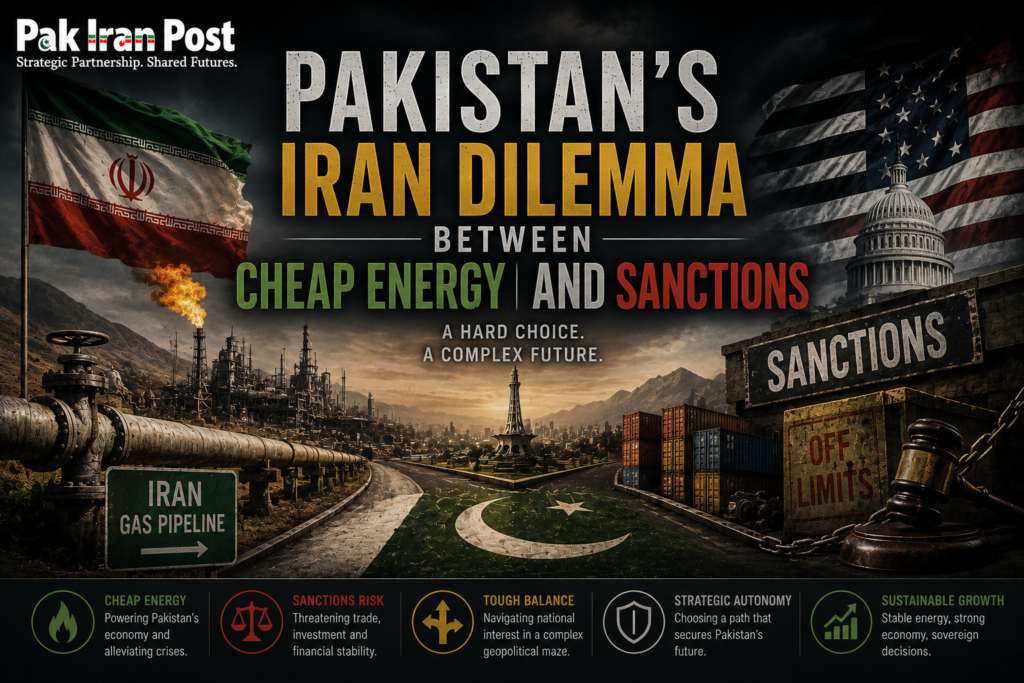
Pakistan’s economic relationship with Iran has long been suspended between obvious geography and persistent fear. Geography says the logic of engagement is straightforward. Iran is next door, energy-rich, undertraded, and connected to Pakistan by a border that should, in theory, make electricity, fuel, transit and commercial exchange cheaper than many of the alternatives Islamabad currently relies upon. Fear says the opposite. Iran is heavily exposed to sanctions risk, politically sensitive for Gulf partners, strategically entangled with the United States and Israel, and increasingly governed through a security lens that makes every commercial opening vulnerable to geopolitical interruption. For decades, Pakistan has tried to live inside this contradiction rather than resolve it. It has kept the idea of economic cooperation with Iran alive rhetorically while shrinking its practical scope to the narrow margins that can be defended politically or administratively. The post-war reordering around Iran now threatens to make that middle position harder to sustain. Pakistan may soon have to decide whether Iran remains primarily a missed economic opportunity, or whether it is becoming a strategic liability that can no longer be approached through half-open channels and deferred decisions.
That question cannot be answered through ideology, sentiment or the habitual invocation of “brotherly relations”. It must be answered through exposure, constraint and national need. Pakistan is an energy-stressed economy with a chronic balance-of-payments problem, a structurally weak export base, high industrial energy costs and a western periphery, especially in Makran and parts of Balochistan, that has often been more physically proximate to Iranian electricity and fuel than to Pakistan’s own grid and supply chains. At the same time, Pakistan remains dependent on Gulf financing, vulnerable to Western financial signalling, repeatedly exposed to IMF conditionality, and institutionally risk-averse when sanctions are involved. A post-conflict Iran that emerges more securitised, more IRGC-dominated and potentially more isolated from the Western order intensifies both sides of the contradiction. It raises the strategic value of nearby energy and trade corridors even as it raises the political and compliance risks of using them.
The core policy problem is that Pakistan’s Iran file has always contained two different conversations that rarely meet honestly. In one conversation, held mostly by economists, traders, energy planners and provincial actors in Balochistan, Iran appears as an underused economic valve. It can supply electricity to underserved districts, offer a land route for trade, provide refined fuels or crude under the right conditions, anchor border markets, and potentially connect Pakistan westward into a larger overland commercial geography. In the other conversation, held by diplomats, finance officials, sanctions lawyers and security planners, Iran appears as a sanctions magnet and strategic tripwire. Any major energy or infrastructure engagement risks American penalties, Gulf discomfort, insurance complications, banking blockages, reputational costs and, increasingly, entanglement with an Iranian economy that may be run more directly through security institutions than through normal commercial logic. Pakistan has tried to preserve both conversations simultaneously by doing just enough with Iran to avoid total economic distance, but not enough to trigger systemic backlash. That approach may no longer be sufficient.
The most immediate example is electricity. Pakistan’s energy relationship with Iran is often discussed in sweeping terms about pipelines and strategic realignment, but the most concrete and operationally relevant form of engagement has been power supply to Balochistan’s Makran region. In May 2026, Pakistan’s regulator approved tariff arrangements that effectively expanded and regularised Iranian electricity imports for the coastal belt, taking the total supply to around 204 megawatts, including the continuation of the existing 104 MW and an additional 100 MW through the Polan-Gabd corridor. Pakistani reporting on the decision was blunt about the practical reality: Makran does not yet have a credible immediate substitute for imported Iranian power, and the national grid remains too weak to provide reliable relief at scale. This is not a grand geopolitical vision. It is an admission of infrastructural dependence. Iran is already part of Pakistan’s energy system, albeit in a limited, peripheral and politically manageable way.
That matters because it exposes the fiction that Pakistan can keep Iran economically distant at negligible cost. It cannot, at least not in the western districts that already rely on Iranian supply. The question is not whether there is economic contact; there already is. The question is whether Islamabad can continue to confine that contact to piecemeal exceptions while the strategic context around Iran is changing. A more militarised and sanctions-exposed Iran does not automatically make electricity imports impossible. In fact, the opposite may be true in the short term: Tehran may have stronger incentives to monetise nearby export channels, and Pakistan may have stronger incentives to secure relatively cheaper cross-border energy for underserved regions. But the durability of such arrangements depends on whether Pakistan can build a framework for limited economic engagement that is technically useful, financially defensible and politically survivable.
The difficulty is that Pakistan’s economic debate about Iran often oscillates between fantasy and paralysis. The fantasy is that Iran can solve Pakistan’s energy crisis if only Islamabad were courageous enough to ignore outside pressure. The paralysis is that any meaningful engagement with Iran is so risky that Pakistan should leave the relationship frozen at its current underdeveloped level. Both positions are flawed. Iran cannot rescue Pakistan from structural energy dysfunction, debt dependence or industrial weakness. But nor is it strategically rational to leave a neighbouring energy producer economically underused when Pakistan continues to pay high costs for imported fuels, struggles to electrify peripheral districts and seeks regional connectivity wherever it can find it.
The old symbol of this dilemma is the Iran–Pakistan gas pipeline, a project that has haunted Pakistani policy for years as a monument to suspended intent. On paper, the pipeline promised obvious advantages: nearby gas, a land-based supply route, and a strategic diversification of Pakistan’s energy mix. In practice, it became trapped between U.S. sanctions, financing obstacles, domestic indecision, weak infrastructure planning and the state’s unwillingness to absorb the diplomatic consequences of implementation. It survives today less as a project than as a recurring test of whether Pakistan can convert declared national interest into actual policy when external pressure rises. The post-war environment makes that test even harsher. If Iran emerges more isolated and more heavily shaped by the IRGC, any revival of the pipeline would no longer be read simply as a commercial decision. It would be interpreted as a geopolitical signal, a sanctions challenge and a measure of Pakistan’s willingness to bear external costs for energy gain.
That is why the right question is not whether the pipeline is theoretically beneficial. It is whether Pakistan, in its present financial and diplomatic condition, can operationalise a project of that scale without triggering costs larger than the benefits. At present, the answer remains doubtful. A gas pipeline requires not only physical infrastructure but payment channels, insurance confidence, long-term pricing credibility, domestic transmission capacity and a sanctions environment that does not turn every stage of implementation into a legal and diplomatic hazard. Pakistan lacks most of those cushions. Its macroeconomic vulnerability means it cannot casually invite punitive financial signalling from Washington or secondary discomfort from Gulf lenders. Its energy governance remains too weak to absorb a politically explosive mega-project without bureaucratic drift and rent-seeking. And a more security-centric Iran would likely seek terms and strategic assurances that Pakistan may not be comfortable providing. The pipeline is therefore not dead, but it remains strategically overburdened. It may still function as leverage in negotiations or as a contingency option if the regional order softens. It is not yet a practical centrepiece of Pakistan’s Iran policy.
The more realistic economic question lies elsewhere: can Pakistan design a layered model of engagement with Iran that prioritises low-visibility necessity over high-visibility symbolism? That means starting not with the pipeline, but with what is already possible: electricity imports where grid logic supports them, formalisation of border trade where smuggling already dominates, localised fuel and commodity arrangements under tighter customs control, barter or local-currency mechanisms for non-sensitive goods where legally feasible, and infrastructure around border markets that converts illicit dependence into taxable commerce. The virtue of such a model is not that it avoids all sanctions risk; it does not. Its virtue is that it aligns economic engagement with actual need rather than theatrical geopolitics.
Border trade is central to this logic. The Pakistan–Iran frontier has long sustained a dense informal economy in fuel, food, household goods and transport. Much of what Islamabad describes as “smuggling” is also, in social terms, a livelihood system for communities in Balochistan that have few viable alternatives. The state’s dilemma is familiar: crack down too hard and it punishes border populations while driving trade deeper underground; tolerate the system entirely and it loses revenue, visibility and regulatory control. A post-war Iran sharpens the stakes because sanctions pressure and economic insecurity on the Iranian side may push even more commerce into informal channels. If Pakistan continues to approach this only as a law-and-order issue, it will miss the geoeconomic opportunity. Border markets, bonded zones, simplified customs regimes and biometric trade permits will not eliminate smuggling, but they can shift a portion of existing flows into a semi-formal structure the state can monitor and tax. That matters not only for revenue but for stability. A border economy that is partly formal is easier to govern than one that survives entirely through tolerated illegality.
Yet the promise of border trade should not be romanticised. Formalisation requires state capacity, and Balochistan remains administratively thin. Roads, customs infrastructure, cold storage, warehousing, banking channels, scanning equipment and dispute-resolution mechanisms are all limited. Moreover, if Iran’s economy becomes more securitised under pressure, cross-border trade will not necessarily be shaped by civilian commercial logic. It may be shaped by entities with close links to the Iranian security state, including actors better able to exploit sanctions gaps and informal finance. Pakistan therefore cannot simply “open trade” with Iran and assume ordinary market rationality will follow. It needs a sanctions-aware, security-aware trade architecture that identifies which goods can move legally, how payments can be settled, which entities are too exposed to deal with, and how customs intelligence can distinguish licit border commerce from illicit financing or covert logistics.
The strategic question of fuel imports is even more politically sensitive. In every Pakistani debate on Iran, the same temptation reappears: why buy expensive hydrocarbons from far away when a sanctioned but geographically adjacent producer sits across the border? In abstract terms, the argument is compelling. Transport costs can be lower, supply routes shorter, and pricing potentially advantageous. In practice, proximity does not neutralise sanctions, insurance, shipping, refinery compatibility or payment problems. Even where Iranian crude or refined products look cheaper on paper, the landed cost and compliance risk can quickly become more complicated. Pakistan’s refining system is not infinitely flexible; its banking channels are vulnerable; and the reputational risk of visible state-led petroleum imports from Iran is far greater than that of limited electricity purchases for Balochistan. This is why fuel flows from Iran into Pakistan have historically appeared more often through informal trucking and localised leakage than through large, transparent state-to-state arrangements. The economic need is real. The institutional capacity to manage it legally at scale remains weak.
The post-war environment introduces another complication: the strategic value of the Strait of Hormuz and wider maritime volatility. Pakistan’s economy remains exposed to Gulf shipping disruptions, even if the country is less energy-intensive than some regional peers. Recent Reuters reporting on the temporary reopening of maritime routes and the negotiations around Hormuz underlines how central the waterway remains to oil and LNG flows, and how quickly conflict around Iran can ripple into commercial logistics. At first glance, this would seem to strengthen the case for overland energy diversification with Iran. But it also reminds Pakistan that any serious economic engagement with Tehran now sits inside a larger strategic contest over maritime security, sanctions relief and U.S.–Iran bargaining. In other words, the very instability that makes Iranian energy attractive also makes it politically volatile.
Pakistan’s own diplomacy during the recent conflict has slightly altered the landscape. Islamabad’s role in facilitating U.S.–Iran talks and helping create a temporary diplomatic opening has enhanced its relevance in both Tehran and Western capitals. Reuters reporting suggests Pakistani mediation has raised hopes in Islamabad that diplomatic capital could be converted into economic dividends and wider regional access. That creates an opening, but also a temptation. The opening is obvious: a Pakistan that is seen as useful to de-escalation may find somewhat greater room to argue for narrowly tailored economic arrangements with Iran, especially where those arrangements are humanitarian, energy-stabilising or geographically unavoidable. The temptation is to overread that diplomatic goodwill and assume it amounts to a sanctions waiver for broader economic integration. It does not. Mediation can buy attention and perhaps tactical flexibility. It does not dissolve the underlying constraints of U.S. sanctions law, Gulf sensitivities or financial risk.
That is why Islamabad must resist two opposite errors. The first is strategic timidity masquerading as prudence. This is the view that because Iran is difficult, Pakistan should do as little as possible beyond the bare minimum already underway. Such a position may protect officials from immediate controversy, but it leaves Pakistan paying a long-term price in Balochistan, where energy shortages, informal trade and border underdevelopment deepen because the state refuses to build a lawful economic interface with the neighbour it already depends on. The second error is strategic bravado masquerading as sovereignty. This is the view that Pakistan should dramatically deepen oil, gas and infrastructure engagement with Iran as a demonstration of independent foreign policy, regardless of the financial and diplomatic blowback. That is not realism; it is performative risk-taking by a state with too little economic resilience to absorb the consequences.
A serious policy approach would instead rank Pakistan’s economic interests with Iran in order of feasibility. First should come electricity and local energy security in Balochistan. If Iranian power is the most practical short- to medium-term solution for Makran and adjoining districts, Pakistan should secure it through transparent regulatory arrangements, improved transmission infrastructure and contingency planning for supply disruption. This is not a favour to Iran. It is a necessity for Pakistani citizens who should not be held hostage to the underdevelopment of the national grid. Second should come formal border commerce. Pakistan should expand and rationalise border markets, introduce simplified customs channels for local trade, and integrate digital registration, cargo tracking and customs intelligence into the frontier economy. Third should come sanctions-screened barter or local-currency arrangements for non-sensitive goods, especially agricultural products and low-risk commodities, provided legal due diligence is robust. Fourth should come long-term optionality: preserving the legal, technical and diplomatic groundwork for larger projects such as the gas pipeline without pretending they are immediately executable.
This hierarchy matters because it distinguishes economic necessity from economic theatre. Electricity imports for underserved districts are a concrete welfare and stability issue. Border trade formalisation is a governance issue. The pipeline is a geopolitical issue. Pakistan should not allow the symbolic weight of the third to paralyse the practical gains available in the first two. Nor should it permit the first two to become Trojan horses for unstructured, opaque and politically costly expansion into areas where the state lacks both legal cover and institutional competence.
The internal governance challenge is equally important. Pakistan’s Iran economic file is too fragmented. The Foreign Office sees sanctions and diplomacy. The petroleum bureaucracy sees long-term supply. Provincial actors in Balochistan see local need. Customs sees leakage. Security agencies see smuggling and border risk. The finance ministry sees exposure to external lenders. No single institution is currently forcing these perspectives into one ranked strategy. The result is a pattern of drift: tactical approvals for electricity, periodic rhetorical revival of the pipeline, sporadic anti-smuggling drives, and an enduring failure to decide what kind of economic relationship Pakistan actually wants with Iran. Islamabad needs a dedicated inter-agency Iran Economic Risk Board, reporting into the National Security Committee or an equivalent structure, to assess every major proposal against four filters: economic necessity, sanctions exposure, strategic signalling and local stabilisation value. Without such a mechanism, Pakistan will continue lurching between under-engagement and rhetorical overreach.
There is also a broader geoeconomic choice beneath the immediate Iran question. Pakistan must decide whether it wants its western frontier to function as a dead edge of the economy or as a regulated gateway. For decades, the western borderlands have been treated more as security burdens than as economic interfaces. This has produced a predictable outcome: smuggling flourishes, formal commerce lags, local populations distrust the state, and every proposal for legal trade is captured by larger geopolitical fears. But a state that permanently underdevelops its border economies in the name of strategic caution eventually pays a strategic price of its own. Balochistan’s instability is not caused by lack of Iran trade, but it is certainly worsened by the absence of lawful economic pathways. The more the state neglects the frontier’s legitimate commercial life, the more it empowers illicit actors who are harder to tax, harder to regulate and easier for militant or foreign networks to exploit.
Can Pakistan afford to keep Iran economically distant? In one sense, yes. It can continue doing what it has done for years: limiting formal engagement, tolerating some informal trade, importing only the electricity it cannot immediately replace, and leaving bigger projects suspended between rhetoric and caution. That path is survivable. But it is not costless. It means continued underdevelopment in the border belt, continued dependence on more expensive or logistically difficult energy alternatives, continued revenue leakage through smuggling, and continued strategic passivity while other regional actors adapt more pragmatically to Iran’s contested place in the economy of West Asia.
Can Pakistan afford not to keep Iran economically distant? That question is harder, because “not keeping distance” can mean very different things. If it means launching headline-grabbing sanctions-defiant oil and gas projects without financial cover, then no: Pakistan cannot afford that kind of confrontation. If it means constructing a disciplined, limited and sanctions-conscious model of engagement rooted in electricity, border trade, local stabilisation and future optionality, then Pakistan not only can afford it; it may increasingly need it. The choice is not between full embrace and total avoidance. It is between structured pragmatism and strategic drift.
In the end, the post-war reordering around Iran is forcing Islamabad to confront a truth it has long postponed. Economic necessity does not automatically override strategic risk. But neither does strategic risk erase economic necessity. The task of policy is to rank, contain and manage both. Pakistan should not romanticise Iran as an economic saviour, nor should it treat Iran only as a sanctions problem. It should treat Iran as a difficult but unavoidable economic neighbour whose value lies not in dramatic geopolitical gestures but in carefully bounded utility. If Islamabad can build that approach, it will not solve Pakistan’s energy crisis or transform the economy overnight. What it will do is something more modest and more important: reduce vulnerability in Balochistan, formalise part of a lawless frontier economy, preserve future strategic options, and prevent Pakistan’s western geoeconomic choices from being made entirely by fear.
That, ultimately, is the real decision now facing Pakistan. Not whether to choose Iran over the Gulf, or sanctions over sovereignty, but whether it can act like a state that can distinguish between the economic uses of proximity and the political dangers of overexposure. The post-conflict moment has made that distinction unavoidable. If Islamabad still responds with slogans, symbolic pipeline politics and administrative hesitation, it will remain trapped in the same old contradiction, paying the costs of distance without gaining the protection of detachment. If it responds with a layered strategy of limited engagement, legal discipline and border-region pragmatism, it may finally begin to turn Iran from a perpetual policy headache into what geography always suggested it should be: not a miracle, not a threat to be denied, but a constrained economic instrument in a larger and harder national strategy.
A Public Service Message