

SOVEREIGNTY WITHOUT ISOLATION: WHAT RESPONSIBLE NEIGHBOURHOOD POLICY MEANS IN PERPETUAL CRISIS

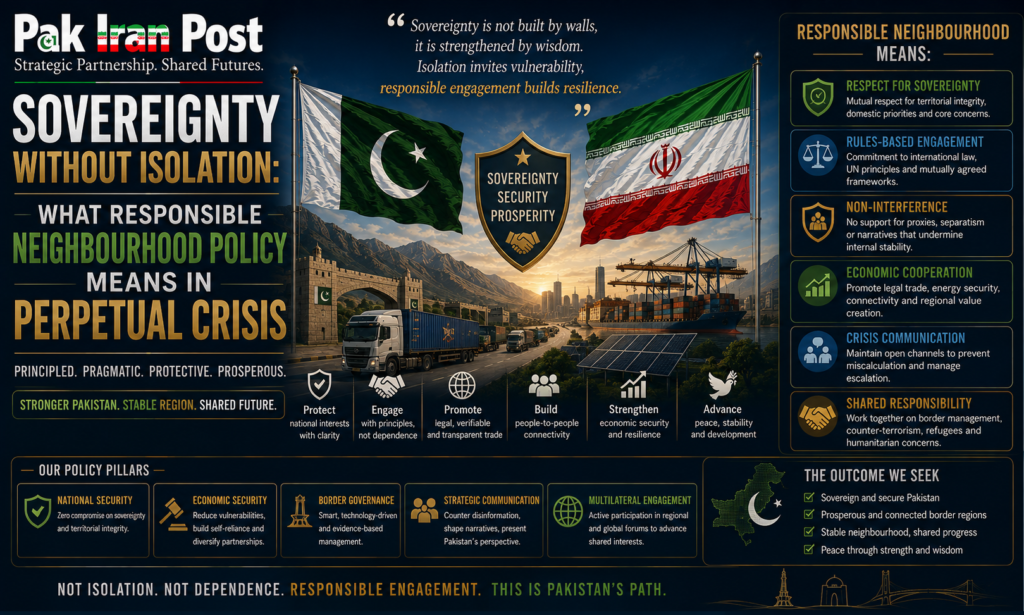
Sovereignty is often discussed as if it were a wall. A state is imagined to be sovereign when it controls its territory, protects its borders, determines its foreign policy and refuses external interference. That conception remains legally important, but it is increasingly inadequate as a description of how states actually survive. In an age of interconnected energy systems, mobile populations, digital communications, transnational crime, maritime commerce, climate stress and persistent regional conflict, sovereignty cannot mean insulation. It means the capacity to remain politically autonomous while managing the consequences of interdependence.
The Pakistan Iran relationship provides an unusually revealing test of this proposition. The two countries share a long frontier, deep cultural connections and economic links that cannot be eliminated simply because governments prefer greater separation. Their relationship is simultaneously diplomatic, commercial, security sensitive, humanitarian and societal. Developments inside Iran can affect Pakistan’s border districts, fuel markets, electricity supply, migration patterns, religious travel, information environment and internal security. Events inside Pakistan can similarly generate consequences for Iranian security perceptions and border management. The frontier is therefore not merely a line separating two sovereign jurisdictions. It is a zone where the practical limits of territorial sovereignty are continuously negotiated.
This reality became particularly visible during the regional crisis of 2026. Pakistan faced the difficult task of protecting its own security while avoiding involvement in a conflict that could destabilise its western frontier. The arrival of Pakistani citizens and foreign nationals through Balochistan demonstrated how quickly external conflict can become a domestic governance challenge. Provincial authorities placed departments on high alert while stressing the need to facilitate and properly manage people entering through the border. The episode illustrated a basic principle that should inform Pakistan’s neighbourhood policy: border security and humanitarian responsibility are not mutually exclusive.
A state that closes its eyes to humanitarian consequences does not necessarily become more sovereign. It may simply transfer the crisis from a controlled administrative environment into an unmanaged one. Conversely, a state that permits uncontrolled movement in the name of humanitarianism risks undermining its own security institutions. Responsible sovereignty therefore requires systems capable of doing both things at once. People must be protected, screened, registered and assisted without turning humanitarian movement into an instrument of political suspicion or allowing genuine security threats to exploit humanitarian channels.
The same logic applies to economic relations. Pakistan and Iran cannot be understood as two sealed national economies. Border communities depend on legitimate commerce, informal trade and access to markets on both sides. Energy supplies have also acquired practical significance. During the 2026 regional war, border trade and supplies involving Iranian fuel and electricity continued despite the wider conflict, although disruptions affected supply and prices. This is precisely why economic interdependence should not automatically be interpreted as strategic vulnerability.
The real question is whether interdependence is governed.
Unregulated interdependence creates vulnerability because states become dependent on networks they cannot monitor. Regulated interdependence can instead become a source of resilience. A border economy with transparent customs procedures, registered traders, digital documentation, enforceable commercial rules and predictable crossing arrangements is more resilient than a border economy dominated by smuggling networks and discretionary enforcement. Energy arrangements supported by contractual clarity, alternative supply planning and emergency protocols are more resilient than informal dependence. Cross border movement governed by verified documentation is safer than movement managed through ad hoc decisions.
This distinction should become central to Pakistan’s thinking about sovereignty. The choice is not between dependence and isolation. It is between unmanaged dependence and institutionalised interdependence.
Pakistan’s official approach already contains elements of such a doctrine. In May 2026, President Asif Ali Zardari instructed Pakistan’s ambassador designate to Iran to prioritise trade, people to people contacts and facilitation of Pakistani visitors, while also reaffirming support for Iran’s territorial integrity, sovereignty and political independence. During President Masoud Pezeshkian’s June visit, Pakistan and Iran again emphasised economic cooperation, connectivity, border security and regional peace. The challenge is therefore not the absence of diplomatic principles. It is translating those principles into a coherent doctrine capable of operating during crisis.
The traditional vocabulary of non interference is also insufficient if it is interpreted mechanically. Non interference should not mean indifference. Pakistan can respect Iran’s sovereignty while objecting to conduct that directly threatens Pakistani territory, citizens or security. It can support Iran’s territorial integrity while insisting that its own territory must not be used for attacks against Iran. It can oppose external military intervention while maintaining the right to protect its own borders. These positions are not contradictory. They represent reciprocal sovereignty.
The principle should be simple: sovereignty must be respected symmetrically.
Pakistan should neither claim a right to manage Iran’s internal affairs nor accept a presumption that Iranian security concerns permit activities affecting Pakistan’s territory. A mature bilateral relationship requires each state to recognise the other’s security perimeter without converting legitimate security concerns into permanent accusations.
This is especially important along the Balochistan frontier. Border communities are often treated as objects of security policy rather than participants in it. Yet communities living around the frontier experience the relationship differently from national capitals. For them, the border can be a livelihood system, a family network, a cultural space, a trading route and a security barrier simultaneously. Excessive militarisation can disrupt legitimate economic activity, while insufficient security can expose communities to armed groups, trafficking and coercion.
The answer cannot be to choose security over society. It must be to make society part of security.
A responsible neighbourhood policy would therefore place border communities within the architecture of bilateral diplomacy. Local traders, transport operators, community leaders, provincial officials and civil society organisations should have institutional channels through which problems can be communicated before they become security crises. Cross border community mechanisms could address market closures, movement restrictions, missing persons, transport disruption, emergency medical access and humanitarian concerns. Such mechanisms would not weaken sovereignty. They would make sovereignty more functional by giving the state better information about what is occurring at its physical margins.
The same principle should govern border enforcement. Pakistan needs stronger surveillance, identity verification and intelligence cooperation, but security should be evidence based rather than indiscriminate. A border cannot be made secure simply by making ordinary movement difficult. Excessive restrictions encourage informal routes and deepen resentment. Effective border management instead distinguishes between legitimate mobility, commercial movement, humanitarian passage and high risk activity.
The proposed transformation from border control to border governance is therefore critical.
Border control asks who enters and exits. Border governance asks why they move, what economic systems depend on that movement, which risks are associated with particular patterns and what institutions can manage those risks. The second approach requires better data, interoperable databases, risk based inspection and cooperation between customs, immigration, law enforcement and provincial authorities.
The economic dimension is equally important. Pakistan’s recent efforts to improve railway and trade connectivity with Iran suggest that Islamabad increasingly recognises the economic value of a functioning frontier. In July 2026, Pakistan and Iran discussed upgrading Main Line 3, improving Taftan’s customs functions and reviving the Islamabad Tehran Istanbul freight service. These initiatives matter beyond transport. Infrastructure creates institutionalised interdependence. When legal trade becomes easier, predictable and more profitable, the incentives for informal networks can decline.
But connectivity without governance can create new vulnerabilities. Railways, energy infrastructure, telecommunications systems, ports and financial networks can all become strategic targets during conflict. The lesson is not to abandon connectivity. It is to build redundancy and protection into it.
Pakistan’s resilience should therefore be measured not by how little it depends on Iran, but by how effectively it can manage dependence without losing policy autonomy.
That distinction becomes especially important in energy. Pakistan’s western border has practical access to Iranian electricity and energy supplies, while regional crises can threaten those connections. Energy dependence becomes dangerous when there are no alternatives, no emergency reserves and no contractual mechanisms for continuity. The appropriate response is diversification, not isolation. Pakistan should strengthen domestic generation, expand renewable capacity, improve transmission resilience and maintain multiple external sources while preserving workable energy channels with Iran where legally and economically feasible.
A diversified system converts dependence into optionality.
The same principle should apply to trade. Pakistan should neither romanticise informal border commerce nor attempt to eliminate it through repeated enforcement campaigns. Informal markets exist partly because formal systems are expensive, slow or inaccessible. The answer is to bring economically viable trade into the formal system through simplified customs, small trader regimes, digital payments, transparent duties and designated border markets. Enforcement should then concentrate on organised smuggling, narcotics, weapons trafficking, money laundering and other high risk activity.
This is where sovereignty becomes a question of institutional quality rather than rhetorical strength.
A state that possesses sovereignty in constitutional theory but cannot administer its border, regulate commerce, manage migration or protect information flows has limited practical resilience. A state that can absorb an external shock while keeping institutions functioning possesses a stronger form of sovereignty, even though it remains deeply connected to its neighbours.
Pakistan should therefore redefine resilience as shock absorption without policy surrender.
That definition has consequences for foreign policy. Islamabad should avoid being drawn into binary regional camps. Its relationship with Iran should not be determined entirely by relations with the United States, Saudi Arabia, Türkiye, China or any other external actor. Equally, Pakistan should not allow solidarity with Iran to dictate policies contrary to its own security and economic interests.
Strategic autonomy does not mean equal distance from every power. It means retaining the ability to make decisions according to national interests.
The regional environment makes this more difficult. Pakistan’s recent defence arrangements with Saudi Arabia and Türkiye have generated considerable international attention, while Iran has publicly said that it does not view the agreement as necessarily threatening, provided regional security arrangements remain inclusive and address genuine sources of instability. The episode illustrates the narrow space within which Pakistan must operate. Its partnerships can create reassurance for some states while generating uncertainty in others.
The answer is not diplomatic ambiguity for its own sake. It is clarity of purpose.
Pakistan should communicate consistently that its security partnerships are defensive, its territory will not be available for aggression against neighbouring states, and its relations with Iran will be governed by sovereign equality and reciprocal security. Such clarity reduces the risk that third parties interpret bilateral arrangements as preparations for confrontation.
Diplomatic restraint is therefore not weakness. It is a strategic asset.A responsible neighbourhood policy must extend beyond diplomacy, trade and border security into the information environment. The digital border is now as consequential as the physical border. Narratives about Iran, Pakistan, Israel, the United States, Gulf states and regional conflicts can move across borders within seconds. A local incident can be transformed into evidence of an alleged state conspiracy before authorities have established basic facts. Recycled photographs, manipulated videos, anonymous accounts and selective translations can produce political pressure that governments then feel compelled to answer.
This creates a new sovereignty problem.The state may control its territory while losing control of the informational environment in which citizens interpret events. Yet the answer cannot be censorship masquerading as national security. Informational sovereignty should mean the ability of citizens and institutions to access reliable information, verify contested claims and distinguish official evidence from political messaging.
Pakistan therefore needs an information resilience doctrine alongside its physical security doctrine.
Government agencies should develop rapid multilingual verification mechanisms capable of addressing major claims relating to Pakistan Iran border incidents, migration, military activity and humanitarian events. Verification should be conducted through journalists, researchers, civil society organisations, provincial authorities and technical experts rather than relying exclusively on government statements. Public trust is strengthened when evidence can be independently examined.
This matters particularly in Balochistan, where language, geography and limited institutional presence can create an information vacuum. Urdu and English narratives may dominate national discourse while local populations receive information through Balochi, Brahui, Persian or informal community networks. A crisis communication system that ignores these linguistic realities will inevitably leave space for rumours.
Informational integrity should therefore become a component of border governance.
The principle should be verification before amplification, attribution before accusation and evidence before escalation.
The digital environment also demonstrates why isolation is impossible. Internet infrastructure, satellite communications, cloud systems and social media platforms cross national boundaries even when governments attempt to regulate them. Research into Iran’s 2026 internet disruptions illustrates the technical complexity of controlling digital connectivity and the difficulty of treating the internet as a conventional national frontier. Pakistan should draw a broader lesson from this. Digital resilience cannot be achieved simply by restricting information. It requires redundancy, cybersecurity, trusted institutions and public media literacy.
The humanitarian dimension deserves equal emphasis. A responsible neighbourhood policy must recognise that crises create human movement before they create policy documents. People do not wait for diplomatic negotiations to conclude before crossing a border. Families seek safety, students attempt to return home, pilgrims require assistance, traders become stranded and transport systems suddenly stop functioning.
Pakistan needs a standing Pakistan Iran humanitarian contingency mechanism capable of activating immediately during regional escalation. It should include federal and provincial authorities, border management agencies, health departments, transport authorities, humanitarian organisations and diplomatic representatives. Its purpose should be to establish predictable procedures for registration, screening, temporary accommodation, medical assistance, family reunification and onward movement.
Such a mechanism would protect both security and dignity.
The absence of preparedness creates two dangers. One is humanitarian disorder. The other is securitisation of vulnerable people. When institutions lack capacity, every unexpected arrival can be treated as a potential threat. That approach is both politically damaging and operationally inefficient.
A professional state does not need to choose between compassion and control. It builds systems that make both possible.
The same institutional logic should shape maritime policy. Pakistan’s western coastline connects the country to Iran, the Gulf and the wider Arabian Sea. Maritime commerce can be affected by regional conflict even when Pakistani territory is not directly attacked. The disruption of shipping routes elsewhere in the region can increase freight costs, insurance premiums, energy prices and supply chain uncertainty. Recent regional developments around the Strait of Hormuz and other maritime chokepoints demonstrate how quickly a conflict centred elsewhere can become an economic problem for Pakistan.
Pakistan therefore needs maritime resilience rather than simply maritime defence. Ports, shipping routes, fuel terminals, telecommunications cables and coastal logistics require contingency planning. Alternative routes, strategic reserves, port security and commercial communication mechanisms should be integrated into national crisis planning.
Again, resilience means absorption.
A sovereign state should be able to experience disruption without allowing disruption to dictate its foreign policy.
This is also why Pakistan should resist the temptation to treat every external shock as a reason for permanent securitisation. Security institutions are essential, but permanent emergency governance can weaken the economic and social systems that actually generate national resilience. Businesses stop investing. Border communities lose livelihoods. Legal commerce moves underground. Citizens become distrustful of institutions. Diplomatic flexibility narrows.
A state can become so focused on preventing vulnerability that it creates vulnerability through institutional rigidity.
The alternative is calibrated security.
Pakistan should establish clear thresholds distinguishing ordinary bilateral disagreements, border incidents, organised criminal activity, terrorism, mass migration, energy disruption and interstate military escalation. Each category should have predefined diplomatic, economic, humanitarian and security responses. This would reduce improvisation and prevent minor incidents from automatically becoming national crises.
A bilateral crisis communication channel between Islamabad and Tehran should be operational at all times, not activated only after an incident. Military and civilian authorities should have mechanisms for immediate clarification of border events. Customs officials should be able to resolve commercial disruptions without waiting for political escalation. Local administrations should know whom to contact across the border during emergencies.
Institutionalised communication is one of the cheapest forms of strategic deterrence.
It reduces misunderstanding before misunderstanding becomes confrontation.
Pakistan should also pursue a doctrine of reciprocal restraint. Neither country should permit its territory to become a platform for attacks against the other. Neither should use border communities as instruments of coercion. Both should strengthen cooperation against transnational armed groups while avoiding the assumption that every cross-border security problem has a purely military solution.
This principle is particularly important because Pakistan’s western border is not only an international frontier. It is also a social landscape. People on both sides have cultural and familial relationships that predate modern state boundaries. Attempts to impose absolute separation on such communities can produce economic dislocation without necessarily producing greater security.
The state should instead distinguish cultural connectivity from political disloyalty.
A trader who crosses the border legally, a family visiting relatives, a pilgrim travelling for religious reasons and an armed operative are not equivalent categories. Effective sovereignty depends on the state’s capacity to distinguish among them.
That requires documentation, intelligence and administrative competence, not collective suspicion.
Economic pragmatism should therefore become another pillar of the doctrine. Pakistan should seek greater formal trade with Iran while protecting itself from sanctions exposure, financial risk and sudden disruption. This requires legal review, transparent payment mechanisms, compliance systems and diversified commercial channels. The objective should not be maximum economic integration regardless of geopolitical constraints. It should be economically useful integration consistent with Pakistan’s legal obligations and national interests.
The distinction is important because pragmatism without safeguards can become vulnerability.
Pakistan should also create a permanent Pakistan Iran Border Economy Observatory. Its task would be to collect data on trade volumes, commodity prices, energy dependence, transport costs, trader registration, border crossings, household dependence and revenue leakage. Policy should then be based on evidence rather than alternating cycles of liberalisation and crackdown.
Such an institution could transform border management from episodic enforcement into continuous policy learning.
The same approach should apply to migration. Pakistan needs reliable estimates of normal cross border mobility and crisis induced movement. Without baseline data, authorities cannot identify unusual patterns accurately. A sudden increase in arrivals may represent humanitarian distress, seasonal movement, pilgrimage, commercial activity or organised exploitation. Data enables differentiation.
This is the heart of modern sovereignty: knowing enough to distinguish risk from normality.
The normative doctrine emerging from this analysis can therefore be expressed through five mutually reinforcing principles.
First, diplomatic restraint. Pakistan should preserve dialogue with Iran even when disagreements are severe. It should avoid public escalation unless necessary and retain channels for deconfliction.
Second, economic pragmatism. Legal trade, energy cooperation and connectivity should be expanded where they strengthen Pakistan’s economy, but dependence should be diversified and governed through transparent institutions.
Third, border security. Pakistan must maintain credible territorial control, prevent militant and criminal exploitation and strengthen intelligence cooperation, while making legitimate movement easier rather than harder.
Fourth, humanitarian responsibility. Civilians affected by regional conflict should be treated as a governance responsibility rather than merely a security problem. Screening and protection should operate together.
Fifth, informational integrity. The state, media and civil society should resist the transformation of uncertain incidents into strategic narratives before facts are established. Verification should precede political mobilisation.
These five principles are not competing objectives. Properly designed, each reinforces the others.
Diplomatic restraint protects economic relations. Economic stability reduces incentives for illicit border economies. Effective border governance protects legitimate commerce. Humanitarian systems reduce disorder during crises. Informational integrity reduces the risk that isolated incidents trigger public pressure for escalation.
The result is a more resilient conception of sovereignty.
Pakistan should stop asking whether it can isolate itself from instability originating in Iran. It cannot. Nor can Iran isolate itself from developments in Pakistan. Geography, economics, society and technology make mutual exposure unavoidable.
The relevant question is whether exposure can be governed.
A mature neighbourhood policy would therefore abandon the false choice between sovereignty and interdependence. Sovereignty should not be measured by the number of connections a state can sever. It should be measured by the quality of institutions through which it manages connections.
This is particularly important for Pakistan because its geography imposes unavoidable strategic interdependence. Iran is not a distant geopolitical variable. It is a neighbour sharing a frontier, communities, markets and security concerns. Any attempt to treat the relationship exclusively through the lens of external alliances will therefore produce distorted policy.
Pakistan needs a relationship with Iran that is neither sentimental nor adversarial by default.
It should be firm without being hostile, open without being naive, cooperative without becoming dependent and sovereign without becoming isolated.
The experience of 2026 makes this imperative clearer. Pakistan and Iran continued diplomatic engagement even amid extraordinary regional instability. Their leaders reaffirmed sovereignty, territorial integrity, dialogue and cooperation, while practical discussions continued on trade, connectivity, border security and economic relations. That continuity is strategically valuable because diplomacy becomes most important when political conditions are most difficult.
The final lesson is therefore broader than Pakistan Iran relations.
In an era of perpetual crisis, national resilience cannot mean preventing every external shock. No state can accomplish that. Resilience means ensuring that an external shock does not automatically become an internal institutional failure. It means having enough energy diversity to withstand supply disruption, enough border capacity to manage sudden movement, enough diplomatic flexibility to prevent escalation, enough economic regulation to preserve legitimate commerce, enough humanitarian capacity to protect civilians and enough informational integrity to prevent rumours from becoming policy.
Sovereignty without isolation is not a compromise between strength and openness. It is a more sophisticated definition of strength.
For Pakistan, responsible neighbourhood policy should ultimately rest on one proposition: the security of the state is not strengthened when every external connection is treated as a potential threat. It is strengthened when institutions can turn unavoidable interdependence into managed, reciprocal and transparent relationships.
The border should therefore become a point of governance rather than merely a line of defence. Diplomacy should become a mechanism of risk reduction rather than ceremonial engagement. Trade should become a stabilising institution rather than a periodic concession. Humanitarian action should become part of national security rather than an exception to it. Information should be treated as a public good requiring verification rather than an arena for unrestricted narrative warfare. That is the doctrine Pakistan needs in an age when crises rarely remain where they begin. A responsible neighbourhood policy does not surrender sovereignty to interdependence. It makes sovereignty durable enough to live with it.
A Public Service Message


