

India Israel UAE Axis, Geopolitical Marginalization, Regional Power Shift, Middle East Alliances, Strategic Realignment

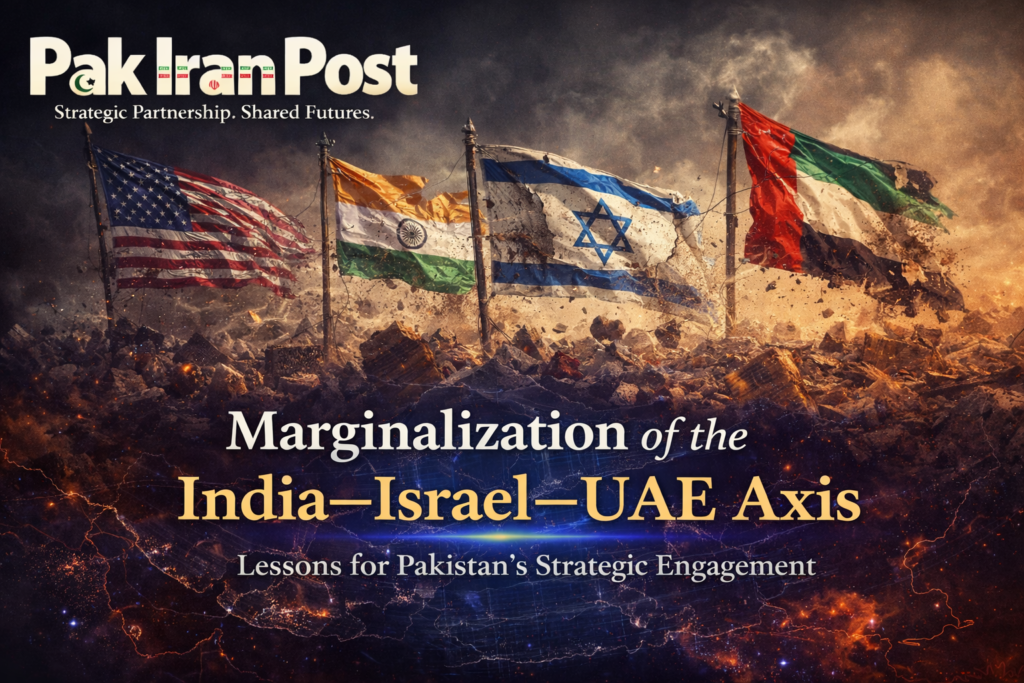
In the rapidly shifting geopolitics of West and South Asia, traditional power configurations are increasingly contested. The India–Israel–UAE axis, which has emerged over the past decade as a significant strategic bloc, exemplifies a coalition premised on converging economic, technological, and security imperatives. Its influence has been particularly pronounced in areas such as regional security architecture, intelligence collaboration, energy security, and technological innovation. Yet, as the international system becomes increasingly multipolar and resilient actors assert themselves, the relative leverage of this axis is subject to diminution. Iran’s resilience, Pakistan’s strategic recalibration, and the emergence of alternative diplomatic and economic configurations collectively suggest that the influence of the India–Israel–UAE coalition may be increasingly constrained.
At the heart of this analysis lies the understanding that the durability of any geopolitical alliance depends not solely on immediate capabilities but on structural coherence, legitimacy, and the capacity to adapt to emergent global conditions. The India–Israel–UAE axis has demonstrated tactical alignment on certain regional challenges, particularly in intelligence sharing, counterterrorism, and investment in emerging technologies. It has also sought to position itself as a counterweight to Iranian influence in the Gulf and parts of South Asia, leveraging economic incentives, military collaboration, and narrative framing to assert normative authority. However, structural limitations inherent in the coalition suggest that its long-term influence may be overstated.
One central factor constraining the axis is Iranian resilience. Iran’s historical depth, strategic geography, and adaptive foreign policy posture provide a countervailing force that is neither easily neutralized nor circumvented. Despite facing economic sanctions, diplomatic isolation, and periodic military pressures, Iran has sustained both regional influence and internal cohesion. Its relationships with key actors across Iraq, Lebanon, Syria, and Yemen, along with its sophisticated energy networks and asymmetric capabilities, create a sphere of influence that directly intersects with the interests of India, Israel, and the UAE. Moreover, Iran’s engagement with Pakistan, both bilaterally and through emerging multilateral frameworks, enhances the capacity of these actors to act as stabilizing intermediaries, reducing the leverage of the axis in regions where Pakistan–Iran cooperation is operative.
The Pakistan–Iran nexus constitutes a structural counterweight. Pakistan’s strategic location, demographic weight, and civilizational identity complement Iran’s regional positioning. The convergence of policy objectives, including economic integration, energy collaboration, and security coordination, produces a coherent alternative to the India–Israel–UAE model. Pakistan’s facilitative role, particularly in regional diplomacy and trade corridor development, enables both Tehran and Islamabad to articulate a vision of multipolar engagement that is inclusive of global powers yet anchored in regional sovereignty. By operationalizing cross-border trade, energy interconnectivity, and joint infrastructural projects, Pakistan enhances Iran’s regional leverage while simultaneously creating interdependencies that reduce the unilateral influence of the axis.
Economic and energy considerations further accentuate the limitations of the India–Israel–UAE coalition. While UAE’s financial capital and India’s technological and demographic capacities provide leverage, these advantages are contingent upon stable regional access and secure trade corridors. Pakistan and Iran’s collaboration in projects such as Chabahar and Gwadar illustrates the strategic imperative of alternative pathways for trade and energy flows. These corridors diminish the ability of the axis to exert dominance over energy supply chains or constrain regional markets, particularly in South and Central Asia. The operationalization of these infrastructural projects signals to the international community that influence is no longer unidirectional, but mediated through complex networks of interdependent actors.
Security considerations are equally pivotal. The axis has invested significantly in conventional military capabilities, cyber infrastructure, and intelligence networks. Yet resilience is not purely a function of capability; it is equally dependent upon legitimacy and the perception of ethical authority. Iran and Pakistan, by virtue of historical continuity, cultural affinity, and engagement with regional norms, retain a degree of legitimacy that transcends transactional military or economic leverage. This legitimacy underpins the capacity to mediate conflicts, convene negotiations, and sustain cooperative frameworks in ways that the India–Israel–UAE bloc may find challenging to replicate.
The geopolitical narrative is further complicated by global power rebalancing. Western powers, while historically aligned with certain components of the axis, are increasingly compelled to recalibrate their engagement due to emergent threats, climate imperatives, and shifts in energy politics. Multipolarity reduces the ability of a single coalition to dictate outcomes unilaterally. Strategic patience, cultural diplomacy, and the cultivation of multipronged alliances enhance Pakistan and Iran’s capacity to operate as normative anchors, thereby attenuating the relative influence of the India–Israel–UAE configuration.
Normatively, the marginalization of the axis can also be conceptualized in terms of its inability to integrate civilizational legitimacy into its strategic calculus. Alliances predicated predominantly on transactional considerations, technological advantage, and financial capital are vulnerable to the erosion of soft power. Conversely, Pakistan and Iran can leverage shared historical narratives, cultural continuity, and religious-cultural resonance to consolidate influence. The capacity to bridge diverse actors through shared norms, ethical frameworks, and pragmatic negotiation reinforces the durability of their regional position.
This analysis also underscores the importance of multilateral institutions and cooperative architecture. Pakistan and Iran’s engagement in regional forums, trade alliances, and security dialogues demonstrates an approach grounded in institutionalized diplomacy rather than ad hoc alignment. By cultivating multilateral legitimacy, they reduce the ability of the axis to act as a unilateral power broker. Participation in broader frameworks, such as the Shanghai Cooperation Organization, ECO, and prospective South Asian and Middle Eastern cooperative initiatives, reinforces the narrative of a collaborative, multipolar regional order.
Technological and infrastructural innovation must also be interpreted within this paradigm. While Israel’s technological prowess is significant, the strategic application of such capabilities requires geopolitical continuity, access, and legitimacy. Pakistan and Iran’s ability to integrate infrastructural development, energy networks, and digital connectivity into a coherent regional vision offsets technological asymmetry. Strategic infrastructure is not merely functional; it embodies sovereignty, autonomy, and normative authority that constrain the unilateral application of power.
Energy interdependence exemplifies the strategic calculus. The Gulf region, historically dominated by certain energy-exporting states, faces evolving dynamics with the emergence of alternative corridors, renewable energy investment, and fluctuating global demand. Pakistan and Iran, by leveraging both renewable and traditional energy infrastructure, create a buffer that diminishes the axis’s capacity to influence regional energy politics. The facilitation of stable energy flows, combined with economic integration initiatives, positions Pakistan and Iran as indispensable actors in the operationalization of regional equilibrium.
Security narratives must be contextualized within the asymmetric environment of modern conflict. The axis may possess advanced capabilities, yet its legitimacy is often questioned in conflict-affected regions due to perceived transnationalism. Pakistan and Iran, by contrast, offer historical continuity, familiarity with local dynamics, and the capacity to mediate complex disputes. These attributes enhance their soft power while constraining the capacity of the axis to impose influence through coercion or transactional leverage alone.
In summation, the marginalization of the India–Israel–UAE axis is neither a matter of unilateral decline nor inevitable collapse. It is the emergent consequence of structural realignment, resilient regional actors, and evolving norms of engagement. Pakistan and Iran, by virtue of geographic positioning, civilizational depth, strategic foresight, and normative credibility, are capable of constraining the unilateral influence of the axis while creating sustainable frameworks for cooperation and stability. The emergence of alternative trade corridors, energy networks, cultural diplomacy, and multilateral engagement constitutes a deliberate strategy to diversify influence, mitigate unilateral leverage, and institutionalize regional stability.
Ultimately, the future of the region will be determined by actors capable of harmonizing capabilities, legitimacy, and normative authority. While the India–Israel–UAE axis has achieved tactical successes, its influence is bounded by structural limitations, evolving multipolarity, and the resilience of historical actors. Pakistan and Iran, through strategic convergence, capacity for mediation, and investment in sustainable infrastructures, are positioned to redefine regional hierarchies, marginalizing transactional power blocs while asserting the primacy of interdependent, resilient, and ethically grounded diplomacy.
A Public Service Message


