

Regional Energy Diplomacy Framework

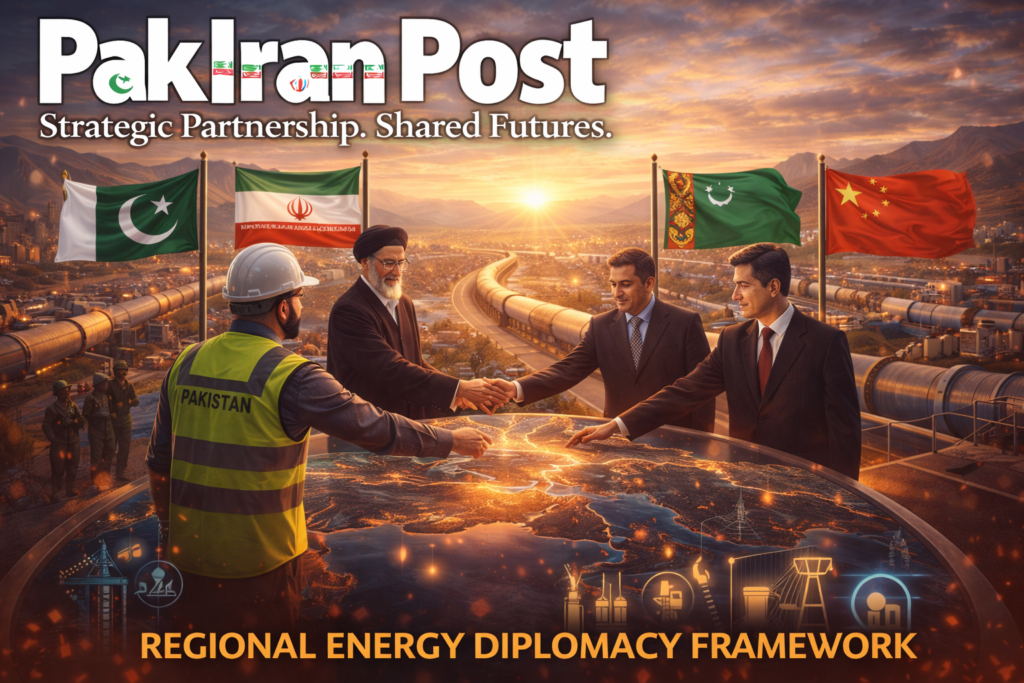
The contemporary energy system is no longer governed primarily by market efficiency or supply demand equilibrium. It is increasingly shaped by geopolitical fragmentation, maritime insecurity, sanctions regimes, and the reconfiguration of global power centres. Nowhere is this more evident than in the arc stretching from the Persian Gulf to South Asia, where energy flows intersect with some of the world’s most persistent strategic rivalries. Within this environment, Pakistan occupies a structurally significant yet institutionally underutilised position. It sits adjacent to Iran’s vast hydrocarbon reserves, maintains deep energy dependencies on Gulf suppliers, and is increasingly linked to China’s long term energy security architecture. This triangulation creates both vulnerability and opportunity, depending on whether it is managed through fragmentation or coordination.
A regional energy diplomacy framework involving Pakistan, Iran, Gulf states, and China must therefore be understood not as an aspirational cooperation agenda but as a stabilization necessity. The absence of coordinated governance mechanisms in this space has produced recurring cycles of price volatility, supply insecurity, and geopolitical escalation. Energy insecurity in this region is not merely an economic issue; it is a multiplier of political instability and strategic mistrust. A structured multilateral architecture could reduce these risks by embedding predictability into an otherwise volatile system.
At the heart of such a framework lies the principle of interdependence rather than unilateral security. Current energy relationships in the region are largely bilateral and asymmetrical. Producers seek price maximization and geopolitical leverage, while importers seek cost minimization and supply security. These competing objectives are managed through short term contracts and crisis driven negotiations. What is absent is a stabilizing institutional layer that can absorb shocks and coordinate responses across multiple actors simultaneously.
The first pillar of a regional energy diplomacy framework is infrastructural integration. Energy infrastructure in the region is currently segmented into disconnected corridors, each vulnerable to disruption. Maritime routes through the Strait of Hormuz remain exposed to geopolitical tensions, while overland pipeline projects are constrained by sanctions and security risks. A more resilient model would involve the creation of multi vector energy corridors that combine maritime, pipeline, and rail-based transport systems. Pakistan’s geographic position allows it to function as a bridging node between Iranian supply zones, Gulf export terminals, and Chinese demand centers. However, this requires coordinated infrastructure planning that transcends bilateral project logic and moves toward network-based design.
Such integration would not imply the elimination of competition among suppliers, but rather the creation of redundancy and flexibility within the system. Energy flows would no longer depend on single routes or single suppliers, but on interchangeable pathways that can be adjusted in response to disruptions. This would significantly reduce the strategic value of chokepoint control and lower the risk premium embedded in regional energy pricing.
The second pillar is financial architecture reform. The dominance of dollar denominated transactions in regional energy trade has created systemic exposure to external monetary policy cycles and sanctions regimes. A more resilient framework would incorporate partial currency diversification through structured settlement mechanisms involving regional currencies and alternative clearing systems. A tri currency arrangement involving the Chinese yuan, Pakistani rupee, and Iranian rial, supplemented by Gulf currency baskets for hydrocarbon exports, could reduce transactional friction and insulate trade flows from external financial shocks.
However, currency diversification alone is insufficient without institutional backing. A regional energy clearing house could be established to manage settlement imbalances, provide liquidity during disruptions, and coordinate payment cycles among participating states. This would function as a stabilization mechanism rather than a full monetary union, ensuring flexibility while reducing dependence on external financial intermediaries.
The third pillar is strategic reserve coordination. At present, energy reserves are managed almost entirely at the national level, with limited transparency and no coordination across borders. This fragmented approach increases vulnerability during systemic shocks, as each state competes for limited supply during crises. A regional framework could introduce the concept of shared or pooled emergency reserves, where participating states contribute a defined portion of their strategic stocks into a coordinated buffer mechanism. Access to these reserves would be governed by pre agreed protocols based on crisis severity, supply disruption thresholds, and humanitarian necessity.
Such a mechanism would not eliminate national sovereignty over reserves but would add a collective insurance layer to the system. It would also reduce panic driven procurement behavior, which often exacerbates price spikes during crises. For import dependent economies like Pakistan, this could provide critical stabilization during external shocks, while for exporters it would ensure demand continuity even during temporary disruptions.
The fourth pillar is diplomatic institutionalization. Energy cooperation in the region is currently embedded within ad hoc bilateral negotiations and crisis driven diplomacy. What is missing is a standing multilateral platform dedicated specifically to energy security governance. A Regional Energy Security Council involving Pakistan, Iran, key Gulf states, and China could serve this function. Its mandate would include coordination of supply policies, crisis response planning, infrastructure prioritization, and dispute mediation.
Unlike traditional political forums, such a council would be technocratic in nature, focusing on data driven forecasting, risk modelling, and logistical coordination rather than ideological or geopolitical positioning. Its effectiveness would depend on insulating energy governance from broader regional conflicts, ensuring that cooperation in energy does not collapse during political disputes in unrelated domains.
The fifth pillar is security coordination for energy infrastructure. Energy systems in this region are exposed to multiple forms of disruption, including maritime threats, border instability, and internal sabotage risks. Without coordinated security frameworks, infrastructure investments remain vulnerable and insurance costs remain elevated. Joint maritime security arrangements in the Arabian Sea, coordinated border monitoring systems between Pakistan and Iran, and shared intelligence mechanisms on infrastructure threats could significantly reduce operational risk.
This does not require military alliances but rather functional security coordination focused narrowly on protecting energy flows. In practice, this could include joint patrols, coordinated surveillance technologies, and rapid response protocols for infrastructure incidents. The objective is not strategic alignment but risk containment.
China’s role within this framework is structurally distinct. Unlike regional actors, China functions as both a major energy consumer and a critical infrastructure financier. Its Belt and Road related investments in energy corridors position it as a de facto system architect, even if not formally acknowledged as such. Including China within a regional energy diplomacy framework introduces financial depth, technological capacity, and long term demand stability. However, it also requires careful balancing to ensure that the system does not become overly dependent on a single external actor.
For Pakistan, participation in such a framework offers strategic advantages that extend beyond energy security. It enhances its role as a transit state, increases its relevance in regional supply chains, and provides access to diversified energy sources. However, it also demands institutional capacity upgrades, particularly in regulatory coordination, infrastructure management, and financial governance.
For Iran and Gulf states, the framework offers demand stability and reduced exposure to geopolitical disruption risks. For Iran, in particular, it provides potential pathways for partial economic integration despite sanctions constraints. For Gulf exporters, it offers diversification of demand routes and reduced dependency on single market cycles.
Despite its theoretical appeal, the framework faces significant implementation challenges. Regional mistrust, sanctions regimes, currency volatility, and infrastructure asymmetries all complicate coordination. Moreover, energy remains a highly politicized sector, often used as an instrument of strategic leverage rather than cooperative governance. Overcoming these constraints requires gradual institutional layering rather than immediate comprehensive integration.
The most realistic pathway is incremental institutionalization, beginning with technical coordination mechanisms, followed by financial cooperation frameworks, and eventually evolving into formalized diplomatic structures. Early successes in data sharing, reserve coordination, and infrastructure planning could build trust necessary for deeper integration.
In conclusion, regional energy diplomacy in the Pakistan Iran Gulf China corridor is not a utopian project but a structural response to systemic instability. The current fragmented architecture is increasingly incapable of managing volatility in energy markets, geopolitical tensions, and supply chain disruptions. A coordinated framework offers a pathway toward reducing risk, improving predictability, and stabilizing one of the world’s most strategically important energy regions. Its success will depend not on grand political alignment but on the slow construction of technical, financial, and institutional linkages that make cooperation more efficient than fragmentation.
A Public Service Message