
Refugees Trafficking and Human Security in Pakistan Iran Arc

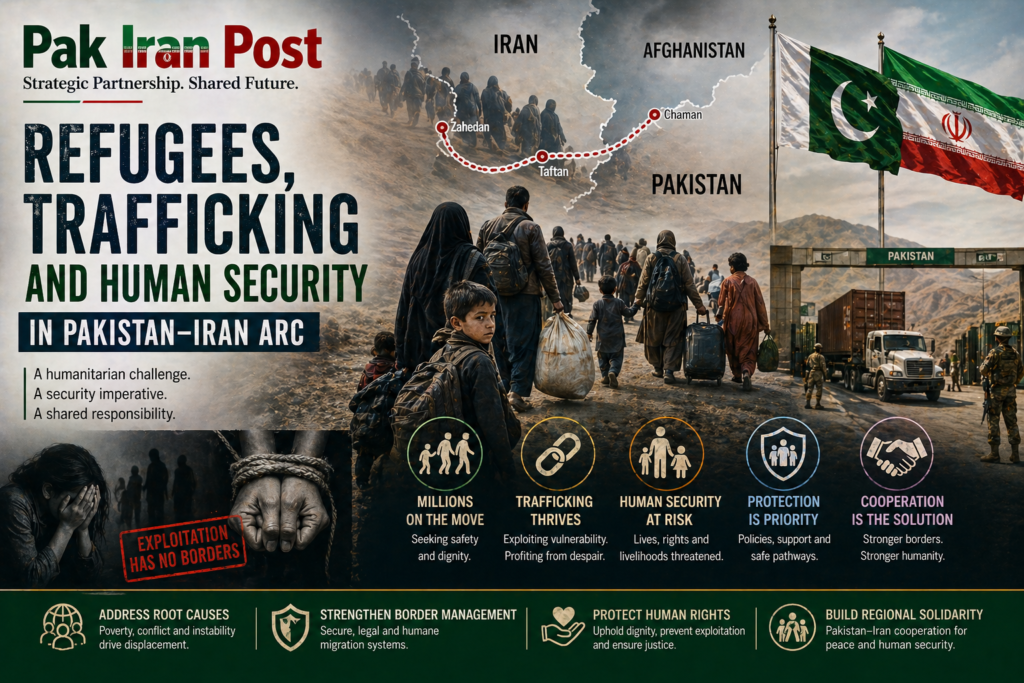
The Pakistan–Iran borderlands have become one of the most complex human mobility corridors in South and West Asia, where displacement, economic migration, trafficking networks, and state security regimes intersect in a continuously shifting humanitarian landscape. This arc, stretching across arid frontier districts, is not merely a line of separation between two sovereign states but a deeply embedded socio-economic space in which survival strategies, informal economies, and coercive structures coexist. In recent years, the human security dimension of this corridor has intensified, shaped by regional instability, economic precarity, and increasingly sophisticated illicit mobility networks.
At the core of this transformation lies the expansion of forced and semi voluntary migration flows. The prolonged instability in Afghanistan, coupled with chronic underdevelopment in border regions of Pakistan and Iran, has generated a layered migration environment where individuals move for survival rather than opportunity. These movements are rarely linear. Instead, they are fragmented, irregular, and mediated by intermediaries who operate across legal and illegal domains. Refugees, undocumented migrants, and seasonal workers often share overlapping pathways, making clear categorisation increasingly difficult.
The border itself functions as both barrier and passage. Despite increasing securitisation efforts, including fencing, surveillance technologies, and expanded border patrols, mobility persists through informal routes that are deeply embedded in local geography and community networks. These routes are not new; they reflect historical patterns of cross border interaction among ethnic and tribal communities whose social ties predate modern state boundaries. However, what has changed is the commercialisation and criminalisation of these routes, as organised trafficking networks have expanded their role in facilitating movement.
Human trafficking in the Pakistan–Iran arc is no longer limited to isolated incidents of exploitation but has evolved into a structured economy. Smuggling networks now operate with hierarchical organisation, involving recruiters, transport coordinators, document facilitators, and cross border handlers. These networks exploit economic desperation, particularly among young men seeking employment in Gulf countries or urban centres in Iran. Increasingly, women and children are also being drawn into these flows, either through forced migration, deceptive recruitment practices, or familial economic pressures.
The digital transformation of recruitment mechanisms has further complicated the situation. Social media platforms, messaging applications, and informal online job advertisements are frequently used to lure potential migrants with promises of employment abroad. These digital pathways create a false sense of legitimacy, masking the underlying risks of trafficking and exploitation. Once individuals enter the migration pipeline, they often lose control over their journey, becoming dependent on intermediaries who control information, movement, and documentation.
Within this context, the distinction between refugee protection and trafficking prevention becomes blurred. Many individuals who begin their journey as voluntary migrants find themselves in coercive situations due to debt bondage, document confiscation, or physical confinement. The fluidity between voluntary and involuntary movement challenges existing legal frameworks, which are often designed around rigid categories that do not reflect the realities of contemporary mobility.
State responses to these challenges have primarily focused on border enforcement and deterrence. Both Pakistan and Iran have increased border militarisation in recent years, deploying physical barriers, expanding surveillance infrastructure, and conducting joint operations against smuggling networks. While these measures have disrupted some trafficking routes, they have also pushed mobility further underground, increasing the risks faced by migrants and making journeys more dangerous. In many cases, stricter controls have not reduced movement but rather increased its cost and vulnerability.
The humanitarian consequences of this enforcement centred approach are significant. Migrants and refugees attempting to cross the border frequently encounter detention, deportation, or abandonment in remote desert regions. Access to legal protection is limited, and humanitarian assistance is often inconsistent. International organisations operating in the region face logistical and political constraints, reducing their ability to provide sustained support. As a result, much of the burden of care falls on local communities, many of whom are themselves economically vulnerable.
Media narratives surrounding migration in the Pakistan–Iran arc are highly polarised. State aligned media outlets tend to frame irregular migration through the lens of national security, emphasising risks of terrorism, smuggling, and border violations. In contrast, humanitarian reporting highlights cases of abuse, exploitation, and deaths in transit. Social media platforms add another layer of complexity, where fragmented testimonies, viral incidents, and unverified reports circulate rapidly, shaping public perception in emotionally charged ways. This fragmented media ecosystem contributes to a lack of coherent public understanding of the structural drivers of migration.
In recent years, there has also been an increasing tendency to link migration flows to broader geopolitical narratives. Discussions around regional instability, proxy conflicts, and economic sanctions often intersect with debates on human mobility, creating a discursive environment in which migrants are sometimes portrayed as instruments of external influence or victims of systemic regional breakdown. These narratives, while not always grounded in empirical evidence, significantly influence policy discourse and public sentiment.
The economic dimension of migration and trafficking cannot be separated from the broader political economy of the borderlands. Informal labour markets in Iran and Gulf countries continue to attract workers from Pakistan and Afghanistan, despite legal restrictions and high risks. These labour markets are characterised by demand for low cost, flexible, and often undocumented labour. Migrants, lacking formal protection, are frequently subjected to wage exploitation, unsafe working conditions, and limited access to legal recourse. This structural demand sustains trafficking networks, even in the presence of enforcement efforts.
Gender dynamics add another layer of complexity. Women in migration corridors face distinct vulnerabilities, including heightened risk of sexual exploitation, forced marriage, and domestic servitude. These risks are often underreported due to social stigma and lack of institutional support. In many cases, women’s mobility is mediated by male family members or intermediaries, further limiting their agency and increasing exposure to coercion.
Children represent another particularly vulnerable group. Unaccompanied minors or those migrating with families in distress often experience interrupted education, malnutrition, and psychological trauma. Their legal status is frequently ambiguous, leaving them outside formal protection systems. The long term implications of this disruption are significant, as it contributes to intergenerational cycles of vulnerability and exclusion.
Despite the severity of these challenges, policy responses remain fragmented. There is limited coordination between migration governance, border security, labour regulation, and humanitarian protection frameworks. This institutional fragmentation reduces the effectiveness of interventions and allows gaps to persist where exploitation can flourish. A more integrated approach is required, one that recognises migration not solely as a security issue but as a complex socio-economic phenomenon.
Bilateral cooperation between Pakistan and Iran on migration management exists but remains largely operational rather than strategic. Joint border commissions and occasional information sharing mechanisms address immediate enforcement concerns but do not engage with the structural drivers of mobility. There is minimal emphasis on creating safe migration pathways, improving labour protections, or developing regional frameworks for refugee protection that reflect current realities.
The role of climate and environmental stress further compounds migration pressures. Water scarcity, land degradation, and declining agricultural productivity in border regions are increasingly pushing populations toward mobility as a coping mechanism. This environmental displacement is often gradual and unrecognised, yet it contributes significantly to the overall migration flow. As climate pressures intensify, this dimension is likely to become more prominent.
Ultimately, the Pakistan–Iran migration corridor represents a convergence point of multiple global trends, including forced displacement, labour market informality, digital transformation of trafficking networks, and securitisation of borders. Addressing its challenges requires moving beyond enforcement-centric models toward a comprehensive human security framework that integrates protection, opportunity, and governance reform.
Without such a shift, the region risks entrenching a cycle in which vulnerability feeds exploitation, exploitation reinforces insecurity, and insecurity justifies further securitisation. In this cycle, human mobility becomes not a managed phenomenon but a persistent source of instability, shaping the social and political fabric of one of the most sensitive borderlands in the region.
A Public Service Message