Digital Borders Surveillance Technology and Frontier Governance in South Asia

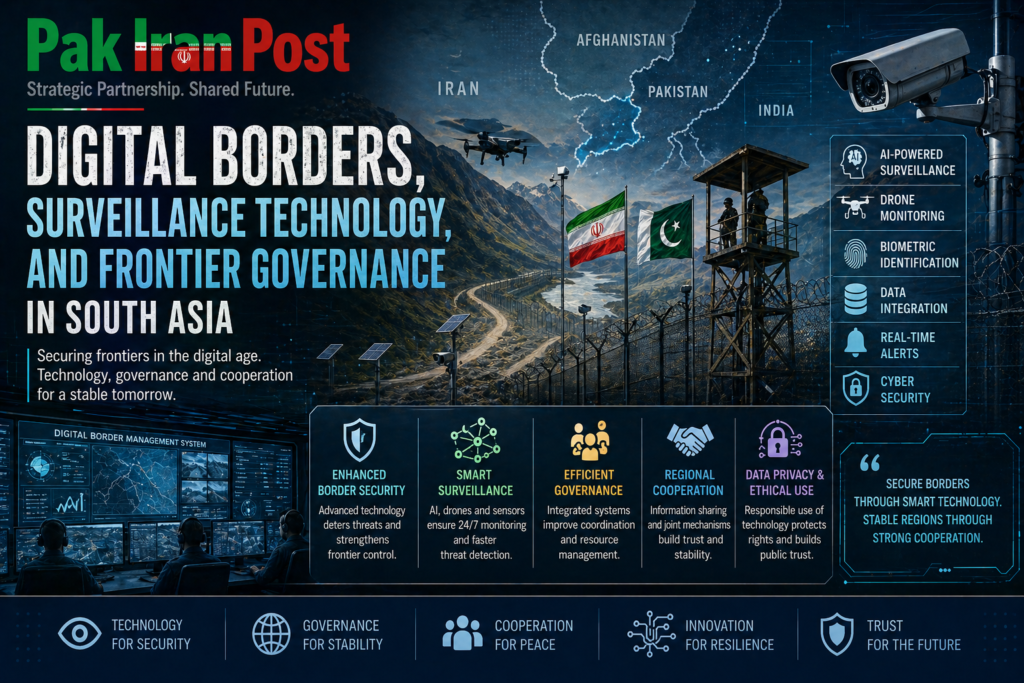
The Pakistan Iran frontier is quietly becoming one of the most technologically mediated borders in Asia, not through dramatic political declarations but through incremental accumulation of surveillance systems, biometric infrastructures, and algorithmic governance tools that are reshaping how sovereignty is exercised, narrated, and perceived. What was once a porous, historically negotiated and socially embedded borderland is increasingly being reconfigured into a data saturated corridor of state visibility, where movement is no longer merely regulated by patrols and checkpoints but by continuous computational assessment. This transformation does not announce itself as rupture. It unfolds as optimization, efficiency, modernization and security enhancement, all terms that circulate through official discourse, policy documents, and media reporting in Pakistan and Iran with remarkable consistency.
At the heart of this transformation is a shift in the logic of border control from territorial enforcement to informational governance. Drones are deployed not simply as aerial surveillance tools but as persistent sensing devices capable of generating live feeds of movement patterns across rugged terrain. Biometric verification systems extend identity from physical documents to digital signatures embedded in centralized databases, allowing border authorities to authenticate individuals not only at the point of entry but across multiple layers of administrative interaction. Artificial intelligence enabled customs systems are introduced to accelerate cargo clearance, scanning containers within seconds and flagging anomalies based on predictive models rather than human inspection alone. These technologies collectively constitute a new regime of borderhood in which the frontier is no longer a line but a network.
This networked border is increasingly interoperable. Pakistan’s expanding digital identity infrastructure, anchored in national biometric databases, integrates with immigration and customs platforms, creating a layered system of verification that ties mobility to data trails. In parallel, Iran’s own efforts toward digitizing border logistics and customs management reflect a similar trajectory, though shaped by different technological partnerships and constraints arising from sanctions regimes. Between these two systems, the frontier becomes a zone of partial alignment rather than full integration, producing a governance space defined by asymmetry, adaptation and selective connectivity.
The political significance of this transformation lies not only in its technical architecture but in its capacity to redefine the meaning of sovereignty. Classical sovereignty at the border was expressed through physical control, the presence of the state in the form of soldiers, checkpoints, and customs officers who exercised discretionary authority over movement. In the emerging digital border regime, sovereignty is increasingly expressed through data capture, algorithmic sorting, and automated decision making systems that pre classify risk before human intervention occurs. The border guard is no longer the primary site of judgment. The algorithm becomes the first filter of legitimacy.
This shift introduces a subtle but profound change in the experience of mobility. Travelers, traders, and transport operators are increasingly required to exist within pre authenticated data categories. Identity is not merely verified but continuously scored. Cargo is not only inspected but profiled. Movement is not only permitted or denied but predicted, optimized, and routed. The border thus becomes anticipatory rather than reactive. It operates in a temporal logic that privileges prediction over observation, suspicion over evidence, and pattern over encounter.
Yet this transformation is not purely technocratic. It is deeply embedded in the political economy of security and development narratives that circulate across state institutions and media ecosystems. In official discourse, digital border technologies are framed as instruments of modernization that reduce corruption, enhance trade efficiency, and strengthen national security. The introduction of artificial intelligence based customs systems is celebrated as a leap toward global best practice. Biometric integration is described as a safeguard against identity fraud and illegal crossings. Drone surveillance is presented as a necessary response to asymmetric threats and difficult terrain. These narratives construct a vision of the border as a site of technological salvation.
However, critical perspectives suggest that these narratives conceal as much as they reveal. The expansion of digital surveillance infrastructure raises questions about data sovereignty, privacy, and asymmetrical power between state and citizen. The increasing reliance on foreign technology vendors for surveillance systems and data analytics introduces dependencies that complicate claims of autonomy. Moreover, the opacity of algorithmic decision making creates new forms of unaccountable authority at the border, where classifications of risk and legitimacy are embedded in systems that are difficult to audit or contest.
The Pakistan Iran border region also has its own social and economic realities that complicate the clean logic of digital governance. It is a space of informal trade networks, familial mobility, seasonal labor flows, and long standing cultural interconnections that predate modern state boundaries. These practices do not disappear under digital surveillance. Instead, they adapt, reconfigure, and sometimes evade it. Informal economies increasingly intersect with digital systems in hybrid forms, where biometric registration coexists with cash based transactions and where formal checkpoints are bypassed through alternative routes that remain socially embedded.
Media narratives play a crucial role in shaping how these transformations are perceived. Across Pakistani and Iranian media ecosystems, digital border technologies are frequently framed through dual registers of progress and threat. On one hand, they symbolize state capacity, technological advancement, and alignment with global standards of governance. On the other hand, they are associated with fears of surveillance overreach, data misuse, and loss of human discretion in critical security decisions. This duality reflects a broader tension in contemporary digital governance, where the same technologies that promise efficiency also generate anxieties about control.
International reporting on border technologies often reinforces a similar ambivalence. Global media outlets tend to situate such developments within broader narratives of smart borders, digital sovereignty, and AI driven security regimes. Yet these narratives frequently abstract away the local specificities of borderland life, reducing complex social geographies to technical case studies of innovation or risk management. In doing so, they contribute to a homogenizing discourse of digital modernity that may obscure more than it illuminates.
The emergence of digital borders also intersects with broader geopolitical dynamics in the region. Pakistan and Iran occupy a shared frontier that is simultaneously a site of cooperation and constraint. Energy discussions, trade aspirations, and security concerns all converge in this space, yet are shaped by external pressures including sanctions regimes, regional rivalries, and shifting global alliances. Digital border infrastructure becomes part of this geopolitical equation, not only as a domestic governance tool but as a signal of alignment with particular technological and strategic ecosystems.
Within this context, surveillance technology is not neutral. It is embedded in networks of influence that extend beyond national borders. The procurement of biometric systems, AI platforms, and surveillance drones often involves international vendors whose technologies carry embedded assumptions about risk, identity, and governance. These assumptions may not always align with local political realities, creating friction between imported systems and domestic practices.
At the same time, the deployment of digital border technologies is reshaping labor and institutional structures within the state itself. Border management increasingly requires technical expertise in data analytics, system maintenance, and algorithmic interpretation. Traditional roles of customs officers and border guards are being supplemented, and in some cases redefined, by digital interfaces and automated workflows. This creates new hierarchies of knowledge within border institutions, where technical literacy becomes a form of administrative power.
The long term implications of this transformation remain uncertain. On one trajectory, digital borders may enhance efficiency, reduce corruption, and facilitate more secure and predictable trade flows between Pakistan and Iran. On another trajectory, they may deepen surveillance asymmetries, marginalize informal economies, and create new forms of exclusion based on data visibility. Most likely, both dynamics will coexist, producing a hybrid border regime that is simultaneously more efficient and more opaque.
What is clear is that the border is no longer simply a geographical threshold. It is becoming an informational environment in which governance is exercised through data flows, algorithmic classifications, and digital infrastructures. This shift challenges conventional understandings of sovereignty, security, and mobility. It also demands new forms of analytical attention that move beyond traditional geopolitical frameworks to engage with the technical and informational dimensions of power.
The Pakistan Iran frontier thus offers a critical site for understanding the future of border governance in South Asia and beyond. It reveals how emerging technologies are not merely tools of administration but active participants in the production of political order. It shows how surveillance is becoming infrastructural rather than exceptional, embedded in the everyday functioning of state systems. And it demonstrates how media narratives, policy discourses, and technological architectures converge to produce a new grammar of borderhood that is both deeply local and globally connected.
In this evolving landscape, the question is not whether digital borders will expand, but how they will be governed, contested, and interpreted. The answer will depend not only on technological capacity but on political choices, institutional accountability, and the ability of societies to negotiate the balance between security and openness in an increasingly data driven world.
A Public Service Message