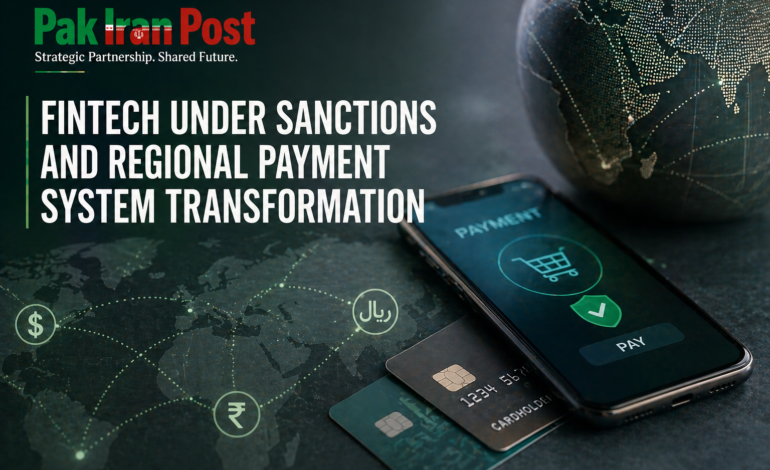
Fintech Under Sanctions and Regional Payment System Transformation


The evolution of financial technology in the Pakistan Iran economic corridor is increasingly shaped not by market-driven innovation alone but by the structural constraints of sanctions regimes, currency fragmentation, and restricted access to global financial infrastructure. In this constrained environment, fintech does not function as a neutral tool of modernization. It operates instead as a geopolitical adaptation mechanism, through which states, firms, and informal actors attempt to reconstruct the basic infrastructure of value exchange outside dominant Western financial architectures. The result is the emergence of a parallel financial ecology, partially visible, partially informal, and increasingly digitized, where money, trust, and transaction flows are being redefined under pressure.
At the center of this transformation is the gradual decoupling from traditional correspondent banking systems that anchor global trade in dollar dominated settlement networks. For Pakistan and Iran, this decoupling is not voluntary but imposed through overlapping layers of financial restrictions, compliance pressures, and secondary sanctions risks. As access to conventional cross border banking channels narrows, both states are compelled to explore alternative mechanisms of settlement that minimize exposure to external regulatory scrutiny. These mechanisms include bilateral currency arrangements, localized clearing systems, barter adjusted trade accounting, and experimental digital payment platforms that operate in semi formal or pilot stages.
The logic underpinning these innovations is not ideological opposition to global finance but pragmatic necessity. Trade between Pakistan and Iran continues to expand in areas such as energy, agriculture, construction materials, and consumer goods, yet payment settlement remains structurally constrained. This mismatch between trade ambition and financial architecture generates friction that fintech solutions are increasingly tasked to resolve. Mobile wallets, digital remittance platforms, and interoperable payment applications are being adapted to facilitate cross border transactions that would otherwise require cumbersome intermediary routing through third country banking systems.
However, the emergence of fintech under sanctions is not merely a technical workaround. It is also a reconfiguration of financial sovereignty. By developing alternative payment channels, both states are attempting to reclaim a degree of autonomy over transaction flows that are otherwise subject to external monitoring and disruption. This has led to renewed interest in local currency settlement mechanisms, where trade is denominated and cleared in national currencies rather than hard currencies. While such systems reduce dependency on external financial infrastructure, they introduce new forms of volatility, requiring sophisticated digital conversion tools and real time exchange stabilization mechanisms.
In parallel, there is growing experimentation with digital ledger technologies that could support trade transparency without reliance on centralized global systems. Although fully decentralized cryptocurrency adoption remains limited due to regulatory caution and volatility concerns, blockchain inspired accounting systems are being explored in controlled environments such as customs valuation, trade documentation, and supply chain verification. These systems are framed by policymakers as tools for transparency and efficiency, yet their deeper significance lies in their potential to rewire trust away from external institutions toward state mediated digital protocols.
The informal economy plays a crucial role in this evolving landscape. Along border regions, particularly in Balochistan and adjacent Iranian provinces, financial transactions often occur through hybrid systems that combine cash exchange, mobile transfers, and trusted intermediary networks. These systems predate digital fintech but are now being partially integrated into formal platforms through digitized onboarding processes and mobile based financial services. The result is a layered economy where formal fintech infrastructure and informal financial practices coexist, overlap, and sometimes compete.
Media narratives surrounding fintech in this context are deeply polarized. Official discourse in both countries tends to emphasize fintech as a symbol of resilience, innovation, and economic modernization under constraint. Reports highlight the expansion of digital wallets, the growth of e commerce ecosystems, and the potential for cross border digital trade corridors. These narratives construct an image of technological adaptation that positions fintech as a pathway toward financial sovereignty and regional integration.
Conversely, critical media and international reporting often frame these developments through the lens of sanctions circumvention, financial opacity, and regulatory risk. In this framing, alternative payment systems are interpreted less as innovation and more as adaptive mechanisms designed to bypass global oversight structures. This dual narrative environment creates a discursive tension in which the same technological systems are simultaneously celebrated as developmental tools and scrutinized as potential vectors of financial irregularity.
The reality, however, is more complex than either narrative suggests. Fintech systems operating under sanctions constraints are neither fully formal nor entirely informal. They occupy a hybrid space shaped by regulatory ambiguity, technological improvisation, and geopolitical necessity. This hybridity is particularly evident in cross border remittance flows, where migrant labor transfers and trade payments intersect within partially digitized ecosystems. Mobile applications facilitate rapid transfers, but underlying settlement often depends on a combination of local intermediaries and currency balancing mechanisms that remain opaque to external observers.
A further dimension of this transformation is the increasing role of data in financial governance. Digital payment systems generate granular transactional data that can be used for risk profiling, credit assessment, and behavioral analysis. In theory, this datafication enhances financial inclusion by enabling previously unbanked populations to access formal financial services. In practice, however, it also introduces new forms of surveillance and exclusion, where access to financial systems becomes contingent on algorithmic scoring and compliance thresholds.
This convergence of fintech and surveillance is particularly significant in sanctioned environments. Because external financial scrutiny is high, domestic systems often adopt stricter internal monitoring protocols to ensure regulatory compliance and minimize exposure to secondary sanctions risks. As a result, financial inclusion and financial surveillance expand simultaneously, creating a paradoxical condition in which greater access to digital finance is accompanied by increased visibility into individual and institutional financial behavior.
The geopolitical dimension of fintech under sanctions cannot be overlooked. Pakistan and Iran are situated within broader regional and global financial realignments, where alternative payment systems are being explored not only at bilateral level but also within wider configurations involving neighboring economies and emerging financial alliances. Discussions around de dollarization, regional clearing unions, and alternative reserve currency mechanisms reflect a broader dissatisfaction with the concentration of financial power in a limited set of global institutions.
Yet these ambitions are constrained by infrastructural limitations. Building resilient cross border digital payment systems requires interoperability standards, cybersecurity frameworks, liquidity backstops, and institutional trust that are still unevenly developed. Moreover, technological fragmentation between different national fintech ecosystems complicates the creation of seamless regional payment corridors. Without harmonized regulatory frameworks and shared digital standards, fintech systems risk becoming isolated silos rather than integrated networks.
Despite these challenges, incremental progress continues. Pilot projects in digital trade documentation, mobile based customs payments, and bilateral digital settlement mechanisms indicate a gradual movement toward more structured financial connectivity. These initiatives are often small in scale but significant in signaling intent. They reflect an emerging recognition that financial infrastructure is as strategically important as physical infrastructure in shaping regional connectivity.
The broader implication of these developments is that finance is increasingly becoming a contested domain of technological governance. Fintech is no longer simply about efficiency or convenience. It is about control over transaction visibility, sovereignty over payment rails, and the ability to sustain economic activity under conditions of external constraint. In this sense, fintech under sanctions is not an exception to global financial transformation but an accelerated laboratory of it.
What emerges from the Pakistan Iran context is a financial system in transition, suspended between global integration and regional autonomy, between formal regulation and informal adaptation, between technological innovation and geopolitical constraint. This system is not stable, nor is it fully coherent. But it is increasingly functional in its own hybrid logic.
The future of fintech in this corridor will likely depend on the interplay between three forces. The first is technological innovation, particularly in digital payments, blockchain based settlement, and AI driven financial management. The second is regulatory evolution, both domestically and internationally, which will determine the extent to which alternative systems can scale. The third is geopolitical pressure, which will continue to shape the boundaries within which financial experimentation can occur.
In this uncertain environment, fintech becomes more than a sector. It becomes an infrastructure of adaptation, a mechanism through which economies under constraint attempt to maintain connectivity with global and regional systems while simultaneously constructing alternative pathways of exchange. The outcome is not a replacement of existing financial order but its gradual fragmentation into multiple overlapping systems of value circulation.
The Pakistan Iran experience thus offers a critical lens through which to understand the future of global finance in an era of fragmentation, where sanctions, technology, and regionalization are jointly reshaping the architecture of money itself.
A Public Service Message