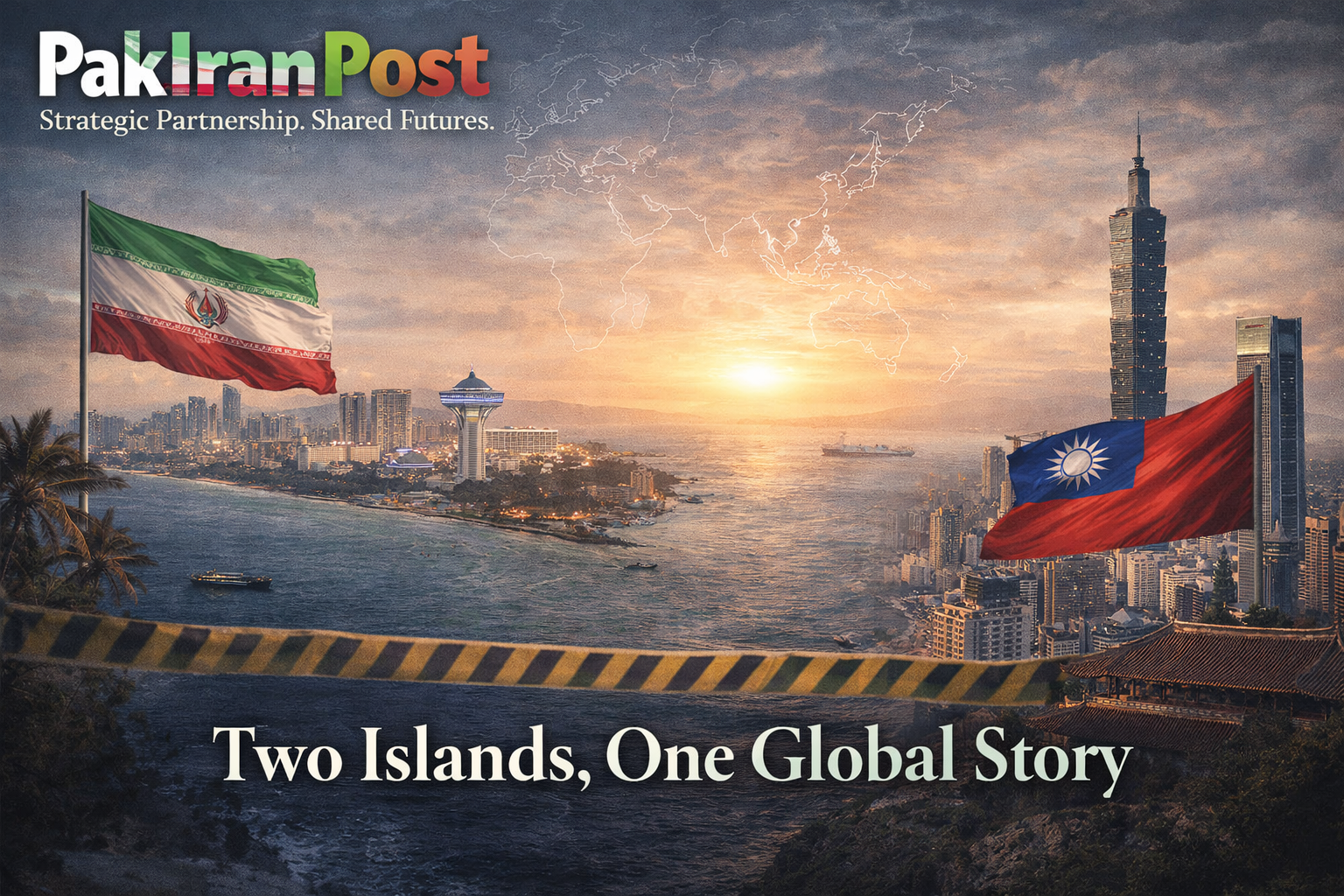

Newsroom Borders Shape Pakistan Iran Mutual Media Perceptions


In the evolving information ecology of South Asia and the wider Middle East, the boundary between journalism and geopolitics has become increasingly porous, and in some cases almost indistinguishable from statecraft itself. Nowhere is this transformation more visible than in the mediated relationship between Pakistan and Iran, where newsroom practices do not merely report bilateral developments but actively participate in constructing the cognitive borders through which each society understands the other. What emerges is a form of discursive geopolitics in which news framing, omission, lexical selection, and narrative sequencing function as instruments of perception management, often more influential than formal diplomatic exchanges.
At the core of this phenomenon lies a structural asymmetry between event and interpretation. Cross border incidents, whether involving security operations, militant activity, energy negotiations, or diplomatic signaling, rarely enter public consciousness as raw facts. Instead, they are filtered through institutional logics of news production that prioritize immediacy, national interest, and ideological coherence. Pakistani and Iranian media ecosystems, while differing in institutional design and regulatory environments, converge in their tendency to interpret the other through pre established narrative templates that are periodically activated during moments of tension.
In Pakistani mainstream and digital media, Iran is often positioned within a dual frame of strategic proximity and securitized ambiguity. On one level, it is portrayed as a historically and religiously contiguous neighbor, bound by civilizational affinity and shared regional interests. On another level, particularly during episodes of border instability or militant activity in peripheral regions, Iranian territory becomes symbolically associated with opacity, indirect threat vectors, and transnational security risks. This dual framing produces a form of cognitive oscillation, where Iran is simultaneously familiar and uncertain, cooperative and suspect, stable and peripheral to Pakistan’s internal security imagination.
The lexical architecture of this framing is particularly revealing. Terms such as infiltration, external facilitation, border management failure, and non state actor mobility are frequently deployed in ways that imply structural concern without explicit attribution. Such language allows media narratives to maintain plausibility while avoiding direct diplomatic escalation. The result is a form of strategic ambiguity embedded within journalistic discourse, where meaning is suggested rather than declared, and implication replaces assertion.
Iranian media representations of Pakistan exhibit a structurally comparable but inversely oriented logic. Pakistan is often framed as a geopolitically sensitive buffer space situated at the intersection of competing regional influences. Media discourse tends to emphasize issues of border governance, sectarian spillover risks, and the influence of extra regional powers on domestic and regional stability. In this framing, Pakistan is not necessarily constructed as adversarial, but rather as structurally vulnerable to external manipulation and internal fragmentation.
This produces a recurring pattern of externalization, where bilateral tensions are frequently attributed to third party interference or systemic regional instability rather than direct state agency. Such framing serves a dual function. It preserves the possibility of diplomatic engagement while simultaneously insulating domestic audiences from interpretations that might imply reciprocal accountability or shared responsibility for tensions.
Across both media systems, omission plays a role as significant as explicit framing. One of the most striking features of Pakistan Iran media coverage is the relative underrepresentation of cooperative domains. Energy connectivity projects, trade potential, cultural exchange frameworks, and regional integration initiatives are frequently overshadowed by security centric narratives. This imbalance is not accidental but structurally incentivized. Conflict driven narratives generate higher audience engagement, align more easily with national attention economies, and provide clearer interpretive binaries than complex cooperative arrangements.
In this sense, both media ecosystems operate within what may be described as a security salience bias. Events are not evaluated primarily according to their economic or diplomatic significance but according to their capacity to signal threat, instability, or strategic advantage. This bias is reinforced by political communication strategies, editorial incentives, and audience expectations, creating a self reinforcing cycle in which conflict narratives dominate informational space even when cooperation is materially more consequential.
The convergence between Pakistani and Iranian media framing becomes particularly evident when examined through agenda setting theory. Both systems demonstrate a consistent tendency to prioritize security related developments while marginalizing structural economic interdependence. However, divergence emerges in attribution patterns. Pakistani discourse tends to externalize causality toward cross border facilitation networks or regional instability spillovers, while Iranian discourse more frequently attributes causality to broader geopolitical alignments and external strategic pressures.
Despite these differences, both systems share a deeper structural characteristic. They operate within nationalized epistemic frameworks where media functions not only as a source of information but as a producer of national coherence. In such environments, journalism is not merely a watchdog but also a participant in the reproduction of collective identity. This dual role inevitably produces tension between informational accuracy and narrative coherence, particularly in cross border contexts where competing national imaginaries intersect.
The role of digital media intensifies these dynamics. Unlike traditional broadcast journalism, which is subject to editorial hierarchies and institutional gatekeeping, digital platforms enable rapid circulation of partial information, speculative commentary, and emotionally charged interpretation. This has led to the emergence of hybrid media environments in which professional journalism, influencer commentary, and user generated content coexist within the same informational streams.
In the Pakistan Iran context, this hybridization produces what can be described as narrative echo chambers across borders. Content originating in one national media ecosystem is rapidly reinterpreted, reframed, and redistributed within the other, often stripped of its original context. This cross circulation generates feedback loops in which misinterpretation becomes structurally embedded, reinforcing mutual suspicion even in the absence of direct confrontation.
A further dimension of newsroom border construction lies in the temporal sequencing of reporting. Early framing of an event often determines its long-term interpretive trajectory. Initial reports, even if incomplete or speculative, tend to anchor subsequent narratives, a phenomenon consistent with primacy effects in cognitive processing. In fast moving digital environments, this effect is amplified, as corrections or clarifications rarely achieve the same visibility as initial claims.
The implications of these dynamics extend beyond media studies into the domain of regional policy and diplomatic strategy. When media systems consistently construct the neighboring state through securitized and fragmented narratives, they contribute to a broader environment of interpretive rigidity. Diplomatic signals are filtered through pre-existing media frames, reducing flexibility in crisis communication and increasing the risk of misperception.
Moreover, the persistence of asymmetrical framing between Pakistan and Iran contributes to what may be termed a perceptual trust deficit. Even when formal diplomatic channels remain stable, public perception shaped by media narratives can constrain policy options, limit political space for compromise, and increase domestic sensitivity to bilateral engagement.
In this environment, attempts at media correction or narrative balancing face structural limitations. Journalistic ecosystems are shaped not only by editorial choices but by deeper political economies of attention, where audience engagement, platform algorithms, and national security discourses intersect. As a result, even well-intentioned efforts at balanced reporting often struggle to compete with more emotionally resonant or conflict-oriented narratives.
Ultimately, the Pakistan Iran media relationship reveals a broader transformation in international communication, where newsrooms function as informal border institutions. They do not merely report on geopolitical boundaries but actively participate in their construction. These discursive borders are often more rigid than physical ones, shaping perception long before policy is formulated.
In this sense, the most enduring boundary between Pakistan and Iran is not territorial but interpretive. It is maintained through continuous cycles of framing, omission, amplification, and reinterpretation. And while diplomacy seeks to manage material realities, media systems increasingly govern the perceived reality within which diplomacy must operate.
A Public Service Message