
Borderless Surveillance Futures and Pakistan Iran Security Algorithm

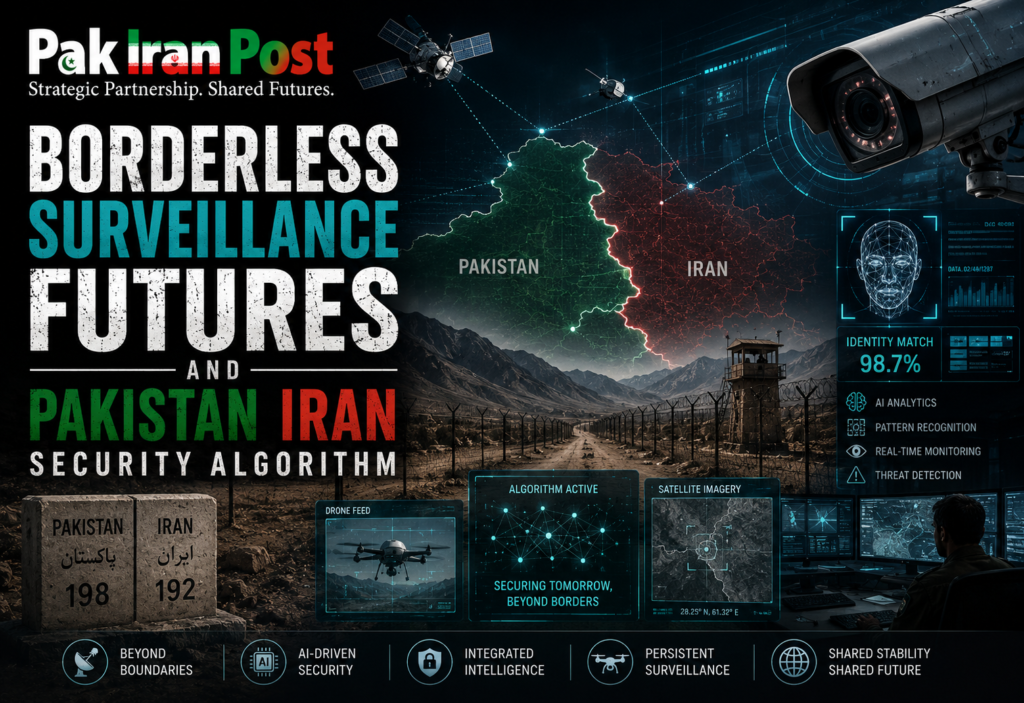
The contemporary Pakistan–Iran frontier is increasingly being reconstituted as a technologically mediated security continuum rather than a conventional geopolitical boundary. What is emerging is not merely an upgrade in border enforcement mechanisms but a structural transformation in the epistemology of sovereignty itself. Artificial intelligence, drone surveillance architectures, biometric authentication systems, and integrated sensor networks are converging into a dense technological assemblage that redefines how states perceive, classify, and act upon mobility. The border, once imagined as a linear territorial threshold, is now evolving into a continuously computed space of anticipatory governance.
Recent developments in regional security infrastructure underscore this transition. Pakistan has accelerated the deployment of AI-enabled scanning systems at key transit corridors, particularly at trade and logistics nodes connected to Iran, where cargo inspection times have been drastically reduced through automated imaging and algorithmic classification systems that process container data within seconds, thereby diminishing reliance on manual customs inspections and human discretionary judgment (ProPakistani). Parallel innovations in biometric governance have further extended the state’s reach into the corporeal domain, as national identity systems now integrate facial recognition, iris scanning, and multi-modal authentication frameworks that reduce dependency on fingerprint verification alone, thereby expanding the biometric legibility of populations previously excluded from formal identification regimes (Biometric Update).
This technological reconfiguration is not confined to administrative efficiency; it represents a deeper shift toward predictive security logic. In the evolving surveillance ecosystem, drones equipped with computer vision capabilities, AI-assisted monitoring platforms, and sensor-fusion technologies are increasingly capable of detecting anomalous movement patterns across vast and difficult terrains. Such systems are no longer passive recording instruments but active interpretive agents that generate risk scores, classify behaviours, and trigger automated alerts. The border thus becomes a site of algorithmic anticipation rather than retrospective enforcement.
Within Pakistan–Iran relations, this transformation is embedded in a broader narrative of securitised modernisation. Both states are pursuing technological adoption not as a symbolic alignment with global digital modernity but as a pragmatic response to persistent asymmetries in border control capacity, irregular trade flows, and transnational security threats. Yet this narrative of necessity obscures a more complex structural reality: technological infrastructures are not neutral instruments but carriers of epistemic authority, shaping what is visible, what is legible, and what is rendered administratively actionable.
The increasing reliance on imported surveillance systems and externally developed algorithmic platforms introduces a subtle but consequential form of dependency. While such technologies enhance operational efficiency, they simultaneously embed external logics of classification and risk assessment into domestic security architectures. This raises critical questions about data sovereignty, algorithmic transparency, and infrastructural autonomy. In a region where geopolitical contestation intersects with technological dependency, surveillance systems risk becoming conduits of strategic influence rather than purely defensive tools.
At the same time, the social consequences of this technological intensification are unevenly distributed. Borderland communities, historically characterised by fluid mobility and informal economic exchange, are being reclassified into highly surveilled populations. The introduction of biometric documentation requirements and stricter visa regimes has already altered long-standing patterns of cross-border interaction, replacing informal corridors of movement with formalised, data-intensive checkpoints that privilege legibility over relational trust (Balochistan Pulse). This shift produces a paradoxical condition in which state visibility increases while socio-economic permeability decreases, potentially exacerbating marginalisation in already fragile peripheries.
The policy challenge, therefore, is not simply technological adoption but institutional calibration. A bilateral Pakistan–Iran framework for border digital governance could offer a pathway toward harmonised surveillance standards, interoperable data systems, and coordinated risk management protocols. However, such cooperation must avoid collapsing into technological homogenisation that erodes institutional diversity and reinforces shared vulnerabilities. Instead, a distributed architecture of border intelligence, grounded in mutual but independent infrastructural sovereignty, may offer a more resilient model.
Equally critical is the development of ethical and legal frameworks governing AI deployment in security contexts. Without clear regulatory oversight, algorithmic border systems risk evolving into opaque decision-making structures that operate beyond democratic accountability. The incorporation of explainable AI protocols, audit mechanisms, and civilian oversight structures would be essential in mitigating the drift toward automated securitisation without oversight.
Ultimately, the transformation of the Pakistan–Iran border into a digitally governed security environment signals a broader global shift in sovereignty itself. Authority is increasingly exercised through data flows, algorithmic classification, and infrastructural control rather than through purely territorial assertion. In this emerging order, the capacity to govern borders is inseparable from the capacity to govern information. For Pakistan and Iran, the strategic question is no longer whether to adopt surveillance technologies, but how to ensure that such technologies reinforce rather than erode sovereign epistemic autonomy in an era of accelerating digital interdependence.
A Public Service Message