Energy Corridor Fragility Shapes Pakistan Iran Future

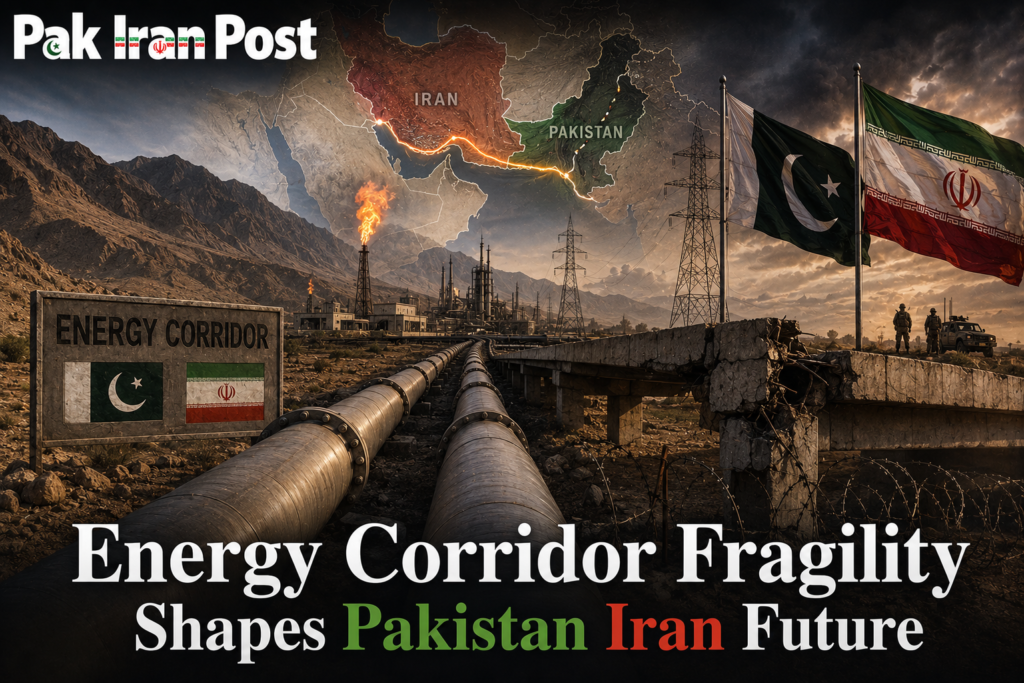
The Pakistan–Iran geo-economic interface in 2026 is increasingly being reshaped by an accumulation of structural pressures that are neither fully diplomatic nor purely commercial in nature. It is instead the product of overlapping constraints, including tightening external financial governance under IMF-supervised fiscal adjustment pathways, persistent secondary sanctions pressure linked to Iran’s energy export architecture, and the intensifying volatility of maritime supply routes passing through the wider Hormuz–Arabian Sea energy corridor. In this evolving configuration, the bilateral economic relationship is not expanding in a linear sense but is instead mutating into a constrained adaptive system, where formal agreements coexist with informal flows, and where strategic intent is repeatedly overridden by compliance exposure, liquidity scarcity, and energy insecurity.
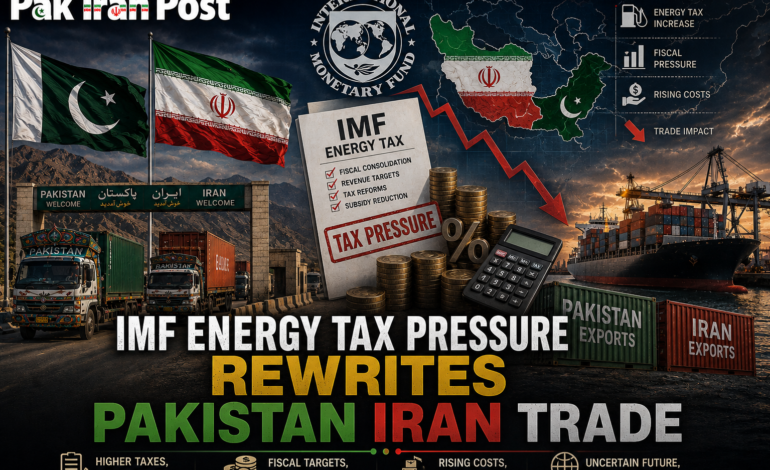
Pakistan’s macroeconomic position remains heavily conditioned by external financing cycles and IMF engagement frameworks, particularly under revenue mobilisation requirements that include expansion of energy taxation regimes, rationalisation of subsidies, and broadening of indirect taxation instruments. These measures, while intended to stabilise fiscal accounts, are generating a secondary effect: increased energy cost transmission to industrial, agricultural, and transport sectors. This has amplified structural demand for diversified and lower-cost energy sources, including potential overland or proximate imports from Iran. However, the same fiscal stabilisation architecture that incentivises diversification simultaneously constrains the policy flexibility required to operationalise it, particularly given compliance risks associated with sanctioned-origin energy transactions.
On the Iranian side, the economic calculus is shaped by prolonged external sanctions exposure, currency instability, and restricted access to global financial clearing systems. This has led to the emergence of adaptive export strategies, including regionalised trade routing, discounted pricing structures, and reliance on adjacent border economies for partial absorption of hydrocarbons and refined products. Within this framework, Pakistan is not merely a neighbouring state but a structurally relevant adjacency node that can function as a partial economic buffer, albeit within tightly constrained operational parameters.
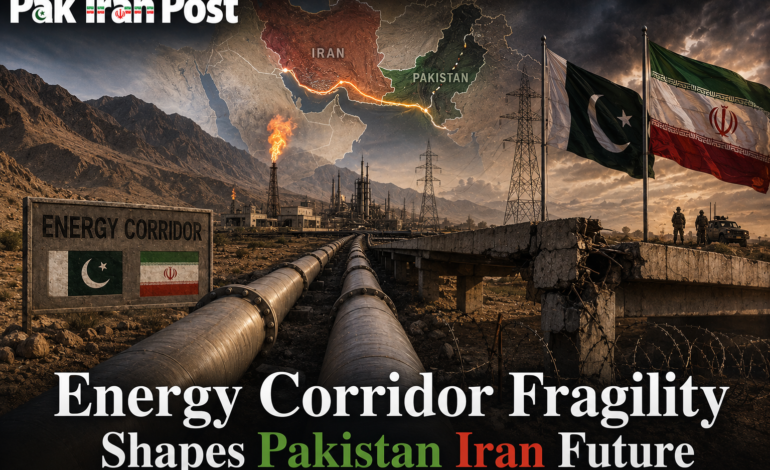
The interaction between these two constrained systems produces what can be described as a frictional corridor economy. It is neither fully formalised nor entirely informal, but instead exists in a hybrid state where political declarations of intent are periodically disrupted by enforcement risk calculations and external financial oversight mechanisms. The Iran–Pakistan gas pipeline, long discussed as a flagship connectivity project, now operates less as an infrastructure plan and more as a strategic placeholder within a wider matrix of deferred energy expectations and contingent geopolitical possibilities.
Recent shifts in regional energy security dynamics have intensified the relevance of this corridor. Maritime disruptions in global shipping lanes, fluctuating insurance premiums for energy cargo, and episodic instability in chokepoint regions have increased the premium on overland or shorter-route energy alternatives. For Pakistan, whose energy import bill remains one of the most sensitive components of its external account, these developments reinforce the structural attractiveness of proximity-based energy sourcing. Yet attractiveness does not translate into operational feasibility without navigating a dense regulatory and financial constraint environment.
Within multilateral frameworks, particularly those involving IMF oversight, energy sector reforms are increasingly tied to fiscal discipline metrics and revenue expansion benchmarks. The introduction or expansion of energy taxation is often framed as necessary for stabilising budgetary deficits and reducing circular debt accumulation within the power sector. However, such measures also increase domestic energy prices, thereby intensifying demand for alternative supply arrangements. This creates a policy paradox: fiscal stabilisation measures indirectly heighten the strategic appeal of precisely those energy partnerships that are constrained by external sanctions regimes.
For policy-making institutions in Islamabad, the establishment-level concern is not simply whether energy cooperation with Iran is desirable, but whether it can be structured in a manner that does not trigger external financial disruption. This includes risks related to correspondent banking exposure, potential disruption of IMF programme conditionalities, and reputational costs within global financial markets. As a result, decision-making is increasingly characterised by temporal deferral, phased signalling, and reliance on non-binding frameworks that preserve optionality without committing to immediate execution.
At the same time, border economies along the Pakistan–Iran frontier continue to demonstrate a persistent tendency toward informal economic integration. Goods, energy derivatives, and labour-linked exchanges operate through semi-regulated channels that are responsive to local demand conditions rather than national-level policy architectures. These flows, while economically significant at the micro level, remain structurally disconnected from formal fiscal accounting systems, thereby limiting their macroeconomic stabilisation potential while simultaneously enhancing local resilience.
From a strategic governance perspective, this divergence between formal constraint and informal adaptation is increasingly central to understanding the corridor’s future trajectory. The more formal mechanisms are constrained by external compliance regimes, the more informal systems expand to absorb unmet demand. This does not necessarily indicate policy failure, but rather the emergence of a dual-track economic reality in which state policy and ground-level economic behaviour operate on different temporal and regulatory logics.
For international stakeholders, including multilateral institutions and external financial observers, the Pakistan–Iran interface represents a test case in the limits of sanction durability as a tool of long-term economic structuring. While sanctions regimes remain effective in constraining large-scale capital flows and formalised energy contracts, they are less effective in eliminating demand-driven adjacency trade and adaptive regional substitution mechanisms. This creates a landscape in which economic behaviour is not fully suppressed but instead redistributed into alternative channels.
Investor perception of this environment is correspondingly complex. On one hand, the corridor represents a high-risk jurisdiction characterised by regulatory unpredictability, currency volatility, and geopolitical exposure. On the other hand, it also represents a frontier opportunity space in which infrastructure gaps, energy deficits, and logistics inefficiencies create potential for asymmetric returns. However, such returns are contingent not on conventional market stability but on the evolution of hybrid governance mechanisms that can partially reconcile formal compliance with informal functionality.
The establishment concern within Pakistan is increasingly centred on maintaining strategic autonomy in energy decision-making while remaining within the boundaries of international financial legitimacy. This requires a calibrated approach that avoids overt confrontation with sanction regimes while preserving long-term optionality for energy diversification. In practical terms, this translates into incremental diplomacy, staged feasibility reassessments, and the maintenance of infrastructure readiness without immediate activation.
Iran, similarly, operates within a strategic framework that prioritises regional economic embedding as a mechanism of resilience against external isolation. The Pakistan corridor, in this sense, is not merely a bilateral opportunity but part of a broader spatial strategy of economic continuity under constraint. However, the effectiveness of this strategy is limited by the extent to which adjacent economies are themselves embedded within global financial compliance architectures.
The interaction of these constraints produces a corridor that is structurally significant but operationally fragmented. It exists as a geopolitical idea with partial economic manifestation, rather than as a fully integrated economic system. This condition is likely to persist unless there is a significant shift in either sanction regimes, regional energy security architecture, or Pakistan’s macro-fiscal dependency profile.
From a policy perspective, the critical challenge is not the absence of strategic intent but the absence of convergence between intent and operational feasibility. This gap is widened by external financial oversight requirements, particularly those linked to IMF programme conditionalities that prioritise fiscal consolidation and energy sector reform. While these conditions are designed to enhance macroeconomic stability, they also inadvertently narrow the range of feasible external energy partnerships.
At the diplomatic level, Pakistan–Iran engagement is likely to remain characterised by symbolic continuity, periodic announcements, and selective technical discussions that do not immediately translate into full-scale implementation. This pattern reflects a broader regional trend in which connectivity projects are increasingly subject to geopolitical gating conditions rather than purely economic viability assessments.
In the medium term, the most plausible trajectory is not full corridor activation nor complete disengagement, but rather a sustained state of calibrated suspension. In this state, infrastructure proposals remain technically alive, trade continues in selective and adaptive forms, and energy cooperation is periodically re-evaluated in response to shifts in external pressure environments.
For policymakers, the implication is that strategic planning must account for prolonged ambiguity rather than binary outcomes. For investors, the implication is that value lies not in immediate execution but in positioning within preparatory and enabling sectors that can operate across multiple scenario outcomes. For diplomatic actors, the implication is that corridor stability is less about final agreements and more about continuous management of constraint interactions.
Ultimately, the Pakistan–Iran geo-economic interface is not evolving toward clarity but toward managed complexity. It is a system in which energy security, financial governance, and geopolitical constraint are increasingly fused into a single operational environment. Within this environment, policy success will depend not on eliminating constraint, but on learning how to operate effectively within it.
A Public Service Message