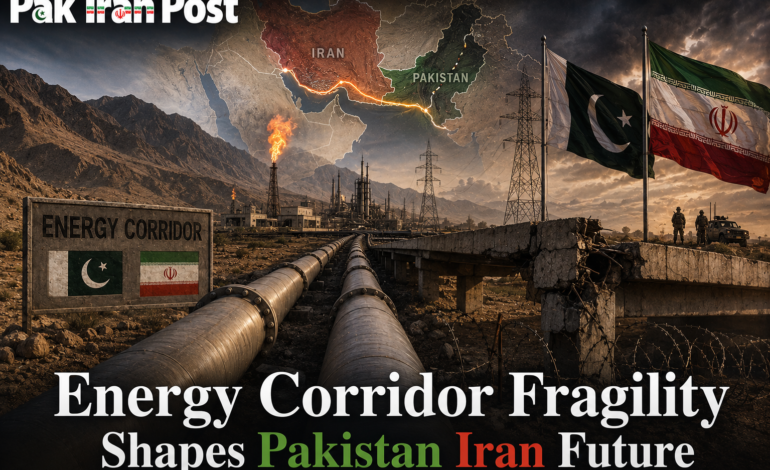

Pakistan Iran Borderlands Emerge As Central Geopolitical Contest Zone Today


The long neglected frontier stretching across Pakistan and Iran is undergoing a structural transformation that is quietly altering the strategic geometry of South West Asia. What was once treated as a peripheral security margin, defined largely by low intensity movement, informal trade networks, and episodic diplomatic friction, is increasingly being repositioned as a central geopolitical space where regional security doctrines, fiscal vulnerabilities, external financial pressures, and evolving Eurasian connectivity ambitions converge. In this recalibration, the borderlands are no longer an edge of the state system. They are becoming a core arena of contestation where sovereignty, economics, and external influence intersect with growing intensity.
This shift is not occurring in isolation. It is embedded within a broader transformation of the regional order in which fiscal constraints imposed through international financial oversight mechanisms, rising energy taxation regimes, and structural economic adjustments are reshaping domestic policy priorities across Pakistan. Simultaneously, Iran continues to operate under prolonged sanctions pressure, restricted financial integration, and persistent macroeconomic stress. Together, these conditions are generating a shared but uneven vulnerability that is increasingly visible in the governance of border regions.
In Pakistan’s case, ongoing engagement with international financial institutions has introduced a policy environment characterized by stringent macroeconomic conditionalities. These include energy sector reforms, taxation restructuring, subsidy rationalization, and fiscal consolidation measures designed to stabilize external accounts. While these interventions are framed as necessary for macroeconomic discipline, they also generate secondary effects that directly influence borderland stability. Rising energy prices and adjusted taxation frameworks increase transport costs, reduce informal trade absorption capacity, and intensify socio economic pressures in already fragile frontier districts.
The border economy, which has historically functioned as a hybrid system combining formal trade, informal exchange, and localized survival networks, is particularly sensitive to such fiscal recalibrations. As energy tariffs rise and regulatory enforcement expands, informal economic flows that once provided a buffer against structural poverty begin to contract. This contraction does not eliminate cross border movement. Instead, it shifts it into more opaque channels, increasing the risk of unregulated networks becoming embedded within broader security concerns.
From a strategic perspective, this transition is critical. Borderlands that lose economic elasticity often gain strategic volatility. Economic contraction does not simply reduce trade. It alters incentives, redistributes informal power structures, and creates conditions where non state actors may gain comparative advantage in controlling cross border movement. This dynamic is increasingly visible along segments of the Pakistan Iran frontier, where local economies are adjusting to both domestic fiscal tightening and external regulatory scrutiny.
Iran faces a parallel but structurally distinct set of constraints. Long standing sanctions regimes have created an economic environment in which border regions play an outsized role in sustaining localized livelihoods. Informal trade networks, energy exchange mechanisms, and cross border commercial adaptation strategies have become embedded within the economic survival architecture of peripheral Iranian provinces. Any disruption to these networks, whether through external pressure or internal recalibration, carries direct social and political consequences.
The asymmetry between Pakistan’s IMF influenced fiscal restructuring and Iran’s sanctions constrained economy produces a unique borderland condition. Both states are attempting to stabilize macroeconomic systems under external pressure, yet their frontier regions are absorbing the unintended consequences of these adjustments in different but interconnected ways. This convergence of economic stress zones creates a shared vulnerability that is often underestimated in conventional diplomatic analysis.
Overlaying these fiscal pressures is an increasingly complex security environment. The Pakistan Iran border region has long been characterized by low intensity insurgent activity, smuggling networks, and intermittent militant mobility. However, recent years have seen a gradual shift in the nature of these dynamics. Instead of isolated incidents, there is a growing tendency toward networked instability, where localized disruptions are linked to broader regional security architectures involving multiple external actors, intelligence competition, and competing geopolitical interests.
Establishment level security assessments in both Islamabad and Tehran increasingly view border instability not merely as a law enforcement issue but as a strategic domain influenced by external pressures. There is a growing recognition that peripheral instability can be instrumentalized within broader geopolitical contests, particularly in contexts where corridor development projects, energy routes, and maritime access points are being redefined across Eurasia.
In this context, the borderlands are acquiring a dual identity. On one hand, they remain zones of economic marginality and underdevelopment. On the other, they are becoming strategic buffers whose stability or instability can influence wider regional calculations. This duality is central to understanding why border management has become a priority concern within both national security establishments.
The evolution of connectivity projects further intensifies this transformation. Regional initiatives aimed at linking the Arabian Sea to Central Asia and beyond have placed renewed emphasis on transit corridors that pass through or near border regions. While these projects are framed as economic integration mechanisms, they also carry implicit strategic implications. Infrastructure is no longer neutral. It is increasingly viewed as a vehicle of influence projection, economic dependency creation, and geopolitical alignment shaping.
Within this environment, competing corridor visions intersect across the Pakistan Iran frontier. On one side, Pakistan’s integration into broader Eurasian connectivity frameworks emphasizes eastern linkages and maritime access through established port infrastructure. On the other, Iran’s geographic positioning offers alternative westward and northward connectivity pathways that intersect with Central Asian and Caucasian routes. These overlapping visions create both opportunities for cooperation and potential friction depending on how strategic trust evolves.
The presence of major external powers further complicates this landscape. China’s long term connectivity strategy prioritizes stability across western transit routes, including those passing through Pakistan. This creates an implicit interest in border stabilization and economic predictability. At the same time, other global actors continue to assess regional infrastructure through a security centric lens, where connectivity projects are interpreted as extensions of geopolitical influence. This divergence in interpretation contributes to strategic ambiguity surrounding border development initiatives.
The informational environment surrounding the border region adds another layer of complexity. International narratives often emphasize instability, trafficking, and militancy while underrepresenting the structural economic and demographic factors driving cross border interaction. This selective framing influences external risk assessments and investment behavior. Over time, such narratives can reinforce a perception of chronic instability, even when localized conditions are more nuanced and variable.
At the domestic level, political economies on both sides of the border are undergoing subtle but significant shifts. In Pakistan, fiscal tightening associated with energy taxation reforms and IMF guided restructuring is reshaping resource allocation priorities. Development spending in peripheral regions often faces constraints as macroeconomic stabilization takes precedence. This creates governance gaps that can inadvertently affect border management capacity.
In Iran, economic constraints linked to sanctions and financial isolation have produced a parallel set of governance challenges. Localized economic adaptation strategies have filled some gaps, but structural investment limitations continue to constrain long term infrastructure development in border regions. The cumulative effect is a persistent underinvestment in formal institutional capacity on both sides of the frontier.
This institutional asymmetry is critical. Border stability is not solely determined by security deployment. It is equally shaped by administrative capacity, economic inclusion, and infrastructural integration. Where these elements are weak, informal systems expand to fill the vacuum. While such systems can provide short term resilience, they often lack transparency and can become vulnerable to external exploitation.
The establishment perspective in both states increasingly recognizes that unmanaged borderlands represent strategic liabilities in an era of intensified regional competition. However, addressing these vulnerabilities requires more than tactical security measures. It requires structural rethinking of border governance models, including economic integration, joint coordination mechanisms, and long term development planning.
Policy discussions in Islamabad increasingly reflect an awareness that border stabilization cannot be achieved through enforcement alone. Economic inclusion, trade facilitation, and regulated cross border commerce are emerging as necessary components of a sustainable strategy. However, fiscal constraints linked to broader macroeconomic adjustment programs limit the pace at which such initiatives can be implemented.
Similarly, Iranian policy discourse acknowledges the need for more structured border governance frameworks that balance security concerns with economic necessity. Yet external pressures, combined with internal economic constraints, limit the scope for rapid institutional reform. This creates a situation in which both states recognize the problem but face structural limitations in addressing it comprehensively.
The broader geopolitical environment further complicates these efforts. The gradual fragmentation of global order into overlapping spheres of influence has increased the strategic value of border regions as potential transit corridors, buffer zones, and influence nodes. In this context, Pakistan Iran borderlands are not only local governance challenges but also components of wider Eurasian strategic architecture.
The risk is that without coordinated management, these regions may become zones of chronic instability shaped by competing external and internal pressures. Such an outcome would have implications not only for bilateral relations but also for broader regional connectivity projects and economic integration efforts.
Conversely, if managed effectively, the same borderlands could serve as bridges rather than barriers. Structured economic zones, coordinated security mechanisms, and regulated trade frameworks could transform the frontier into a stabilizing interface between two critical regional economies. However, achieving this outcome requires sustained political will, institutional coordination, and insulation from short term geopolitical volatility.
Ultimately, the transformation of Pakistan Iran borderlands reflects a broader global pattern in which peripheries are becoming central to geopolitical competition. As economic corridors expand and security doctrines evolve, traditional distinctions between center and periphery are dissolving. Border regions are no longer margins of state authority. They are increasingly arenas where the future shape of regional order is being quietly negotiated.
The challenge for both Islamabad and Tehran is whether they can adapt their governance frameworks to this new reality before external pressures and internal constraints harden existing vulnerabilities into long term structural instability. The answer to this question will shape not only bilateral relations but also the broader trajectory of regional connectivity across Eurasia and the Middle East.
A Public Service Message