
Artificial Intelligence and Strategic Power Reordering Across Asia

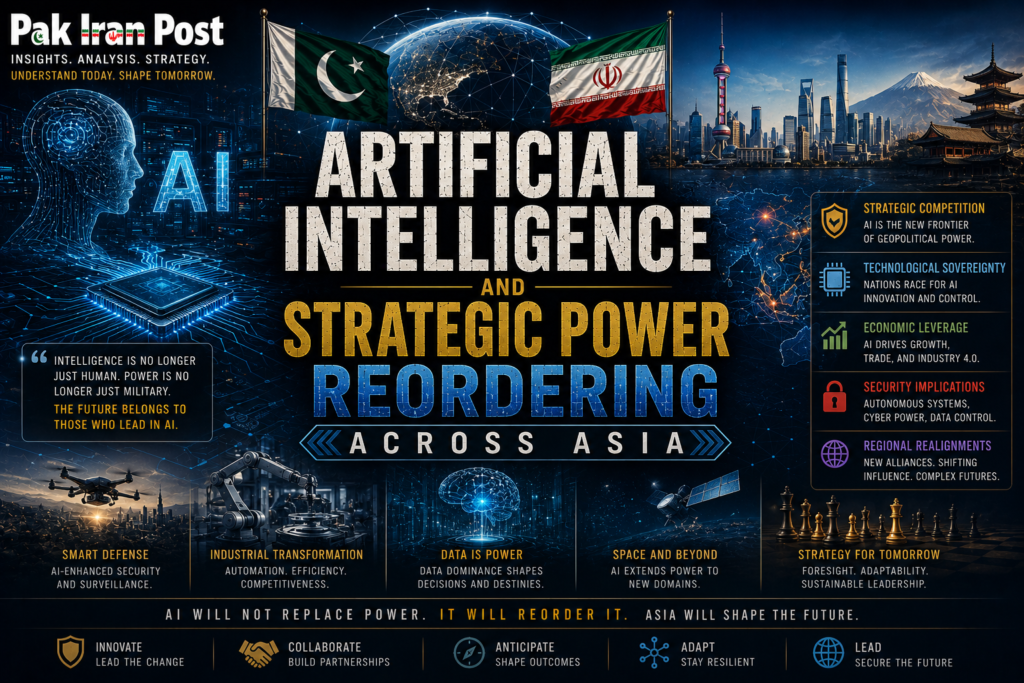
Artificial intelligence is no longer an auxiliary technological instrument; it has become a structural determinant of state behaviour, security architecture, and economic hierarchy across South and West Asia. In contemporary policy corridors from Islamabad to Tehran, and in parallel analytical rooms in Washington, Beijing, and Brussels, AI is increasingly treated not as innovation policy but as strategic infrastructure, comparable in its implications to energy grids, financial systems, and military logistics.
What distinguishes the present phase of technological transformation is not merely the speed of computational advancement, but the way artificial intelligence has collapsed the temporal distance between data acquisition, interpretation, and strategic response. In earlier eras, intelligence cycles were linear, mediated through institutional hierarchies and human interpretation. Today, algorithmic systems compress these cycles into near real time decision loops, generating what security analysts increasingly describe as continuous contingency environments. Within such environments, uncertainty is not reduced; it is accelerated, refined, and redistributed across domains of governance.
For South and West Asia, this transformation intersects with pre existing structural fragilities. States already navigating fiscal constraints, energy deficits, demographic pressures, and external financial dependencies are now required to integrate AI into governance ecosystems that were not designed for such velocity or opacity. The result is an uneven adaptation landscape, where technological adoption outpaces institutional calibration.
In security terms, AI is fundamentally altering threat perception. The integration of machine learning into surveillance systems, border monitoring, drone operations, and cyber intelligence platforms has introduced a level of predictive capacity that was previously unattainable. Yet predictive capacity does not equate to predictive certainty. Instead, it produces a condition of probabilistic governance, where state responses are guided by likelihood distributions rather than verified intelligence alone. This shift has profound implications for crisis stability, particularly in regions marked by historical rivalries and intermittent military escalation.
The most consequential development is the fusion of AI with cyber operational theatres. Cyber operations, once episodic and tactical, are now persistent and adaptive. Machine learning systems enable continuous scanning of vulnerabilities, autonomous exploitation of network weaknesses, and rapid recalibration of offensive and defensive postures. This creates an operational environment where attribution becomes increasingly ambiguous and deterrence frameworks become structurally unstable. In such a landscape, misinterpretation is not an exception but an embedded risk.
Simultaneously, the information domain has undergone a transformation that is no longer adequately captured by traditional media analysis frameworks. Algorithmically curated content ecosystems, reinforced by recommendation engines and behavioural profiling systems, have redefined the architecture of public perception. Information is no longer disseminated; it is selectively amplified. Narratives are no longer broadcast; they are engineered. In this context, state and non state actors compete not only over facts but over the visibility of facts.
This competition is further intensified by the emergence of synthetic media production capabilities. Deep generative systems now enable the creation of highly plausible audio, visual, and textual content that can simulate institutional voices, political figures, or crisis events. The strategic implication is the erosion of epistemic certainty, where verification becomes slower than dissemination, and correction becomes less influential than initial exposure. For fragile political environments, this introduces a new class of vulnerability that is both informational and psychological.
Economically, artificial intelligence is beginning to redefine the hierarchy of competitiveness. Global value chains are increasingly structured around computational intensity rather than purely labour cost arbitrage. Countries that fail to integrate AI into industrial policy frameworks risk gradual exclusion from high value segments of global production networks. This is particularly significant for economies reliant on remittances, commodity exports, or low complexity manufacturing bases.
However, the economic promise of AI is deeply uneven. Productivity gains are concentrated within capital intensive sectors, while labour displacement pressures are disproportionately absorbed by semi skilled workforces. This generates a structural bifurcation in labour markets, where high productivity enclaves coexist with expanding informal or precarious employment sectors. Without corrective policy interventions, this divergence risks translating into social stratification and political instability.
Within this broader transformation, external financial institutions and multilateral policy frameworks have begun to incorporate technological variables into macroeconomic governance assessments. Institutions such as the International Monetary Fund are increasingly attentive to digital taxation regimes, energy pricing structures linked to data infrastructure consumption, and fiscal sustainability models that account for automation induced labour displacement. In several developing economies, energy taxation reforms are being indirectly shaped by external financing conditionalities that link fiscal discipline with structural adjustment in energy consumption patterns. These dynamics introduce a layered sovereignty question, where technological transition is not fully autonomous but partially externally mediated.
For Pakistan and Iran, the intersection of AI transformation with existing geopolitical constraints introduces additional complexity. Both states operate within environments shaped by sanctions regimes, restricted access to advanced semiconductor technologies, and constrained participation in global digital supply chains. This structural positioning creates a dependency paradox. On one hand, AI adoption is necessary for administrative modernization, security enhancement, and economic competitiveness. On the other hand, the foundational components of advanced AI ecosystems, particularly high end chips, cloud infrastructure, and advanced datasets, remain externally controlled or commercially gated.
This dependency translates into what can be described as infrastructural vulnerability. Unlike traditional dependencies on oil, trade routes, or financial capital, technological dependency is embedded within operational systems. It is continuous, opaque, and difficult to decouple without systemic disruption. The most critical concern is that control over infrastructure often implies indirect influence over data flows, computational capacity, and system uptime. In extreme scenarios, this creates the potential for selective access modulation, where digital continuity becomes contingent on external political or commercial conditions.
The strategic implications of this condition are profound. National sovereignty, historically defined in territorial and military terms, is increasingly being reconstituted through data jurisdiction, algorithmic governance autonomy, and cyber infrastructural independence. States that lack control over these domains may retain formal sovereignty while experiencing functional dependency.
Within this evolving framework, policy responses remain uneven. In many cases, AI policy is treated as a sectoral innovation issue rather than a cross cutting strategic imperative. This fragmentation of governance limits the ability of states to construct coherent national AI strategies that integrate security, economy, education, and foreign policy dimensions into a unified architecture.
A further complication arises from institutional readiness gaps. Regulatory frameworks remain underdeveloped, while technical expertise within public sector institutions is limited. This creates a governance asymmetry where private sector actors and external technology providers often possess superior informational and operational capabilities compared to regulatory authorities. Such asymmetries risk regulatory capture, or at minimum regulatory dependency.
The establishment concerns within this environment are not limited to economic or technological domains; they extend into strategic continuity. AI driven systems increasingly inform intelligence assessments, fiscal forecasting, and even internal security evaluations. If such systems are externally sourced or inadequately audited, the risk of embedded bias, data leakage, or analytical distortion becomes non trivial. In high sensitivity environments, this raises questions regarding the integrity of decision support systems.
Moreover, the convergence of AI with energy systems introduces a new layer of infrastructural interdependence. Data centres, cloud infrastructure, and computational clusters require substantial and continuous energy inputs. In energy constrained economies, this creates competition between domestic consumption needs and digital infrastructure expansion. IMF influenced energy taxation reforms, aimed at fiscal stabilisation and subsidy rationalisation, further complicate this balance by increasing the cost of energy intensive digital expansion. The result is a policy tension between macroeconomic stabilisation and digital modernisation imperatives.
At the societal level, AI induced transformation is reshaping labour identity and social cohesion. Automation in administrative processes, media production, financial services, and logistics is reducing demand for traditional mid tier employment categories. This shift is not merely economic but psychological, altering perceptions of career stability, upward mobility, and institutional trust. In contexts where social safety nets are limited, such transitions may amplify socio political volatility.
Against this backdrop, the emergence of algorithmic governance systems introduces both opportunity and risk. On one hand, AI enabled public service delivery systems can improve efficiency, reduce corruption opportunities, and enhance administrative transparency. On the other hand, opaque algorithmic decision making can reduce accountability and concentrate discretionary power within technical systems that are not easily subject to democratic oversight.
The strategic challenge, therefore, is not whether to adopt artificial intelligence, but how to govern its integration within national systems in a manner that preserves sovereignty, enhances resilience, and mitigates systemic vulnerability. This requires a multi layered policy architecture.
First, states must prioritise the development of sovereign data ecosystems, ensuring jurisdictional control over critical datasets and their storage infrastructures. Second, investment in indigenous computational capacity must be treated as a strategic priority rather than a commercial afterthought. Third, cyber resilience must be institutionalised as a core component of national security doctrine, with continuous stress testing of critical digital infrastructure. Fourth, regulatory frameworks must be strengthened to ensure algorithmic transparency, auditability, and accountability.
Finally, regional cooperation frameworks may offer partial mitigation against structural dependency. For geographically contiguous and politically aligned states, shared digital infrastructure initiatives, joint research ecosystems, and collaborative cybersecurity frameworks could reduce individual exposure to external technological coercion.
Artificial intelligence, in its current trajectory, is not simply reshaping economies or security systems; it is reorganising the architecture of power itself. The states that recognise this transformation early and respond with institutional coherence are likely to retain strategic agency. Those that do not risk entering a condition of managed dependency, where sovereignty persists in form but erodes in function.
In this sense, the AI revolution is not merely technological. It is constitutional in its implications for the modern state.
A Public Service Message