

Technological Dependency and Strategic Exposure in Emerging States

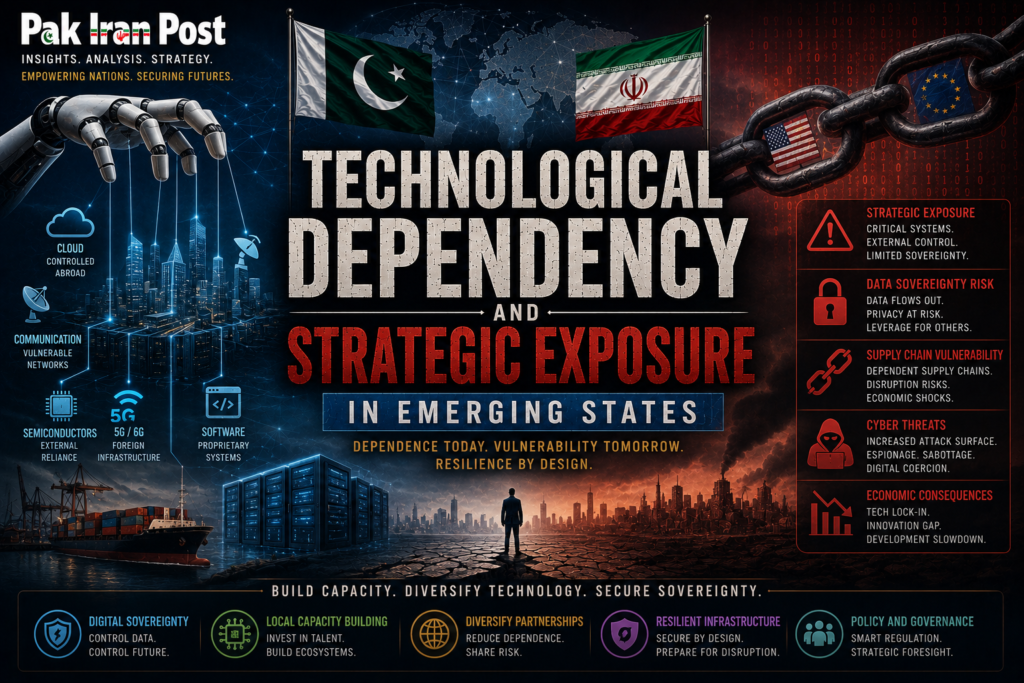
Technological dependency, once framed as a developmental lag in industrial capacity or scientific advancement, has now evolved into a structural condition of strategic exposure that shapes sovereignty, fiscal autonomy, and geopolitical agency. Across South and West Asia, the accelerating digitisation of governance, finance, energy, and security systems has created an intricate lattice of external technological reliance that is increasingly difficult to reverse without systemic disruption.
This dependency is not monolithic. It operates through layered architectures of control embedded in cloud infrastructure, semiconductor supply chains, proprietary software ecosystems, undersea data cables, and global cybersecurity protocols governed largely outside the jurisdictions of developing states. The contemporary paradox is that states are becoming more digitally integrated at precisely the moment when the material foundations of that integration remain externally concentrated.
In practical terms, this creates a condition where the operational continuity of critical national systems is partially contingent upon foreign-controlled technological nodes. Banking systems rely on global payment architectures, government databases depend on cloud services often hosted abroad, and telecommunications infrastructures are frequently built on imported hardware ecosystems with embedded software dependencies. The result is a silent but persistent erosion of infrastructural sovereignty.
What distinguishes the present phase from earlier forms of dependency is its invisibility. Unlike traditional trade or financial dependence, technological reliance is embedded within operational processes that are continuously active. It is not episodic; it is structural and recursive. This means that even in periods of political stability, latent vulnerabilities persist within the digital substrate of governance itself.
For states operating under sanctions regimes or constrained access to advanced technology markets, this condition becomes more acute. Restricted access to semiconductor manufacturing ecosystems, advanced cloud infrastructure, and high performance computing systems limits the ability to develop indigenous alternatives at scale. Consequently, reliance shifts from diversified global markets to narrow corridors of permissible technological acquisition, often mediated through third parties or commercially constrained arrangements.
This narrowing of technological options produces a form of strategic asymmetry. External actors, whether states or corporations, may not exercise direct control over domestic policy environments, yet they retain indirect influence through infrastructure dependencies. In extreme scenarios, this can manifest as throttled access to services, conditional licensing arrangements, or subtle recalibration of system capabilities through software updates and platform governance changes.
The strategic implications of such dependencies are increasingly being recognised within global security discourse. Technological infrastructure is no longer treated as neutral. It is now understood as an extension of geopolitical competition, where control over compute capacity, data flows, and digital platforms translates into measurable influence over state behaviour and economic trajectories.
In this context, sanctions regimes have acquired a new technological dimension. Beyond financial restrictions, modern sanctions increasingly operate through digital chokepoints, limiting access to advanced chips, restricting software exports, and controlling access to cloud based artificial intelligence services. This creates a layered containment architecture where technological denial becomes as significant as financial isolation.
For developing states, this introduces a dual vulnerability. On one side lies exposure to external coercion through technological restriction; on the other lies internal fragility due to insufficient domestic capacity to substitute critical systems. The gap between these two dimensions defines the strategic bandwidth available for autonomous policy making.
Energy systems further complicate this equation. Digital infrastructure is inherently energy intensive, particularly as artificial intelligence workloads expand. Data centres, high performance computing clusters, and cloud services require stable, high quality energy inputs. In energy constrained economies, this introduces competition between industrial, residential, and digital consumption priorities. When combined with fiscal adjustment pressures and energy pricing reforms often influenced by multilateral financial institutions, the expansion of domestic digital infrastructure becomes economically and politically constrained.
In several developing economies, energy taxation frameworks are undergoing recalibration under external financial oversight aimed at improving fiscal sustainability and reducing subsidy burdens. While such reforms may be macroeconomically justified, they inadvertently raise the operational cost of digital expansion, thereby slowing the development of indigenous technological ecosystems. This creates a policy contradiction where digital transformation is encouraged in principle but constrained in practice.
The semiconductor question sits at the core of this structural vulnerability. Semiconductors are no longer merely industrial components; they are strategic assets that define the upper limits of technological capability. Without access to advanced chip manufacturing ecosystems, states face inherent ceilings in artificial intelligence development, defence modernisation, and industrial automation. The global concentration of semiconductor fabrication in a small number of geographies intensifies this constraint, transforming supply chains into instruments of strategic leverage.
Within this environment, attempts at technological diversification often take the form of partial localisation rather than full sovereignty. States may develop software capabilities or assemble hardware systems domestically, yet remain dependent on imported core components. This partial autonomy creates an illusion of independence while preserving structural dependence at the foundational layer.
Cybersecurity further intensifies these dynamics. As critical infrastructure becomes digitised, cyber resilience emerges as a core determinant of national stability. However, cybersecurity itself is increasingly dependent on external tools, threat intelligence feeds, and proprietary defensive systems. This introduces a paradox where protection mechanisms may themselves constitute vectors of dependency.
The informational dimension of technological reliance is equally significant. Data is now the primary input for both economic modelling and security analysis. However, data flows are governed by platform architectures that are largely owned and operated by external entities. This raises questions of data jurisdiction, ownership, and interpretive sovereignty. If data is collected domestically but processed externally, the epistemic framing of that data may not fully align with national priorities or contextual realities.
This epistemic dependency is subtle but consequential. It influences how risks are assessed, how markets are modelled, and how populations are categorised. Over time, this can shape policy decisions in ways that are not fully transparent to domestic institutions, particularly when algorithmic systems are integrated into governance processes without full auditability.
Against this backdrop, the concept of technological sovereignty is gaining analytical traction. However, sovereignty in the digital age cannot be understood as complete autarky. Rather, it must be conceptualised as controlled interdependence, where critical systems are insulated while non critical systems remain globally integrated. The challenge lies in distinguishing between the two in a rapidly evolving technological landscape.
For policymakers, the strategic imperative is to construct multi layered resilience architectures. These include diversification of technology suppliers, development of domestic cloud and data infrastructure, investment in open source ecosystems, and establishment of regional technological alliances that reduce exposure to single point dependencies. Equally important is the development of institutional capacity capable of auditing, regulating, and stress testing digital systems across sectors.
Establishment concerns in this domain are increasingly linked to national security considerations. The integrity of digital governance systems, particularly those used in taxation, identity management, border control, and financial regulation, depends on the reliability of underlying technological architectures. If these systems are externally dependent, the risk is not only operational failure but also strategic manipulation, whether intentional or incidental.
In this evolving landscape, technological dependency is no longer a passive condition. It is an active strategic variable that can be leveraged, contested, or mitigated. The difference between these outcomes depends on the degree of foresight embedded in national policy frameworks and the speed with which institutional reforms are implemented.
Ultimately, the question is not whether technological dependency can be eliminated, but whether it can be managed in a way that preserves strategic autonomy. For states navigating constrained fiscal environments, geopolitical pressures, and rapid digital transformation, this balancing act will define the contours of sovereignty in the coming decades.
Those unable to adapt to this reality risk entering a condition where policy autonomy exists formally but is constrained operationally. Those that succeed in constructing adaptive technological ecosystems may retain a degree of agency even within an increasingly interdependent global system.
A Public Service Message


