
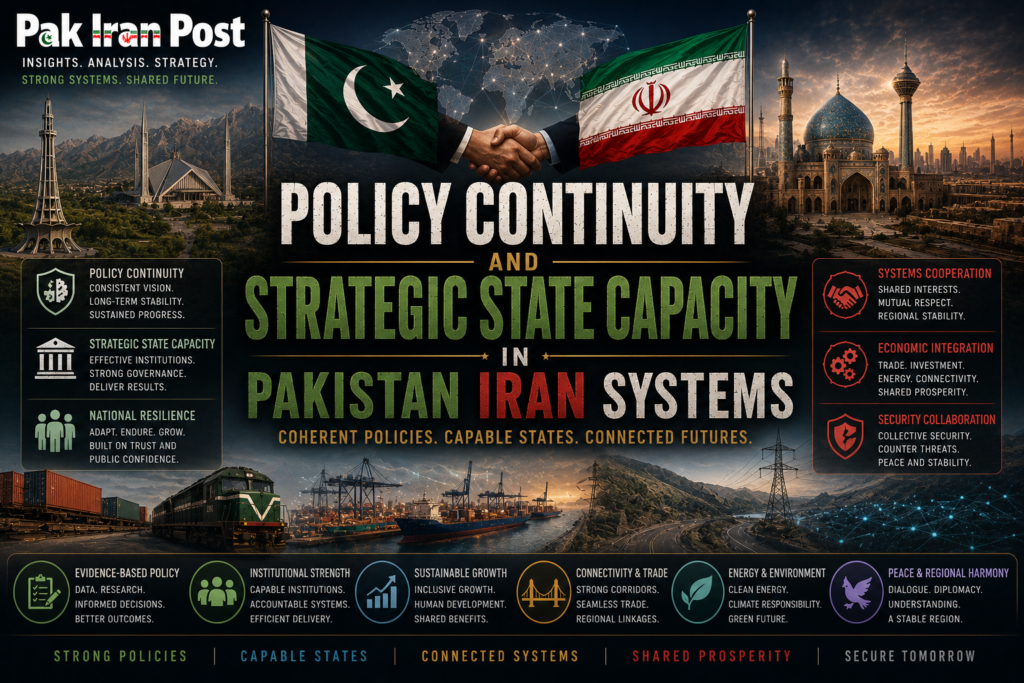
Policy Continuity and Strategic State Capacity in Pakistan Iran Systems

In contemporary geopolitical and economic environments defined by prolonged volatility, institutional discontinuity has emerged as one of the most consequential yet under-analysed constraints on state performance. For states such as Pakistan and Iran, where governance systems are repeatedly subjected to external economic pressures, internal administrative turnover, and shifting political priorities, the question of policy continuity is no longer a technocratic concern but a structural determinant of strategic survival.
At the heart of this challenge lies a fundamental tension between cyclical political authority and the long-horizon requirements of economic and security planning. Governments change, leadership styles evolve, and institutional hierarchies are periodically reconfigured, yet macroeconomic stabilization, energy transition frameworks, infrastructure development, and national security doctrines require continuity across decades rather than electoral or administrative cycles. This disjunction produces what policy theorists describe as strategic discontinuity, a condition in which long-term objectives are repeatedly interrupted by short-term recalibration.
In Pakistan, recurring engagements with multilateral financial institutions, particularly the International Monetary Fund, have introduced a layered complexity to policy continuity. IMF-supported programmes often require multi-year fiscal consolidation frameworks, energy tariff adjustments, and structural reforms in taxation and subsidy regimes. However, the implementation of these reforms frequently encounters discontinuities arising from political transitions, cabinet reshuffles, and institutional resistance within administrative structures. Each interruption not only delays reform implementation but also erodes external confidence in policy predictability, increasing borrowing costs and reducing fiscal space.
Iran presents a different but structurally comparable challenge. Long-term exposure to sanctions regimes has produced a parallel governance ecosystem where policy continuity is shaped less by electoral turnover and more by external constraint adaptation. While this has enabled a degree of institutional persistence in certain sectors, it has also generated fragmentation between formal economic channels and informal or semi-legal adaptive networks. This dual structure complicates the formation of coherent long-term planning frameworks, as policy instruments must simultaneously address sanctioned and non-sanctioned economic realities.
The concept of state capacity becomes central in this context. State capacity is not merely the ability to formulate policy but the institutional competence to implement it consistently over time, across multiple governance layers, and under varying political conditions. In both Pakistan and Iran, capacity is unevenly distributed across institutions. Certain technocratic bodies demonstrate continuity and professionalism, while others are more vulnerable to political influence, resource constraints, or administrative turnover. This unevenness produces gaps in execution that undermine strategic coherence.
A critical yet often overlooked dimension of policy discontinuity is the erosion of institutional memory. When policy teams are frequently rotated, replaced, or restructured, accumulated expertise is lost, and each new administrative cycle effectively restarts learning processes. This phenomenon is particularly damaging in complex policy areas such as energy sector reform, tax administration modernization, and public financial management systems, where incremental learning and long-term calibration are essential for success.
Establishment-level institutions, particularly those involved in strategic governance and national security coordination, often attempt to mitigate this fragmentation through parallel planning structures and continuity mechanisms. These may include specialized policy units, long-term strategic frameworks, and inter-agency coordination platforms designed to preserve continuity beyond electoral cycles. However, the effectiveness of such mechanisms is often constrained by overlapping jurisdictions, bureaucratic competition, and insufficient integration with civilian administrative systems.
Another structural factor influencing policy continuity is external dependency. Engagement with international financial institutions, bilateral donors, and multilateral development agencies introduces both stabilizing and constraining effects. While external frameworks can enforce discipline and long-term planning consistency, they can also generate policy rigidity, particularly when domestic political systems lack consensus on reform direction. In such cases, policy continuity is externally enforced rather than internally generated, creating vulnerabilities when external pressure conditions shift.
Energy sector reform remains a particularly sensitive domain in this regard. Both Pakistan and Iran operate energy systems that are deeply embedded in broader political economies, where pricing, subsidy structures, and supply chains have direct implications for social stability. Attempts to reform energy pricing mechanisms under IMF conditionality or fiscal restructuring programmes often encounter resistance due to immediate inflationary impacts. This creates a cyclical pattern where reforms are initiated, partially implemented, politically contested, and subsequently modified or delayed, resulting in structural incoherence over time.
The strategic risk arising from such discontinuity is not merely economic inefficiency but the gradual weakening of governance credibility. International investors, domestic markets, and multilateral institutions all respond not only to policy content but to policy consistency. When reform trajectories are repeatedly altered, even well-designed policies lose credibility, and the cost of future adjustment increases.
In parallel, geopolitical volatility further complicates continuity frameworks. Regional tensions, shifting alliance structures, and external pressure environments require states to frequently adjust strategic priorities. While adaptability is necessary, excessive responsiveness can undermine long-term planning discipline. The challenge lies in distinguishing between strategic adaptation and reactive policy oscillation.
Digital transformation introduces both opportunities and risks for continuity. On one hand, integrated data systems, digital registries, and automated monitoring frameworks can enhance institutional memory and reduce reliance on individual actors. On the other hand, if not properly institutionalized, digital systems can become fragmented across departments, reinforcing rather than resolving coordination failures. The effectiveness of digital governance thus depends on institutional integration rather than technological adoption alone.
A deeper structural issue is the absence of binding long-term policy frameworks that transcend political cycles. In many advanced governance systems, continuity is ensured through legally embedded fiscal rules, independent regulatory bodies, and multi-year strategic planning frameworks that are insulated from short-term political shifts. In contrast, in environments where institutional insulation is weaker, policy direction remains more susceptible to administrative change, resulting in cyclical reform patterns.
From a strategic perspective, strengthening policy continuity in Pakistan and Iran requires a multi-layered approach. First, institutional frameworks must be designed to preserve technical expertise across administrative cycles through professional civil service structures and protected policy units. Second, long-term strategic planning institutions must be empowered with operational authority rather than advisory status alone. Third, inter-agency coordination mechanisms must be formalized to reduce fragmentation in implementation. Fourth, external engagement frameworks with institutions such as the IMF must be integrated into domestic planning cycles rather than treated as parallel processes.
The hidden risk in the absence of such reforms is the emergence of what can be described as strategic drift. This occurs when states continue to articulate long-term objectives without possessing the institutional mechanisms necessary to execute them consistently. Over time, this gap between intention and implementation becomes structurally embedded, reducing the credibility of governance systems both domestically and internationally.
Ultimately, policy continuity is not a bureaucratic technicality but a core determinant of state capacity. In environments characterized by economic constraint, geopolitical pressure, and internal administrative volatility, the ability to sustain coherent policy trajectories over time becomes a defining feature of governance effectiveness. Without it, even well-designed reforms risk becoming episodic interventions rather than sustained structural transformations.
A Public Service Message