
Pakistan’s Iran Transit Gamble Needs A Sanctions Firewall

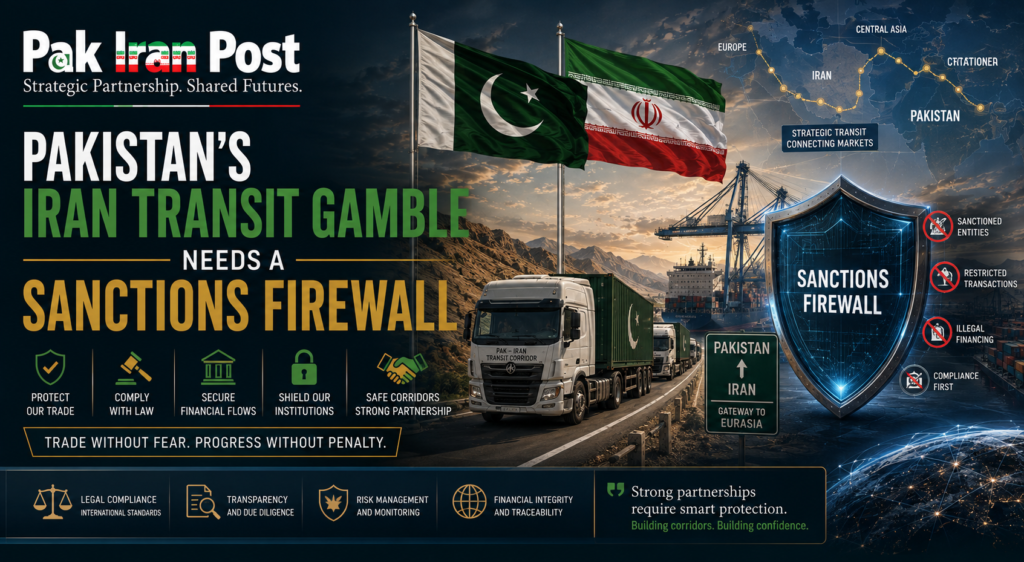
Pak Iran Post examines a commercial opening that could materially alter Pakistan’s western economic geography, but only if Islamabad can distinguish transit facilitation from sanctions exposure. Pakistan’s Ministry of Commerce brought the Transit of Goods through Territory of Pakistan Order 2026 into force on April 25, establishing a legal framework for Iran bound cargo and activating six designated routes connecting Karachi, Port Qasim and Gwadar with Gabd and Taftan. The order draws upon the Pakistan Iran agreement on international transport of passengers and goods by road signed in 2008, converting an old diplomatic commitment into a contemporary logistics instrument. (Pakistan Computer Society)
The commercial proposition is substantial. Pakistan is not merely offering road space to Iranian commerce. It is potentially inserting its ports, customs territory, trucking fleet, bonded warehouses, clearing agents, insurers, freight forwarders and maritime services into a trade architecture that has historically routed a considerable share of Iranian external commerce through alternative Gulf logistics centres. Gwadar is particularly consequential because its proximity to Gabd creates a short land connection into Iran, while Karachi and Port Qasim offer established container, bulk cargo and multimodal handling capabilities. The six notified routes create a network rather than a single corridor, giving Pakistan the possibility of distributing traffic according to cargo type, port capacity, security conditions and border congestion. (EPINOVA Publications)
Yet the central policy question is not whether Pakistan can attract cargo. It is whether Pakistan can process Iranian linked cargo without allowing its ports, banks, transport operators or customs infrastructure to become instruments of sanctions circumvention. That distinction is indispensable. Transit itself is not synonymous with a prohibited transaction, but the legal character of a shipment can change according to its commodity, consignee, beneficial owner, carrier, financial intermediary, insurer, port operator and ultimate commercial purpose. A container moving physically through Pakistan may therefore appear innocuous at the manifest level while creating material exposure through one of the entities embedded in the transaction.
The risk architecture has become more complicated rather than less. The Financial Action Task Force continues to identify Iran as a high risk jurisdiction subject to a call for action, alongside North Korea and Myanmar. FATF urges jurisdictions dealing with such environments to apply enhanced due diligence and, where appropriate, countermeasures designed to protect the international financial system from money laundering, terrorist financing and proliferation financing risks. (FATF) Pakistan consequently cannot treat customs documentation and physical inspection as sufficient safeguards. A transit regime designed for the present environment requires an integrated customs, financial intelligence, sanctions screening and corporate ownership architecture.
The temptation will be to regard transit as a low risk category because the goods are not necessarily imported into Pakistan. That assumption would be strategically complacent. Transit creates economic value precisely because Pakistan provides services around the movement of cargo. Port handling, storage, trucking, documentation, insurance, inspection, financing and agency services all create contractual relationships. Each relationship can generate exposure if the underlying cargo or counterparty falls within a sanctions regime. The more sophisticated the transit ecosystem becomes, the more important the compliance architecture becomes with it.
The United States sanctions framework illustrates the difficulty. OFAC states that non US persons can face sanctions exposure for knowingly providing significant support to designated Iranian persons, facilitating significant transactions involving designated Iranian entities, or engaging in specified transactions involving sensitive Iranian sectors. Iranian shipping, energy and port related activities can carry particular sensitivity, while designated entities remain a separate and more acute category of risk. (OFAC) This does not mean that every Iranian shipment is prohibited, nor does it mean that Pakistan must abandon transit commerce. It means that Islamabad requires transaction level discrimination rather than a blanket political interpretation of sanctions.
That discrimination should begin before cargo reaches a Pakistani port. The Ministry of Commerce, Federal Board of Revenue, State Bank of Pakistan, Financial Monitoring Unit, Port authorities, maritime regulators and security agencies should operate a common Transit Risk Assessment Platform. Every consignment should receive a digital risk profile generated from the importer, exporter, consignee, notify party, vessel, carrier, freight forwarder, insurer, bank, commodity classification, declared value, country of origin, country of destination and beneficial ownership structure. A cargo declaration should not be regarded as complete merely because its Harmonized System code and invoice value appear plausible.
Beneficial ownership is particularly important. Shell companies, nominee directors, opaque trading houses and repeatedly changing consignees can transform a legitimate transit route into an evasion mechanism. Pakistan should require beneficial ownership disclosure for higher risk consignments and establish automated cross checks against sanctions lists, politically exposed person databases, corporate registries, customs histories and suspicious transaction intelligence. Where ownership cannot be established to a satisfactory standard, the cargo should move into enhanced review rather than being cleared through an assumption of innocence generated by incomplete documentation.
The same principle should apply to the commodity itself. A commercially attractive transit regime cannot treat all goods equally. Food, agricultural commodities, pharmaceuticals and ordinary consumer merchandise present a fundamentally different risk profile from petroleum, petrochemicals, dual use technology, advanced electronics, aviation components, industrial machinery or items potentially connected to military and proliferation activity. OFAC guidance recognises specific categories of humanitarian and consumer transactions that may be permissible under defined circumstances, while simultaneously warning that transactions involving sanctioned Iranian financial institutions, designated persons or prohibited activities can alter the analysis. (OFAC) Pakistan therefore needs a commodity risk taxonomy rather than a generic transit permission.
The port authorities should institutionalise a sanctions compliance gate alongside the conventional customs gate. Cargo should not proceed merely because customs revenue has been secured. A customs compliant consignment and a sanctions compliant consignment are related but distinct concepts. The former concerns Pakistan’s fiscal and trade laws; the latter requires assessment of external sanctions exposure and the counterparties involved. A joint clearance protocol could assign consignments to green, amber and red risk categories. Green cargo could proceed through automated processing. Amber cargo would require documentary verification and enhanced ownership screening. Red cargo would require interagency clearance and, where necessary, legal advice before movement is authorised.
This is where Gwadar deserves particular attention. The Gwadar Port Authority has issued guidelines under CGO 05/2026 for Iran transit through the Gabd Rimdan crossing, providing for customs supervised movement and procedures including TIR Carnet, Transit Goods Declaration with security and cross stuffing. The port authority has identified opportunities for traders, transporters, clearing agents, warehousing operators and logistics businesses. (gwadarpro.pk) The proximity of Gwadar to Gabd makes the route commercially compelling, but that same proximity creates a requirement for unusually strong cargo integrity controls. Shorter distance is economically advantageous only when the chain of custody remains auditable.
Pakistan should therefore make electronic seals mandatory for higher risk transit consignments and establish geofenced monitoring from port gate to border crossing. A shipment cleared at Gwadar should generate an immutable digital movement record showing entry, inspection status, seal number, vehicle identity, driver credentials, route compliance, intermediate stoppages and border exit. Any deviation beyond a predetermined tolerance should automatically trigger an alert. This is not excessive bureaucratisation. It is the minimum architecture required when the state is attempting to establish credibility with international banks, insurers and shipping companies.
The TIR system can provide an important foundation because it is designed around customs controlled international road transit, but Pakistan should resist treating TIR documentation as a substitute for sanctions due diligence. Customs transit guarantees establish fiscal security and facilitate cross border movement; they do not by themselves determine whether a beneficial owner, commodity or financial counterparty presents sanctions risk. The two compliance layers must therefore remain interoperable without being conflated.
Insurance presents another underappreciated vulnerability. International insurers and reinsurers may impose restrictions substantially more conservative than domestic regulatory requirements. A shipment can therefore be legally admissible under Pakistani customs rules while remaining commercially uninsurable. If Pakistani logistics companies are forced to absorb sanctions related liabilities, insurance premiums could rise rapidly, eroding the economic advantage of the route. Islamabad should establish a transparent insurance protocol that identifies acceptable insurers, permissible cargo categories and documentary requirements without creating an implicit sovereign guarantee for private commercial risk.
Banking is even more consequential. A transit corridor cannot scale if banks fear that ordinary trade finance, correspondent banking or settlement services could expose them to enforcement action. The State Bank should issue a dedicated compliance framework for transit transactions rather than leaving commercial banks to construct individual interpretations. That framework should require transaction screening, sanctions list updates, beneficial ownership verification, commodity classification and escalation procedures for ambiguous transactions. It should also clarify that the existence of a Pakistani transit document does not automatically confer legitimacy upon an underlying financial transaction.
The objective should not be to create a Pakistani alternative to international sanctions. Such a strategy would be commercially self defeating and strategically reckless. Pakistan needs a compliance firewall, not a sanctions workaround. The distinction is critical for institutions whose continued access to correspondent banking, trade finance, maritime insurance and international shipping networks is worth considerably more than any short term increase in transit fees.
There is nevertheless a legitimate commercial case for accepting Iranian and third country cargo where the transaction can withstand scrutiny. Port utilisation could increase without requiring immediate large scale physical expansion if Pakistan concentrates initially on underused capacity, scheduled truck windows, bonded storage and rapid customs processing. Warehousing could become a meaningful ancillary industry, particularly for cargo requiring consolidation, temperature control, repackaging or onward distribution. Freight forwarding, customs brokerage, vehicle maintenance, container handling and security services could generate employment along routes through Balochistan. These benefits would be more durable than a narrow calculation of customs duties.
The fiscal model should consequently be broader than tariff collection. Transit cargo generally produces less direct customs revenue than domestic imports because the merchandise is not entering Pakistan’s consumption market. Its value lies in service revenues, port charges, handling fees, warehousing, road transport, documentation, inspection and associated commercial activity. The government should establish a Transit Economic Account that measures revenue and foreign exchange effects across the entire logistics chain. This would allow policymakers to determine whether a route is genuinely producing national economic value rather than simply generating truck movements.
The security establishment has an equally important role, but it should be exercised through institutional design rather than ad hoc intervention. Pakistan’s western frontier combines commercial movement with smuggling, irregular migration, militant activity and complex social networks. A formal transit regime could reduce some illicit activity by shifting trade from informal channels into documented corridors, but only if legitimate commerce becomes faster and more predictable than clandestine movement. Excessive inspection delays could produce the opposite outcome, encouraging traders to return to informal arrangements.
A permanent interagency Transit Security and Compliance Cell should therefore be established with representation from customs, commerce, financial intelligence, the State Bank, maritime authorities, border management institutions and relevant security agencies. Its mandate should include cargo risk scoring, sanctions screening, suspicious ownership analysis, route security, incident escalation and quarterly review of high risk trade patterns. The cell should report through a clearly designated federal authority rather than becoming another diffuse committee without operational responsibility.
Pakistan should also negotiate structured information sharing with Iranian customs authorities while maintaining independent Pakistani legal controls. Data exchange should cover advance cargo manifests, vehicle identification, exporter and consignee information, commodity codes, seal numbers and confirmed border exits. Yet Islamabad should avoid allowing Iranian certification to become the sole basis for Pakistani clearance. A sovereign customs jurisdiction must retain the ability to reject, inspect or suspend cargo where its own laws or international obligations require it.
The commercial regime should be explicitly reversible. Each cargo category and route should carry predefined suspension triggers involving sanctions designations, repeated documentation discrepancies, unexplained route deviations, suspicious ownership patterns, cargo substitution or evidence of diversion. This would reassure international partners that Pakistan is not granting an unconditional commercial concession. It would also prevent political pressure from turning individual transit permissions into permanent institutional liabilities.
The newly activated routes therefore represent neither an uncomplicated commercial windfall nor an inherently prohibited undertaking. They are an institutional stress test. Pakistan has acquired the legal instrument to become a transit jurisdiction, but legal authorisation is only the beginning. The credibility of the regime will be determined by whether customs data, beneficial ownership records, financial screening, cargo tracking, insurance requirements and border verification function as one architecture.
Pak Iran Post’s policy position should consequently be unequivocal. Pakistan should proceed with commercially viable transit, but under a differentiated compliance regime that separates permissible cargo from sanctions sensitive transactions and refuses to monetise exposure that cannot be controlled. The state should prioritise food, agricultural products, ordinary consumer goods and other demonstrably lawful categories where documentary and ownership risks can be contained. Petroleum, petrochemicals, strategic industrial equipment, dual use items, sanctioned entities and opaque financial structures should face enhanced scrutiny or exclusion where applicable law requires it. The objective should be to make Pakistan indispensable as a compliant logistics jurisdiction, not notorious as a convenient jurisdiction for evasion.
The strategic prize is larger than transit fees. If Pakistan can demonstrate that an Iranian linked cargo stream can pass through Karachi, Port Qasim or Gwadar with verifiable ownership, traceable movement, defensible insurance and transparent financial documentation, it can enhance the credibility of its broader trade architecture. If it cannot, the same corridor could become an exposure channel for banks, ports, logistics firms and state institutions. The difference will not be determined by geography. It will be determined by governance.
Pakistan therefore needs to treat the transit order as a controlled economic instrument rather than a diplomatic gesture. Every container should have an identifiable owner, every route a traceable movement record, every payment a defensible compliance trail and every exception a documented legal rationale. That is the threshold at which Pakistan’s western geography becomes commercial infrastructure. Anything less risks converting a promising transit opportunity into an externally vulnerable logistics experiment.
A Public Service Message.