The $10 Billion Trade Ambition Needs Institutional Reconstruction

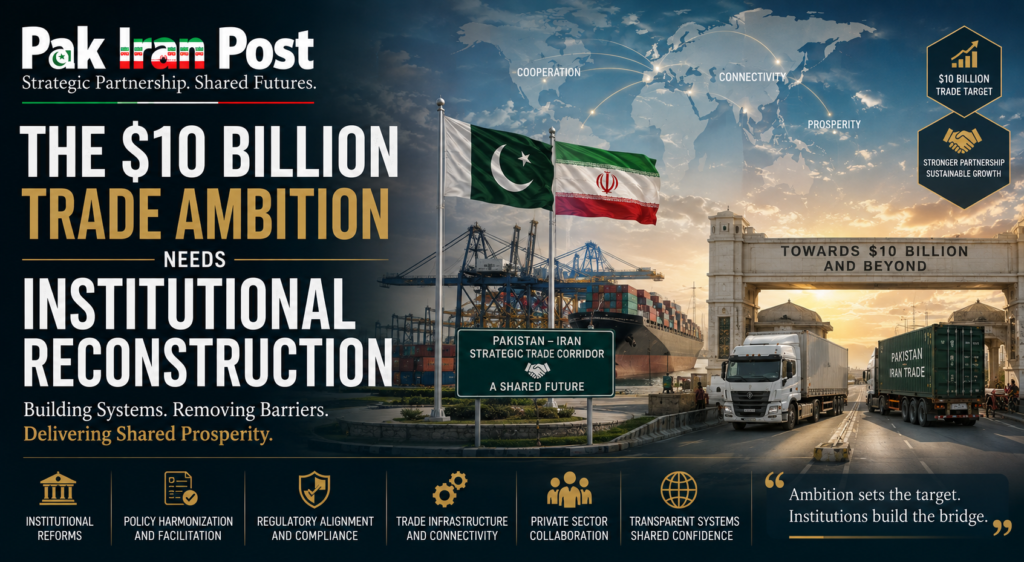
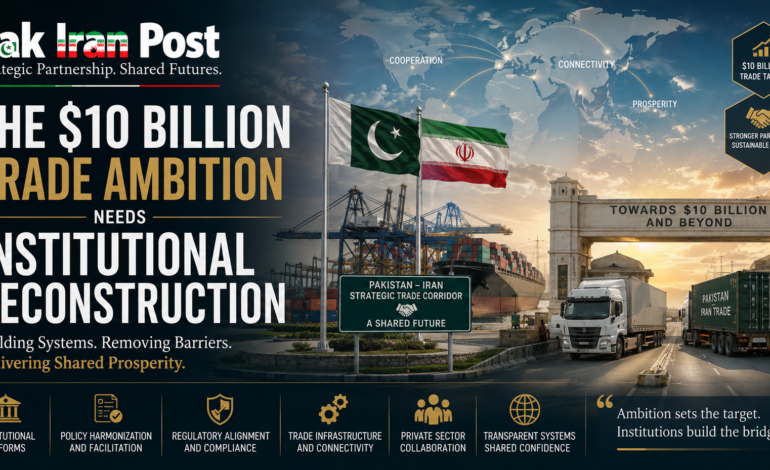
Pak Iran Post must treat the repeatedly invoked $10 billion bilateral trade ambition not as a rhetorical benchmark but as an institutional stress test of Pakistan’s capacity to convert geopolitical proximity into commercially bankable activity. The distance between political declarations and merchandise flows is not principally explained by weak demand on either side. It reflects a more consequential deficiency: Pakistan and Iran have never constructed a sufficiently predictable commercial architecture capable of surviving sanctions exposure, currency constraints, bureaucratic discretion, border insecurity, fragmented customs administration and abrupt regulatory intervention. The result is an asymmetrical commercial relationship in which substantial economic interaction exists, but a considerable proportion of it remains informal, under documented, geographically concentrated and vulnerable to enforcement shocks. For Pakistan’s strategic community, this distinction matters. A trade target becomes meaningful only when the state can identify which sectors will generate the additional exports, which payment mechanisms will settle them, which border facilities will process them, which institutions will supervise them and which contingency arrangements will protect legitimate commerce when political or security conditions deteriorate.
The central misconception surrounding Pakistan Iran trade is that geography automatically creates economic integration. It does not. A common frontier lowers physical distance but does not eliminate transaction costs. Pakistani exporters confront a commercial environment in which formal banking channels are severely constrained, direct financial relationships with Iranian counterparts carry compliance complications, currency convertibility remains problematic and international sanctions can impose secondary risks on banks, insurers, freight operators and larger corporations. Consequently, the commercial incentive often migrates towards cash settlement, third country intermediaries, informal exchange arrangements and undocumented border transactions. Such mechanisms may preserve trade volumes during periods of institutional paralysis, but they cannot support the scale, traceability or corporate participation required for a $10 billion relationship.
The policy question therefore needs to be reframed. Pakistan should not ask merely how much trade it can conduct with Iran. It should determine how much bilateral commerce can be brought inside a transparent, lawful and administratively resilient framework without creating unacceptable sanctions, financial or security exposure. That requires a calibrated architecture rather than an indiscriminate liberalisation programme. The objective should be formalisation where feasible, controlled exceptions where necessary and strategic redundancy where formal channels remain unavailable.
Customs reform is the first operational bottleneck. Pakistan’s border trade remains burdened by documentary requirements, inconsistent classification, inspection delays, valuation disputes and insufficient integration between customs, immigration, security and trade facilitation systems. These frictions have a disproportionate effect on perishable commodities and small exporters. A truck carrying agricultural produce cannot economically tolerate the same procedural architecture designed for a containerised industrial shipment. Pakistan should establish a dedicated Pakistan Iran Border Trade Protocol under which risk based customs clearance, pre arrival electronic documentation, trusted trader accreditation and digital cargo manifests become standard procedures. Customs authorities should create a joint risk matrix identifying low risk consignments eligible for expedited clearance while concentrating physical inspection capacity on anomalous shipments.
The Taftan and Gabd Rimdan corridors should not remain treated simply as crossing points. They should be developed as controlled commercial ecosystems with integrated customs facilities, bonded logistics capacity, cold storage, quarantine services, laboratories, banking compatible payment facilities and secure truck staging areas. Border infrastructure without institutional synchronisation merely transfers congestion from one department to another. A genuinely functional border economic system requires customs, commerce, agriculture, food safety, quarantine, law enforcement and provincial authorities to operate from interoperable databases and common operating procedures.
The second constraint is monetary. Bilateral trade cannot achieve industrial scale if exporters are uncertain about how invoices will be denominated, how receivables will be settled and how banks will interpret compliance obligations. Pakistan therefore needs a ring fenced settlement architecture designed specifically for permissible bilateral trade. This should not be confused with an attempt to evade sanctions. Any mechanism must be constructed around transactions demonstrably permitted under applicable domestic and international legal frameworks, with participating banks, regulators and authorised traders operating under enhanced due diligence. Where conventional correspondent banking remains unavailable, policymakers should examine legally defensible clearing arrangements, controlled currency accounts, barter compatible trade structures and carefully regulated countertrade mechanisms for eligible commodities.
The State Bank of Pakistan should publish a consolidated compliance framework explaining what categories of Pakistan Iran trade can be processed through authorised channels, what documentation banks require and which activities remain prohibited or exposed to sanctions risk. Regulatory ambiguity itself is an economic tax. When banks cannot distinguish between lawful commerce and transactions carrying unacceptable exposure, the rational institutional response is often to reject the entire category. A clearly defined compliance taxonomy would reduce unnecessary de risking while preserving regulatory discipline.
The third obstacle is the structure of the trade basket. Pakistan has too often approached Iran as a neighbouring market rather than as a differentiated demand centre. The result is episodic export activity rather than sectoral strategy. Agriculture provides the most immediate opportunity because of geographic proximity and complementary seasonal cycles. Rice, fruits, vegetables, meat and selected processed food products can potentially expand, but the opportunity is conditional on phytosanitary certification, cold chain infrastructure, predictable customs clearance and commercially viable transport. Pakistan should establish product specific export protocols rather than generic trade targets. For each priority agricultural commodity, the Ministry of Commerce should determine Iranian demand, seasonal windows, permissible standards, logistics costs, border processing time and the minimum transaction volume required for exporters to remain profitable.
Food processing offers a more sophisticated opportunity. Instead of exporting only raw agricultural commodities, Pakistani firms should be encouraged to supply packaged foods, fruit concentrates, spices, confectionery, processed pulses and shelf stable products. Iranian market access will depend heavily on labelling, quality certification and consumer positioning. The state should therefore support accredited testing and certification facilities near major western border commercial centres, allowing exporters to resolve compliance issues before consignments reach the frontier.
Pharmaceuticals represent another underdeveloped segment. Pakistan possesses a sizeable domestic pharmaceutical manufacturing base, yet market penetration in Iran is constrained by registration procedures, payment difficulties, regulatory recognition and the need for reliable distribution partners. The objective should not be a broad pharmaceutical push. It should begin with a defined list of off patent generic medicines, basic healthcare products and formulations for which Pakistani manufacturers can demonstrate international quality standards and competitive pricing. A bilateral regulatory dialogue could establish procedures for recognition of manufacturing documentation and accelerated registration of selected products, subject to Iranian requirements. This would convert pharmaceutical exports from opportunistic sales into a structured industrial category.
Textiles require a different strategy. Pakistan is globally competitive in cotton based products, home textiles and garments, but Iran’s market is subject to domestic industrial policy, import controls and foreign exchange limitations. Pakistani firms should therefore target specialised segments where quality, design or price offers a clear advantage rather than pursuing indiscriminate volume. Yarn, grey fabric, finished textiles, towels, bed linen and selected ready made garments could form differentiated export clusters. Pakistani trade missions should conduct firm level market intelligence rather than relying on aggregate trade statistics, identifying Iranian wholesalers, industrial buyers and retail distributors with verifiable payment capacity.
Engineering goods offer greater long term potential but require deeper commercial preparation. Agricultural machinery, pumps, electrical equipment, transformers, construction inputs, automotive components and selected industrial machinery could exploit geographical proximity if Pakistan can offer after sales service and spare parts. The weakness is not necessarily manufacturing capability. It is the absence of an integrated export proposition. An Iranian buyer purchasing machinery needs installation, maintenance, warranty support and dependable replacement components. Pakistan should therefore establish sector specific distributor networks and service partnerships rather than measuring success solely through shipment values.
Energy related commerce requires the greatest strategic caution. Iran’s geographic proximity makes energy cooperation economically attractive, particularly for Pakistan’s western districts, but the sector is also the most exposed to sanctions, payment and infrastructure constraints. Electricity imports, petroleum related trade and other energy arrangements should therefore be managed through legally reviewed, state supervised frameworks with transparent pricing, metering, settlement and contingency provisions. Pakistan cannot build strategic economic resilience by creating an energy dependency that becomes unusable during a sanctions shock or diplomatic crisis. Every expansion of Iranian energy imports should be accompanied by an emergency substitution assessment specifying alternative supply sources, storage requirements, transmission redundancy and fiscal implications.
Informal trade presents a paradox. It is simultaneously an economic lifeline and an institutional liability. Border populations depend upon commerce that often exists outside formal documentation, while the state loses customs revenue, accurate trade intelligence and regulatory control. Attempting to eliminate such commerce through enforcement alone would merely displace it into more opaque channels. Pakistan needs a graduated formalisation regime. Small traders should receive simplified registration, low value digital documentation and predictable tariff treatment, while commercial operators above defined thresholds should enter conventional customs and tax regimes. Border markets should be governed through transparent licensing, designated product lists, electronic invoicing and transaction ceilings. The aim should be to move commerce gradually from undocumented exchange towards traceable trade rather than criminalising the economic ecosystem on which border communities depend.
Transport economics deserves equal attention. A theoretically competitive Pakistani product can become commercially unviable once freight, security escorts, border waiting time, informal costs and return cargo inefficiencies are incorporated. Pakistan should establish a bilateral logistics cost observatory that measures the full transaction cycle from factory gate to Iranian destination. The data should identify precisely where time and money are being lost. Truck turnaround time, inspection duration, demurrage, empty return ratios, road conditions and security costs should become measurable performance indicators. Without such data, policy remains declaratory.
The $10 billion target also requires an export financing mechanism. Pakistani small and medium sized enterprises cannot assume the compliance and financial risks associated with cross border commerce without institutional support. Export credit insurance, working capital facilities and transaction advisory services should be made available for eligible Iran facing exporters under enhanced risk controls. The government should also establish a dedicated Iran Trade Risk Desk involving the Ministry of Commerce, State Bank, Federal Board of Revenue, relevant security agencies and export promotion institutions. Its mandate should be practical: resolve compliance questions, identify emerging restrictions, monitor payment bottlenecks and prevent legitimate firms from being paralysed by regulatory uncertainty.
For the security establishment, formal trade is not merely an economic objective. It is an instrument of border governance. A predictable commercial economy can reduce incentives for illicit markets, provide lawful income to frontier communities and generate transaction data useful for identifying anomalous financial and logistical activity. But this advantage will emerge only if trade formalisation and security architecture are designed together. Customs data, vehicle registration, trader identities, cargo manifests and immigration records should be interoperable within legally governed intelligence systems. The objective should be risk detection, not indiscriminate surveillance of border populations.
Pakistan also needs a mechanism for managing diplomatic shocks. Trade agreements that function only when bilateral relations are calm are not resilient agreements. A Pakistan Iran commercial continuity protocol should define procedures for maintaining essential food, medicine and electricity trade during temporary political disruptions, subject to applicable law. Emergency contact points, customs continuity arrangements, payment escalation channels and protected humanitarian categories should be agreed in advance. This would prevent every bilateral crisis from automatically becoming a commercial crisis.
The institutional architecture should ultimately be measured against deliverables rather than declarations. Pakistan should establish a five year trade expansion matrix with annual targets for agricultural exports, processed foods, pharmaceuticals, textiles, engineering products and permissible energy commerce. Each sector should have an identified export value, number of participating firms, border clearance benchmark, payment mechanism, market access requirement and responsible government institution. A bilateral trade target without institutional ownership is merely an aspiration. A target attached to measurable indicators becomes policy.
The $10 billion ambition is therefore neither inherently unrealistic nor automatically achievable. Its feasibility depends upon whether Pakistan can replace fragmented border commerce with a governed commercial system. The country does not need another ceremonial trade agreement followed by an implementation committee that meets intermittently. It needs an operational architecture capable of surviving bureaucratic turnover, financial restrictions, security incidents and political volatility.
For Pak Iran Post, the strategic conclusion is unambiguous. Pakistan should pursue economic engagement with Iran through controlled formalisation, sectoral prioritisation and legally defensible financial mechanisms rather than headline driven trade diplomacy. Agricultural and processed food exports can deliver early gains. Pharmaceuticals and textiles can create scalable commercial depth. Engineering goods can provide longer term industrial value. Energy cooperation can strengthen western economic resilience only when accompanied by sanctions compliance and substitution capacity. Border markets can become stabilising institutions if they are regulated rather than neglected. Customs can become a trade accelerator if risk management replaces blanket inspection. Banking constraints can be mitigated if regulators provide clarity instead of leaving commercial institutions to interpret uncertainty independently.
The real challenge is not reaching $10 billion on paper. It is constructing enough institutional reliability for a Pakistani exporter to believe that an order placed in Iran today can still be paid for, transported, cleared and delivered months later without becoming hostage to an unpredictable administrative or geopolitical event. Until that confidence exists, Pakistan Iran trade will remain larger in political imagination than in formal economic reality. The strategic task is to reverse that equation.
A Public Service Message.