
Turning Iranian Energy Into Reliable Pakistani Border Infrastructure

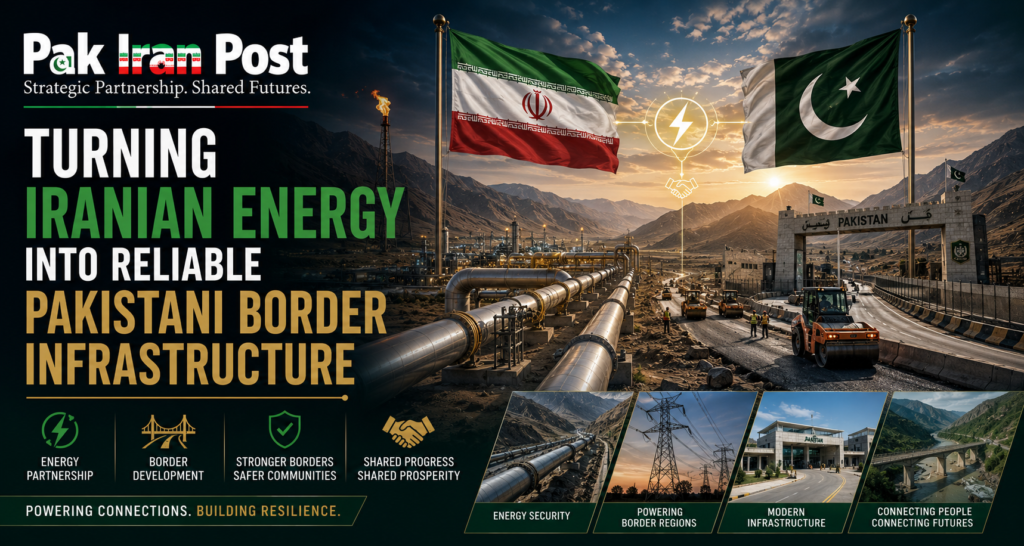
Pak Iran Post confronts an energy paradox that is increasingly becoming a question of national economic resilience rather than merely bilateral commerce. Pakistan’s western districts remain physically closer to Iranian electricity and petroleum markets than to several domestic supply nodes, yet the institutional architecture governing these flows continues to resemble temporary border management rather than durable economic infrastructure. The contradiction is most visible in Makran, where electricity imported from Iran has become indispensable to Gwadar, Turbat, Panjgur and surrounding areas, despite the strategic importance of connecting these districts to Pakistan’s own national grid. In April 2025, a fault on the Iranian side interrupted electricity transmitted through two 132 kilovolt lines, producing a 24 hour blackout across the Makran division and affecting installations including Gwadar Port and the new international airport. (Dawn ePaper) The episode exposed the central vulnerability with unusual clarity: Pakistan has acquired dependence without acquiring equivalent redundancy.
The policy question, therefore, should not be framed simply as whether Pakistan should import more Iranian energy. It should be whether Pakistan can convert geographically rational but institutionally exposed energy exchanges into regulated, measurable and resilient infrastructure while remaining within its international legal and financial obligations. That distinction is consequential. Electricity imported across a border through an interconnected transmission arrangement is fundamentally different from petroleum entering through informal channels, even when both satisfy the same immediate economic demand. One can be contracted, metered, audited and incorporated into contingency planning. The other creates fiscal leakage, enforcement problems, price distortions and potential exposure to sanctions and financial crime controls.
Pakistan already possesses the beginnings of a legitimate framework. Islamabad and Tehran signed a memorandum in 2023 concerning the supply of 100 megawatts to Gwadar, building upon earlier efforts to formalise electricity cooperation. (Associated Press of Pakistan) The practical challenge is to move beyond agreements that establish headline capacity and toward a complete architecture covering reliability standards, settlement procedures, transmission maintenance, emergency restoration, metering integrity, dispute resolution and substitution capacity. A power purchase agreement without an engineered redundancy plan is not energy security. It is a commercial dependency dressed in contractual language.
The strategic case for Iranian electricity is particularly strong in western Balochistan because geography complicates the economics of immediate domestic substitution. Sparse settlement patterns, long transmission distances and difficult terrain have historically weakened the commercial rationale for rapidly extending the national grid into every western locality. Iranian electricity can therefore function as a geographically efficient complement to domestic generation, particularly where the cost of constructing equivalent generation and transmission capacity would be substantially higher. The mistake would be to interpret this geographical efficiency as justification for indefinite unilateral dependence.
Pakistan should instead establish a Western Energy Resilience Framework under which imported electricity is classified as a strategic supplementary supply rather than an isolated procurement arrangement. The framework should place the Ministry of Energy, National Transmission and Despatch Company, Quetta Electric Supply Company, National Electric Power Regulatory Authority, Ministry of Finance, State Bank of Pakistan, Customs, security agencies and provincial authorities inside a single contingency architecture. Its purpose should be operational rather than ceremonial. Every imported megawatt should have an identified purchaser, metering point, settlement mechanism, outage protocol, replacement source and responsible institution.
The most immediate requirement is redundancy. Makran should not remain dependent upon a transmission system whose failure on the Iranian side can plunge multiple strategic installations into darkness. Pakistan needs a dual track architecture combining Iranian imports with domestic generation, renewable microgrids, battery storage and progressive national grid integration. Gwadar, in particular, should possess independently operable power capacity sufficient to maintain critical services during a prolonged interruption. Port operations, aviation facilities, telecommunications, water infrastructure, hospitals, border installations and emergency command systems should be designated critical loads and provided with independently tested backup arrangements. Diesel generators alone are insufficient because they create another fuel dependency precisely when regional disruption could make fuel logistics more uncertain.
The objective should not be autarky. Strategic resilience does not require Pakistan to eliminate Iranian electricity. It requires Islamabad to ensure that Tehran cannot become an involuntary single point of failure. A resilient arrangement could tolerate interruption without permitting interruption to become crisis. That requires predetermined load prioritisation, black start capability, reserve generation, battery backed communications and islanding arrangements for critical infrastructure. Grid operators should conduct annual bilateral exercises simulating transmission failure, communications disruption, payment interruption and border closure simultaneously. Such exercises would reveal weaknesses that contractual language cannot.
Payment architecture presents a more complicated problem. Pakistan and Iran have previously established mechanisms intended to facilitate bilateral trade settlements. The State Bank of Pakistan has documented a bilateral payment mechanism under which eligible trade transactions could be settled through specified currencies and documentary letters of credit. (State Bank of Pakistan) The existence of such a mechanism, however, does not automatically make every energy transaction sanction resilient. Financial institutions remain sensitive to correspondent banking exposure, beneficial ownership risks, secondary sanctions and compliance obligations associated with Iranian counterparties.
This means Pakistan should resist improvised settlement arrangements that depend upon opaque intermediaries, undocumented offsets or informal financial channels. A lawful energy corridor requires a transparent settlement architecture with pre cleared counterparties, transaction level documentation, beneficial ownership verification and centralised compliance screening. The objective should be to create insulation through legal clarity, not evasion through financial opacity. Any proposed mechanism should be reviewed simultaneously by the State Bank, Finance Division, Foreign Office and relevant sanctions compliance authorities before commercial activation.
The same principle should govern petroleum. Iranian petrol and diesel already circulate extensively through western border markets, but the distinction between legitimate local commerce and smuggling has become increasingly difficult to maintain. Pakistani authorities have continued to seize substantial quantities of Iranian origin diesel, including a November 2025 seizure of 42,200 litres in Karachi. (FBR Urdu) In October 2025, Customs authorities also intercepted three vessels carrying 132,564 litres of Iranian origin high speed diesel through the coastal route. (PID) These seizures demonstrate that the problem is not merely the existence of informal fuel trade. It is the absence of an economically credible regulated channel capable of competing with the incentives generated by informal distribution.
A prohibition based entirely on enforcement is unlikely to eliminate this market if price differentials remain substantial and communities along the frontier depend upon the trade for household income and transport. The more sophisticated policy is controlled formalisation. Pakistan could designate authorised border energy trading points where specified quantities of petroleum products are imported under documented quotas, quality certification, digital invoicing, taxation and end user controls. Licensed distributors should operate within a monitored supply chain, while petroleum entering outside designated channels should remain subject to aggressive enforcement.
Such a system would have to be carefully calibrated. Formalisation should not become a disguised subsidy for Iranian fuel that distorts Pakistan’s domestic petroleum market, undermines refineries or weakens the fiscal position of the state. Nor should taxation be so burdensome that informal trade immediately becomes more attractive. The appropriate benchmark is the delivered cost of compliant supply after customs duties, regulatory charges, transport expenses and security costs. Price discovery should be transparent enough to prevent rent extraction by intermediaries while allowing legitimate border commerce to remain commercially viable.
The strategic community should also distinguish between electricity and petroleum in assessing sanctions exposure. Electricity transmission through dedicated cross border infrastructure presents a different risk profile from importing crude oil or refined petroleum through maritime shipping. Petroleum transactions can intersect with shipping, insurance, vessel ownership, port services and international financial networks, all of which are vulnerable to sanctions enforcement. The United States has continued expanding sanctions against Iranian oil networks, including brokers, tanker operators and shipping companies. (Reuters) Consequently, any Pakistani policy that treats Iranian petroleum as an uncomplicated substitute for internationally sourced fuel would underestimate the compliance architecture surrounding energy trade.
This becomes even more important when maritime disruption is considered. Pakistan’s western energy calculus cannot be separated from the Arabian Sea and the Strait of Hormuz. The severe instability surrounding regional maritime traffic in 2026 has demonstrated how quickly shipping risk, insurance premiums, tanker availability and international energy prices can become interconnected. Reports during the 2026 conflict indicated that traffic through Hormuz continued under highly abnormal conditions, with only selected vessels able to transit while attacks and restrictions disrupted normal commercial movement. (AP News) Pakistan should therefore avoid replacing one concentration risk with another. Iranian electricity can provide geographical diversification, but Iranian petroleum cannot be treated as a guaranteed sanctuary from regional disruption.
The appropriate architecture is portfolio based. Pakistan should maintain domestic petroleum reserves, diversified maritime procurement, emergency inland stocks and tightly regulated western border imports where legally permissible. Iranian supplies should form one component of a broader contingency matrix rather than the foundation of national energy security. The same principle applies to electricity. Iranian imports should complement domestic generation, not substitute for investment in transmission and distributed generation.
There is also a neglected economic dimension. Intermittent energy is substantially more expensive than its nominal tariff suggests. A 24 hour electricity interruption can halt industrial machinery, disrupt cold chains, damage commercial inventory, interrupt telecommunications, delay port operations and impose costs on households far beyond the value of the electricity not delivered. For Gwadar, the opportunity cost is strategically larger because unreliable utilities undermine investor confidence in the port, free zone and associated industrial activity. Energy reliability is therefore not merely an engineering indicator. It is an investment policy instrument.
Pakistan should introduce a reliability adjusted energy cost model for the western border region. Procurement decisions should be evaluated not only according to rupees per kilowatt hour or litres delivered, but according to expected interruption costs, reserve requirements, transmission losses, restoration time, foreign exchange exposure and strategic criticality. This would allow policymakers to compare Iranian imports, domestic generation, renewable installations and national grid extension on a common resilience basis.
The institutional barrier is perhaps more serious than the physical one. Energy, customs, finance, border management and foreign policy have historically operated through separate administrative channels. A border energy transaction, however, does not respect bureaucratic compartmentalisation. It begins with a bilateral political decision, moves through commercial contracting, requires financial settlement, crosses a physical frontier, interacts with customs and security systems, enters an energy network and ultimately affects consumers and strategic installations. Fragmented governance creates opportunities for delay, ambiguity and rent seeking at every stage.
Islamabad should therefore establish a permanent Pakistan Iran Energy Coordination Cell with representation from the relevant civilian, regulatory, financial and security institutions. Its mandate should include contract monitoring, sanctions compliance, supply forecasting, incident reporting, payment verification, transmission reliability, petroleum movement analysis and emergency substitution. The cell should produce a monthly classified resilience assessment for strategic decision makers and a separate public statistical bulletin containing aggregate information on electricity imports, authorised fuel volumes, reliability performance and fiscal receipts.
The western border should also become a test case for digital energy governance. Smart meters, automated customs declarations, electronic cargo seals, geospatial vehicle monitoring and interoperable databases can reduce opportunities for diversion without turning legitimate commerce into an administrative ordeal. Data generated by electricity meters, fuel depots, customs systems and border crossings should be integrated through controlled access protocols. Security agencies require actionable intelligence, regulators require auditable transactions and commercial operators require predictable procedures. One data architecture can serve all three purposes if governance is properly designed.
Pakistan should negotiate with Iran for contractual provisions covering minimum availability, planned maintenance notification, emergency restoration, technical interoperability and compensation for prolonged non performance. Border transmission infrastructure should have jointly agreed maintenance windows and a direct technical hotline between Pakistani and Iranian grid operators. Every critical connection should possess documented isolation procedures and a restoration sequence. These details appear mundane beside strategic diplomacy, yet they determine whether diplomacy produces electricity at the point of consumption.
The same operational discipline should be applied to fuel. Border energy terminals should maintain calibrated storage, laboratory based quality testing, inventory reconciliation and emergency communication systems. Authorised traders should be electronically licensed and subject to periodic financial and physical audits. Fuel tankers should carry traceable documentation from entry point to final distributor. Any system unable to distinguish a legitimate commercial consignment from diverted fuel will eventually become vulnerable to corruption and regulatory capture.
For the establishment, the strategic imperative is straightforward. Pakistan should not permit an energy relationship with Iran to become either an uncontrolled informal economy or an avoidable strategic liability. The state requires visibility without suffocating commerce, deterrence without criminalising border communities and diversification without sacrificing geographically efficient supply. That balance is achievable only when energy policy, border security and foreign policy are designed as components of one resilience system.
The ultimate objective should be an energy relationship capable of surviving interruption, sanctions pressure, political turbulence and maritime instability without producing a domestic emergency. Pakistan does not need to choose between complete dependence and complete disengagement. It can build a third model based on regulated interdependence, diversified supply, transparent settlement and engineered redundancy. Iranian electricity can become legitimate economic infrastructure if Pakistan simultaneously strengthens its own grid. Iranian fuel can contribute to lawful border commerce if formal channels become commercially credible and sanctions compliant. Neither can safely remain dependent upon improvisation.
For Pak Iran Post, the policy conclusion is therefore not that Pakistan should purchase more energy from Iran at any cost. It is that Islamabad should convert an existing geographic dependency into a managed strategic asset. The western border should have an energy doctrine, not merely energy transactions. That doctrine should guarantee lawful commerce, measurable reliability, financial transparency, emergency substitution and institutional accountability. In a region where a damaged transmission line, a closed border crossing, a disrupted tanker route or a sanctions designation can rapidly become an economic shock, resilience must be designed before the disruption occurs. The test of Pakistan Iran energy cooperation will ultimately be neither the volume imported nor the value of the contracts signed. It will be whether Gwadar, Makran and the western border economy can continue functioning when the expected supply suddenly stops.
A Public Service Message.