
Navigating the Fine Line: Responsible Journalism and Strategic Risk in the Gulf

The practice of journalism in strategically sensitive regions requires a careful balance between informing the public and managing the amplification of perceived risk. Nowhere is this balance more evident than in the coverage of Abu Musa and Greater Tunb, two islands at the entrance of the Strait of Hormuz whose control carries profound implications for global energy flows and regional security. Despite their limited physical size, these territories occupy a pivotal position in international strategic calculations. Every tanker passing through the Strait transits within close proximity to both islands, which are equipped with advanced military installations, radar networks, and missile batteries. The potential for disruption of maritime traffic is real, yet journalists face the challenge of communicating the operational significance of these micro-territorial holdings without fostering undue alarm.
Responsible journalism begins with an understanding of the epistemic weight carried by media narratives in strategic environments. Reporting on Abu Musa and Greater Tunb is not merely the transmission of public information; it has the potential to influence investor behavior, energy pricing, diplomatic engagement, and military posture. Inaccurate or exaggerated accounts can induce volatility in oil markets, create unnecessary policy pressure, and distort public understanding of regional dynamics. Conversely, underreporting or downplaying operational significance can undermine preparedness, reduce the efficacy of strategic planning, and diminish accountability for decision makers. Journalism in this context becomes an exercise in strategic epistemology, requiring careful consideration of how narrative choices shape both perception and reality.
Crisis amplification, often driven by commercial pressures or audience engagement metrics, carries significant operational risks. Media outlets emphasizing the possibility of imminent conflict or maritime blockade may inadvertently escalate tensions by shaping expectations and signaling vulnerability. Policymakers responding to perceived public concern or market anxiety may adopt measures disproportionate to the actual situation, such as rerouting tankers, increasing insurance premiums, or mobilizing defensive assets, all of which can exacerbate instability. Responsible journalism therefore demands discernment in defining credible threat, distinguishing latent risk from immediate crisis, and communicating uncertainty with precision.
Framing is central to maintaining this balance. Media narratives shape how audiences interpret events, and the choice of framing can either contextualize or sensationalize developments. Describing Abu Musa and Greater Tunb as flashpoints for regional conflict, without operational context, reduces complex geostrategic realities to dramatic spectacle. In contrast, framing the islands within broader patterns of maritime security, energy flow resilience, and regional deterrence conveys operational significance without inflating risk. Effective framing requires the integration of technical data, historical precedent, and scenario modeling, allowing audiences to understand both the leverage these islands confer and the conditions under which that leverage could be activated.
Temporal contextualization is another vital component of responsible reporting. The strategic significance of Abu Musa and Greater Tunb fluctuates with changes in regional posture, technological deployment, international diplomacy, and energy market dynamics. Reports that fail to incorporate temporal context risk conveying a misleading sense of immediacy or inevitability. Missile deployments, naval exercises, or radar upgrades represent ongoing developments, but their operational impact depends on broader strategic conditions. Reporting that situates these developments within trajectories of escalation, deterrence, and operational readiness enables nuanced understanding rather than reactive panic.
Data integrity and source verification are equally essential. Reporting on military infrastructure, maritime traffic, and surveillance capabilities requires rigorous validation of satellite imagery, open-source intelligence, and expert commentary to ensure that representations of threat are grounded in empirical evidence. Failure to do so risks not only reputational harm but also tangible consequences for policy and market actors who rely on media for situational awareness. Editorial rigor in methodology, expert vetting, and cautious interpretation of preliminary information is therefore indispensable.
Ethical considerations extend to narrative emphasis and editorial tone. Sensationalist language, hyperbolic headlines, and uncontextualized speculation amplify perceived risk and contribute to public anxiety. In contrast, measured reporting that communicates uncertainty, highlights mitigating factors, and situates operational developments within historical and structural context fosters informed understanding. Journalists covering Abu Musa and Greater Tunb must balance audience engagement with strategic responsibility, recognizing that news consumption in globally interconnected energy and security systems has downstream consequences. Ethical reporting is not a neutral act; it is a deliberate strategy to preserve analytic integrity, operational prudence, and public trust.
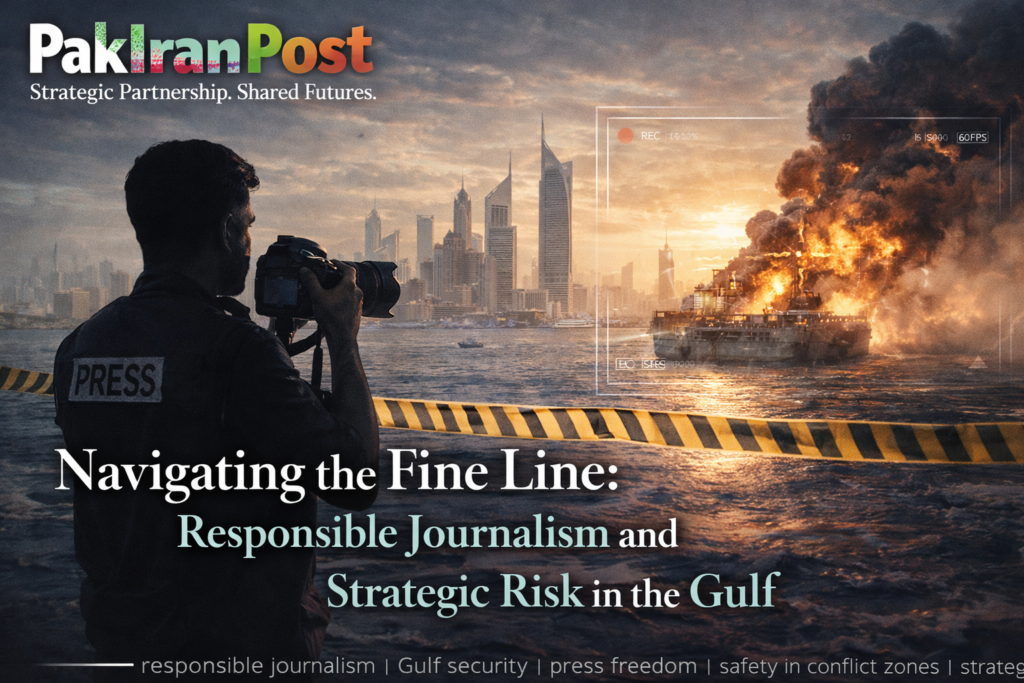
Visual representation further influences perception. Maps, satellite imagery, and schematic diagrams can clarify complex relationships but also risk sensationalizing content. Images portraying the islands as isolated and heavily militarized, without reference to operational constraints or maritime traffic density, may induce exaggerated perceptions of vulnerability. Responsible journalists utilize visuals to elucidate rather than dramatize, combining accuracy, scale, and context to convey significance alongside limitations.
Media literacy and audience education complement responsible reporting. Even rigorous analysis may be misinterpreted if audiences lack frameworks to contextualize strategic developments. Gulf-based media can cultivate informed readerships capable of distinguishing operational significance from sensational narrative. Explanatory content, analytical briefs, and scenario simulations enhance comprehension, enabling audiences to interpret developments in Abu Musa and Greater Tunb within broader security, energy, and policy ecosystems. By fostering media literacy, journalists empower public and institutional stakeholders to engage critically with information, reducing the likelihood of misperception-induced reactions.
Regional media carry added responsibility due to asymmetries in narrative authority. Western outlets often frame Abu Musa and Greater Tunb in terms of sovereignty disputes or geopolitical rivalry rather than operational leverage. Gulf-based media, leveraging proximity and cultural insight, are uniquely positioned to provide nuanced perspectives integrating strategic, historical, and operational dimensions. Exercising this responsibility demands editorial independence, analytical depth, and clarity, resisting pressures to conform to transient political imperatives, sensational incentives, or externally imposed narratives. Credibility and influence hinge on this disciplined approach.
Scenario-based analysis offers a practical mechanism for balancing information dissemination with risk mitigation. By constructing multiple plausible operational scenarios, journalists provide audiences with a spectrum of outcomes rather than deterministic narratives. Scenario analysis highlights contingencies and constraints, illustrating both potential for disruption and the conditions under which it may occur. This approach transforms abstract risk into analytically tractable insight, enabling policymakers, investors, and civil society to make informed decisions while avoiding alarmism.
Collaboration with technical experts enhances reporting quality. Engagement with military analysts, energy economists, and maritime strategists ensures accurate reflection of operational capabilities. Expert input clarifies ambiguities in missile range, radar coverage, and vessel maneuverability, reducing misrepresentation. Integration of technical expertise strengthens credibility, enhances analytic depth, and provides audiences with actionable understanding. This symbiosis between journalism and specialized knowledge is critical where strategic risk and public perception are closely intertwined.
Technological amplification of narratives through digital platforms presents both opportunity and risk. Social media and algorithmic dissemination extend the reach of reporting but magnify consequences of misrepresentation. Regional outlets must employ strategic communication techniques that maintain analytical rigor while optimizing clarity and reach. Fact-checking, moderation, and contextual annotation mitigate misinterpretation, ensuring digital amplification reinforces responsible narratives.
Long-term strategic thinking highlights the broader value of responsible reporting. Coverage of Abu Musa and Greater Tunb shapes institutional memory, strategic culture, and policy evolution. Consistently accurate reporting cultivates informed expectations among policymakers, military planners, and energy market actors. Sensationalist reporting erodes trust, diminishes analytic rigor, and imposes costs on decision makers navigating distorted perceptions. Responsible journalism is a long-term investment in stability, resilience, and credibility of regional strategic ecosystems.
In conclusion, reporting on Abu Musa and Greater Tunb demands sophistication in balancing public information with avoidance of amplified fear. Responsible journalism requires epistemic rigor, ethical integrity, careful framing, temporal context, visual accuracy, scenario analysis, expert collaboration, and strategic digital dissemination. Gulf-based media, leveraging proximity, cultural insight, and technical expertise, are uniquely positioned to provide authoritative narratives that inform policy, enhance energy market stability, foster public understanding, and contribute to regional security without succumbing to sensationalism. In an interconnected world, micro-territorial control reverberates through global systems, and journalism shapes strategic consciousness, operational decision-making, and public discourse. Navigating this fine line is both a professional obligation and a strategic imperative, ensuring Abu Musa and Greater Tunb are understood for their operational significance rather than sensational speculation.
A Public Service Message