Economic Interdependence versus Strategic Divergence

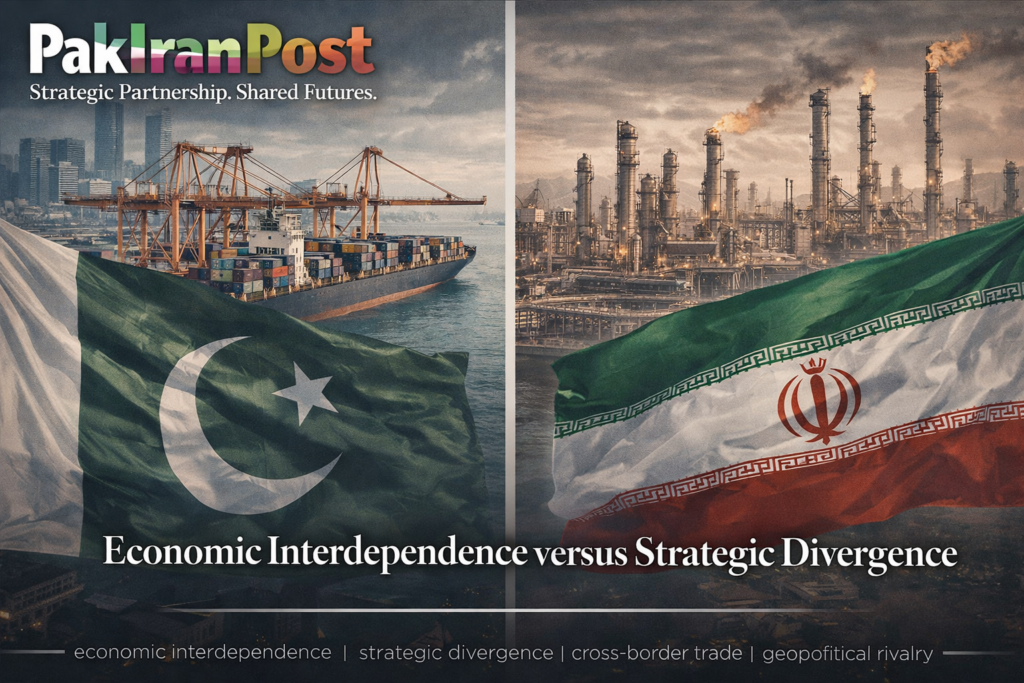
Pakistan occupies a central position in South Asia and the Gulf region where economic imperatives, energy dependencies, and strategic alliances converge. Its economic stability is closely tied to the policies and actions of neighboring powers, particularly Saudi Arabia and Iran. These relationships encompass multiple dimensions, including trade, energy, investment, labor migration, and security cooperation. At the same time, the strategic priorities of Riyadh and Tehran diverge in ways that create structural challenges for Pakistan. While the kingdom of Saudi Arabia emphasizes Gulf security, alliance coherence, and the protection of its energy infrastructure, Iran prioritizes regional influence, border stability, and resilience under sanctions. Pakistan must navigate these sometimes-competing priorities, ensuring that economic interdependence does not compromise its strategic autonomy, and that security obligations do not undermine the benefits of trade and energy cooperation.
The economic relationship with Saudi Arabia is central to Pakistan’s fiscal stability. Saudi Arabia provides significant deposits in Pakistan’s central bank, supports energy supply agreements, and facilitates investment in infrastructure and industrial projects. These contributions are vital for sustaining Pakistan’s balance of payments, stabilizing domestic currency fluctuations, and supporting industrial and agricultural sectors. Beyond immediate fiscal support, Saudi investments and energy arrangements contribute to long-term economic planning, allowing Pakistan to develop projects in power generation, petrochemicals, and transport infrastructure. At the same time, these arrangements carry implicit strategic expectations. Saudi Arabia views Pakistan as a regional partner capable of supporting Gulf security objectives, providing personnel and expertise in military cooperation, and maintaining alignment in diplomatic engagements. This dynamic introduces a subtle tension between economic reliance and strategic obligation, requiring Pakistan to carefully manage its commitments to ensure that economic gains do not translate into compromised policy independence.
Iran represents a complementary yet distinct set of economic interests. Trade between Pakistan and Iran encompasses essential goods, energy supplies, and border commerce that sustains local economies in Pakistan’s western provinces. Iran’s energy exports, particularly natural gas, are vital for power generation and industrial use in Pakistan. Additionally, Iran provides transit routes and trade corridors that connect Pakistan to Central Asia and beyond, offering potential avenues for economic diversification and regional integration. These economic ties are influenced by geopolitical pressures, including sanctions imposed by international actors and the regional competition with Saudi Arabia. Navigating this environment requires Pakistan to maintain diplomatic sensitivity, ensure compliance with international obligations, and manage cross-border security while safeguarding economic flows. The result is a delicate balancing act in which Pakistan must align itself sufficiently with Iranian economic needs while avoiding actions that could provoke Saudi disapproval or jeopardize its Gulf-based economic lifelines.
Labor migration and remittances constitute another dimension of Pakistan’s economic interdependence. Large numbers of Pakistani workers are employed in Saudi Arabia, contributing to household incomes and national foreign exchange reserves. Remittances from these workers support domestic consumption, investment in housing, and small business development. Any disruption in labor flows due to diplomatic tensions or strategic realignments could have immediate consequences for Pakistan’s economy. Similarly, Iran engages Pakistani labor for border projects, trade facilitation, and infrastructure development. While the scale of Iranian engagement is smaller compared to Saudi Arabia, it remains important for local economies along the western frontier. Pakistan’s strategy must therefore consider both the scale and sensitivity of labor dependencies, balancing the needs of domestic economic stability with regional strategic obligations.
Trade, investment, and energy cooperation intersect with Pakistan’s broader security concerns. Pakistan’s security obligations toward Saudi Arabia, including defense partnerships and military cooperation, create expectations for alignment in Gulf conflicts and regional strategic initiatives. At the same time, security stability along the Pakistan-Iran border is essential to prevent spillover from proxy conflicts, smuggling, and militant activity. Pakistan must ensure that economic cooperation with Iran does not compromise its national security or its strategic partnerships. Conversely, economic reliance on Saudi Arabia should not dictate Pakistan’s security posture in ways that provoke instability on its western borders. Managing this duality requires sophisticated policy coordination, intelligence integration, and strategic foresight, ensuring that economic interdependence and strategic obligations complement rather than contradict one another.
Technological infrastructure plays a supporting role in balancing these economic and strategic imperatives. Pakistan has invested in energy infrastructure, border monitoring, and financial technology to ensure continuity of trade, secure supply chains, and accurate fiscal planning. Digital monitoring of energy flows, cross-border transactions, and remittance channels enhances the country’s capacity to anticipate disruptions and respond proactively. Technological tools also enable Pakistan to coordinate with both Saudi and Iranian authorities, providing transparency, efficiency, and accountability in joint economic and security projects. These measures create a foundation for managing the inherent tensions between economic interdependence and strategic divergence.
The divergence of strategic objectives between Saudi Arabia and Iran manifests in multiple arenas, including defense policy, regional influence, and engagement with non-state actors. Saudi Arabia emphasizes cohesive Gulf security, countering Iranian influence in regional conflicts, and preserving leadership within Islamic and Arab institutions. Iran, by contrast, focuses on regional autonomy, resilience under sanctions, and leveraging influence through border regions, trade corridors, and technological adaptation. Pakistan’s challenge is to reconcile these differences where possible while preserving economic stability. This requires nuanced diplomacy, careful policy design, and strategic prioritization. Pakistan cannot fully align with one side without risking adverse consequences from the other, making the careful management of both economic and strategic relationships essential.
Domestic economic planning is directly influenced by these regional dynamics. Energy security, industrial growth, and fiscal stability depend on consistent access to Saudi oil and financial support, as well as reliable imports and trade with Iran. Disruptions to either of these relationships could exacerbate inflation, strain public finances, and undermine industrial productivity. Conversely, strategic alignment that alienates one partner could limit investment, trade, or labor mobility, with direct consequences for employment and national economic resilience. Pakistan’s policymaking must integrate these considerations, ensuring that economic planning, foreign policy, and security strategy operate in a mutually reinforcing framework.
The human dimension of economic interdependence and strategic divergence is significant. Populations in border regions, urban centers, and industrial zones are directly affected by shifts in trade, energy availability, and investment flows. Pakistan’s policies must address social stability, equitable distribution of resources, and protection of livelihoods to prevent domestic unrest and maintain confidence in national governance. Economic initiatives, whether energy projects, trade facilitation, or infrastructure development, must be implemented in ways that provide tangible benefits to local populations while reinforcing national strategic priorities. Engaging civil society, business communities, and regional stakeholders is essential to creating inclusive economic strategies that complement diplomatic mediation and security management.
Multilateral frameworks provide additional avenues for managing economic interdependence and strategic divergence. Regional organizations, trade agreements, and security cooperation mechanisms enable Pakistan to structure its engagement with both Saudi Arabia and Iran in ways that reduce risk and enhance predictability. Institutional participation allows Pakistan to leverage third-party support, ensure transparency, and create mechanisms for dispute resolution that are recognized by multiple stakeholders. This reduces the likelihood of unilateral pressures dictating policy outcomes and reinforces Pakistan’s capacity to act as an autonomous and credible partner in regional economic and security arrangements.
Strategically, Pakistan’s balancing act has long-term implications for its national development and regional influence. By maintaining equilibrium between competing interests, Pakistan enhances its sovereignty, preserves critical economic lifelines, and positions itself as a constructive actor in regional governance. The ability to integrate economic interdependence with strategic autonomy strengthens Pakistan’s negotiating position, provides leverage in multilateral forums, and reinforces its credibility as a mediator in broader conflicts. Conversely, failure to navigate these complexities could result in economic disruption, strategic vulnerability, and reduced influence in regional affairs.
Policy integration is central to managing the interplay between economic interdependence and strategic divergence. Pakistan must design mechanisms that align energy procurement, trade facilitation, and labor migration with national security imperatives. Investment projects must be evaluated not only for economic return but also for their strategic implications, including potential exposure to regional conflicts or diplomatic pressures. Energy infrastructure, trade corridors, and financial channels must be secured against disruption, while technological monitoring and planning ensure that economic flows remain resilient under changing geopolitical conditions. This comprehensive approach reinforces Pakistan’s capacity to manage competing priorities without compromising sovereignty or economic stability.
Regional realignments further highlight the importance of Pakistan’s strategic management of economic relationships. Shifts in global engagement, the influence of external powers, and the emergence of new alliances create additional complexity. Pakistan must anticipate changes in regional priorities, assess the potential impact on its economic and strategic interests, and proactively engage with partners to create resilient frameworks. This includes diversifying trade, expanding regional cooperation, and integrating technological solutions that enhance efficiency and security. The goal is to ensure that Pakistan’s economy and strategy remain adaptable in a dynamic regional landscape.
The integration of economic, strategic, and diplomatic considerations defines Pakistan’s approach to regional balancing. By simultaneously pursuing economic growth, securing energy supplies, and maintaining strategic autonomy, Pakistan creates a platform for sustained stability and influence. The country’s mediation efforts, investment in infrastructure, and diplomatic engagement reinforce each other, creating synergies that enhance both national security and economic resilience. The careful coordination of these efforts demonstrates that economic interdependence and strategic divergence are not inherently contradictory but can be managed through thoughtful policy and proactive engagement.
In conclusion, Pakistan’s position between Saudi Arabia and Iran exemplifies the interplay between economic interdependence and strategic divergence. Reliance on Saudi energy, investment, and labor flows complements trade, energy access, and regional connectivity with Iran. Strategic obligations, security concerns, and geopolitical pressures create a complex landscape that requires nuanced diplomacy, economic planning, and technological adaptation. By balancing these dimensions, Pakistan strengthens its sovereignty, enhances its regional influence, and ensures domestic economic stability. The careful management of these relationships enables Pakistan to act as a stabilizing force, a credible mediator, and a resilient actor capable of navigating one of the most complex and dynamic regional environments in the world. Pakistan’s experience demonstrates that strategic foresight, integrated policy design, and proactive engagement can transform challenges into opportunities, creating a framework for sustainable economic growth, regional cooperation, and enduring national security.
A Public Service Message