
Knowledge Diplomacy: Pakistan’s Strategic Role in Joint Research and Academic Collaboration with Iran

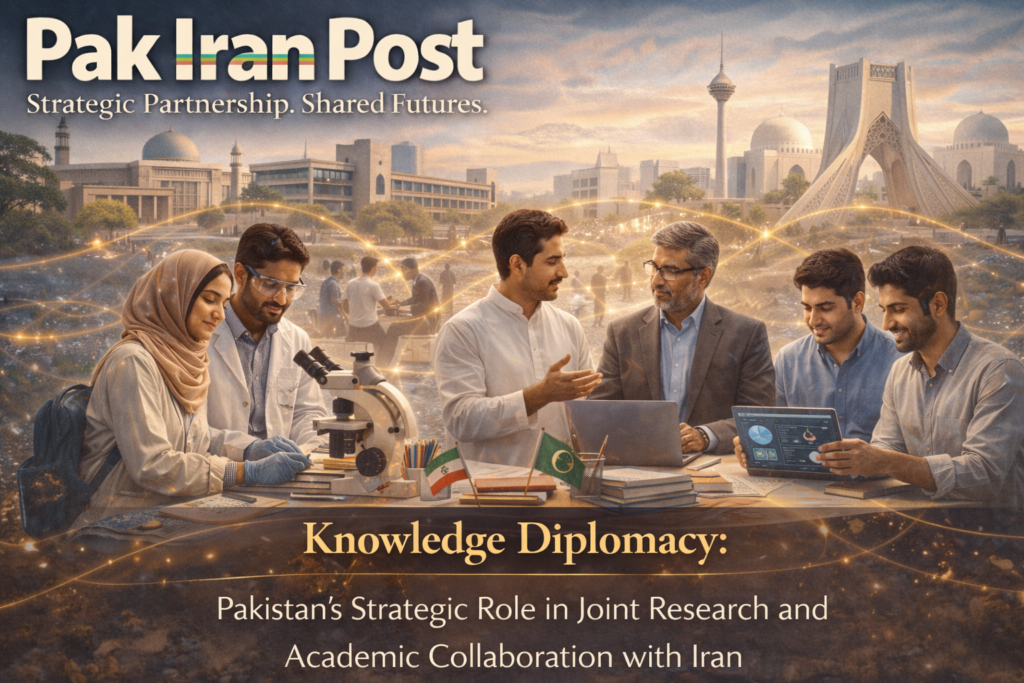
In the contemporary geopolitical landscape, policy influence is increasingly shaped not merely by military or economic power but by the ability to generate knowledge, craft evidence-based policy frameworks, and facilitate intellectual exchange. Iran, as a country with a predominantly young and highly educated population, faces complex social, economic, and humanitarian challenges that demand nuanced solutions. Pakistan, positioned as both a neighbor and cultural partner, has the opportunity to play a decisive role by fostering joint research, think-tank collaboration, and academic exchange with Iran. By institutionalizing knowledge diplomacy, Islamabad can strengthen bilateral relations, build long-term influence, empower youth, and establish itself as a credible partner in regional problem-solving.
The demographic composition of Iran is a critical factor in shaping the scope and impact of academic and policy collaboration. Approximately 60 percent of the population is under 30 years old, representing a generation that is technologically adept, socially aware, and eager for engagement beyond conventional political channels. These demographic faces economic constraints, limited professional mobility, and restrictions in social and cultural expression, making platforms for research, dialogue, and academic collaboration highly attractive. By facilitating access to joint studies, collaborative think-tank initiatives, and academic forums, Pakistan can provide Iranian youth and professionals with opportunities to contribute to policy solutions, skill development, and intellectual networks that transcend political limitations.
Policy diplomacy through think-tank exchanges is central to fostering influence without overt political intervention. Pakistan can partner with Iranian research institutions, universities, and independent policy centers to create structured exchange programs focused on economic development, regional connectivity, energy security, climate adaptation, and social policy. These initiatives allow for the development of joint publications, policy workshops, and shared research agendas that address real-world challenges. By creating mechanisms for dialogue and knowledge sharing, Pakistan positions itself as a neutral facilitator capable of producing actionable insights that benefit both countries while establishing a sustained intellectual presence in Tehran.
Academic collaboration complements policy research by engaging Iranian students, scholars, and early-career professionals in joint projects, curriculum development, and scholarly networks. Pakistan can create joint degree programs, research fellowships, and short-term academic exchanges tailored to Iranian participants. These programs should emphasize practical skill acquisition, interdisciplinary problem-solving, and engagement with regional development priorities. By fostering academic mobility, Pakistan not only strengthens bilateral relations but also cultivates a network of alumni who are likely to maintain long-term professional, cultural, and personal ties with Pakistan. This network serves as a foundation for influence, collaboration, and constructive engagement over decades.
Joint research initiatives are instrumental in addressing pressing regional challenges. Collaborative studies on energy transition, water management, border security, climate resilience, social policy, public health, and migration provide actionable insights for policymakers in both countries. Pakistan can facilitate research grants, institutional partnerships, and cross-border project funding that allow scholars and think-tanks from both nations to co-develop solutions. Emphasizing applied research ensures that outputs are not merely academic exercises but contribute directly to policy design, regional development, and humanitarian response frameworks. The integration of Pakistani and Iranian expertise enhances credibility, resource efficiency, and problem-solving capacity.
Think-tank and research collaboration also provides a pathway for youth engagement and capacity-building. Pakistan can create programs that involve Iranian students, young professionals, and early-career researchers in collaborative policy projects, mentorship schemes, and training programs. By exposing youth to evidence-based policy analysis, strategic research methods, and cross-border problem-solving, Pakistan empowers a generation of Iranian professionals who develop both technical skills and institutional awareness. These initiatives strengthen human capital, promote professional networks, and foster goodwill that reinforces bilateral relations over the long term.
Digital platforms play a central role in enabling academic and research collaboration. Pakistan can establish secure online portals for joint research, virtual conferences, digital resource sharing, and collaborative publications. These platforms allow Iranian youth and scholars to participate in real-time, submit research, and engage in structured dialogues without geographic limitations. Virtual access ensures inclusivity for participants in remote or socially restricted areas, expands outreach, and provides a scalable model for knowledge diplomacy. Digital infrastructure also enables monitoring, evaluation, and assessment of collaboration outcomes, enhancing the efficiency and accountability of programs.
Policy workshops and think-tank forums serve as critical instruments for building dialogue and influence. Pakistan can organize bilateral and regional workshops that bring together experts, policymakers, and scholars from both countries to discuss strategic challenges, social development priorities, and economic integration. Workshops should be structured to generate actionable policy recommendations, facilitate problem-solving, and create institutional linkages between Pakistani and Iranian organizations. By producing tangible policy outputs, Pakistan enhances its credibility as a facilitator of constructive dialogue and knowledge-based cooperation.
Humanitarian policy frameworks are an essential area for joint research. Iran’s youth face social vulnerabilities, including limited access to education, mental health services, employment, and social mobility. Pakistan can collaborate with Iranian institutions to develop evidence-based humanitarian and social policies that target these challenges. Research can focus on program design, resource allocation, impact assessment, and community engagement, ensuring that interventions are practical, scalable, and culturally sensitive. By contributing to humanitarian solutions, Pakistan strengthens regional goodwill while reinforcing its image as a responsible and capable partner.
Institutionalizing collaboration is critical for sustainability. Pakistan can establish a dedicated bilateral knowledge diplomacy platform, integrating universities, think-tanks, policy centers, and youth organizations. This platform would coordinate research agendas, funding, project management, and policy dissemination. Institutionalization ensures continuity, credibility, and systematic impact assessment. By formalizing partnerships, Pakistan mitigates risks associated with ad hoc engagement, enhances resource efficiency, and creates a durable framework for long-term intellectual influence.
Financial investment is central to operational success. Pakistan can mobilize government allocations, private sector contributions, philanthropic funding, and international grants to support joint research, scholarships, academic exchanges, and think-tank initiatives. Structured funding mechanisms ensure predictability, sustainability, and the ability to scale programs. Investments in knowledge diplomacy yield high returns in terms of influence, regional cooperation, and strategic engagement with Iranian youth and policymakers.
Monitoring and evaluation are integral to maximizing impact. Pakistan can develop metrics to assess program effectiveness, including participation rates, research outputs, policy adoption, youth engagement, and long-term network development. Data-driven assessment allows for course correction, impact amplification, and evidence-based decision-making. Longitudinal tracking of alumni, joint publications, and cross-border research outcomes provides insights into sustained influence, institutional capacity-building, and regional integration.
Security and political sensitivities must be carefully managed. Academic and research initiatives should remain neutral, non-partisan, and culturally sensitive. Programs must respect Iranian domestic regulations while maintaining the independence and credibility of participating Pakistani institutions. Risk management protocols, including digital security, intellectual property safeguards, and clear legal frameworks, are necessary to ensure program integrity, participant safety, and long-term trust.
Strategic policy recommendations for Pakistan include: establishment of bilateral research grants and fellowship programs for Iranian youth; creation of joint think-tank networks and policy advisory councils; development of digital platforms for collaborative research, publication, and training; organization of workshops, seminars, and policy forums; and integration of humanitarian, social, and development research into practical policy outputs. Partnerships with civil society, universities, NGOs, and international organizations strengthen legitimacy, reach, and operational efficiency.
Pakistan can further leverage academic collaboration to advance regional connectivity and policy dialogue. Integrating research on energy corridors, trade facilitation, climate adaptation, migration policy, and cross-border economic cooperation allows Pakistan to contribute substantively to regional development agendas. Evidence-based contributions increase credibility in multilateral forums, reinforce strategic partnerships, and provide mechanisms for Iran to engage constructively with Pakistan without geopolitical friction.
Humanitarian impact is central to the legitimacy of knowledge diplomacy. Programs that directly address youth vulnerabilities, skill gaps, and social participation create tangible benefits for participants and communities. By framing initiatives as mutually beneficial and socially constructive, Pakistan reduces risks of politicization and enhances participation rates. Demonstrable outcomes in education, research productivity, employment readiness, and community development strengthen goodwill and reinforce Pakistan’s influence as a partner of choice for Iranian youth and institutions.
Capacity-building is a key benefit of policy and academic collaboration. Pakistani institutions can train Iranian youth in research methodologies, policy analysis, project management, and applied social science. These skills are transferable across sectors, enhancing employability, innovation capacity, and regional development engagement. Capacity-building also establishes Pakistan as a center of excellence for applied research, attracting long-term collaboration and sustaining influence across generations.
International and regional partnerships amplify impact. Cooperation with UNESCO, regional universities, development agencies, and international think-tanks enhances technical expertise, legitimacy, and operational reach. Partnerships provide access to funding, knowledge resources, and global best practices, ensuring that Pakistan’s initiatives meet high standards of quality, sustainability, and measurable outcomes. Strategic alignment with multilateral frameworks positions Pakistan as a leader in knowledge diplomacy and youth-focused academic engagement.
In conclusion, policy diplomacy and shared research represent a powerful instrument for Pakistan to engage with Iran in a manner that is non-confrontational, constructive, and strategically impactful. By investing in joint research, think-tank collaboration, academic exchanges, and youth-focused initiatives, Pakistan can strengthen bilateral relations, empower Iranian youth, and create enduring networks of influence. Knowledge diplomacy facilitates evidence-based policy, enhances regional problem-solving capacity, and promotes stability through practical, scalable, and sustainable interventions.
By structuring programs that integrate research, policy development, education, and humanitarian objectives, Pakistan positions itself as a trusted partner capable of contributing meaningfully to regional development and youth engagement. The impact of such initiatives is multi-dimensional: strengthening Pakistan’s credibility, fostering professional and academic networks, generating actionable policy insights, and promoting social resilience and economic opportunity in Iran.
Strategically, knowledge diplomacy enables Pakistan to influence regional narratives, build long-term intellectual partnerships, and engage youth as active participants in constructive initiatives. This approach complements traditional diplomatic and economic instruments, providing Pakistan with soft power leverage, humanitarian credibility, and a platform for sustained engagement in regional affairs.
Operationalizing this vision requires long-term commitment, structured funding, institutional coordination, and rigorous monitoring. By aligning educational institutions, research centers, and civil society organizations with strategic objectives, Pakistan ensures that knowledge diplomacy is both effective and sustainable. Clear evaluation metrics, phased implementation, and evidence-based adaptation allow for continuous improvement, scalability, and measurable outcomes.
Pakistan’s engagement in policy diplomacy and shared research with Iran demonstrates that intellectual influence, youth empowerment, and humanitarian objectives are mutually reinforcing. By providing Iranian youth with access to education, research collaboration, and policy forums, Islamabad creates pathways for skill development, cross-border engagement, and regional problem-solving. These initiatives establish Pakistan as a constructive actor capable of shaping regional outcomes through knowledge, dialogue, and collaboration rather than coercion or economic leverage.
In sum, knowledge diplomacy through joint research, think-tank collaboration, and academic exchange is a strategic tool for Pakistan to pivot effectively in the region. It provides Iranian youth with opportunities for empowerment, professional development, and civic engagement. It strengthens bilateral relations, builds institutional capacity, and reinforces Pakistan’s credibility as a constructive regional actor. By integrating policy, research, and education with practical and humanitarian objectives, Pakistan creates a sustainable platform for influence that delivers long-term benefits for both countries, enhancing stability, resilience, and shared prosperity across the region.
A Public Service Message